

Tuesday 11 March 2025
The Internet of Things (IoT) is rapidly becoming an integral part of our daily lives, connecting devices and sensors in a vast network that can collect, share, and analyze vast amounts of data. However, as the number of connected devices grows, so does the complexity of managing and optimizing their communication.
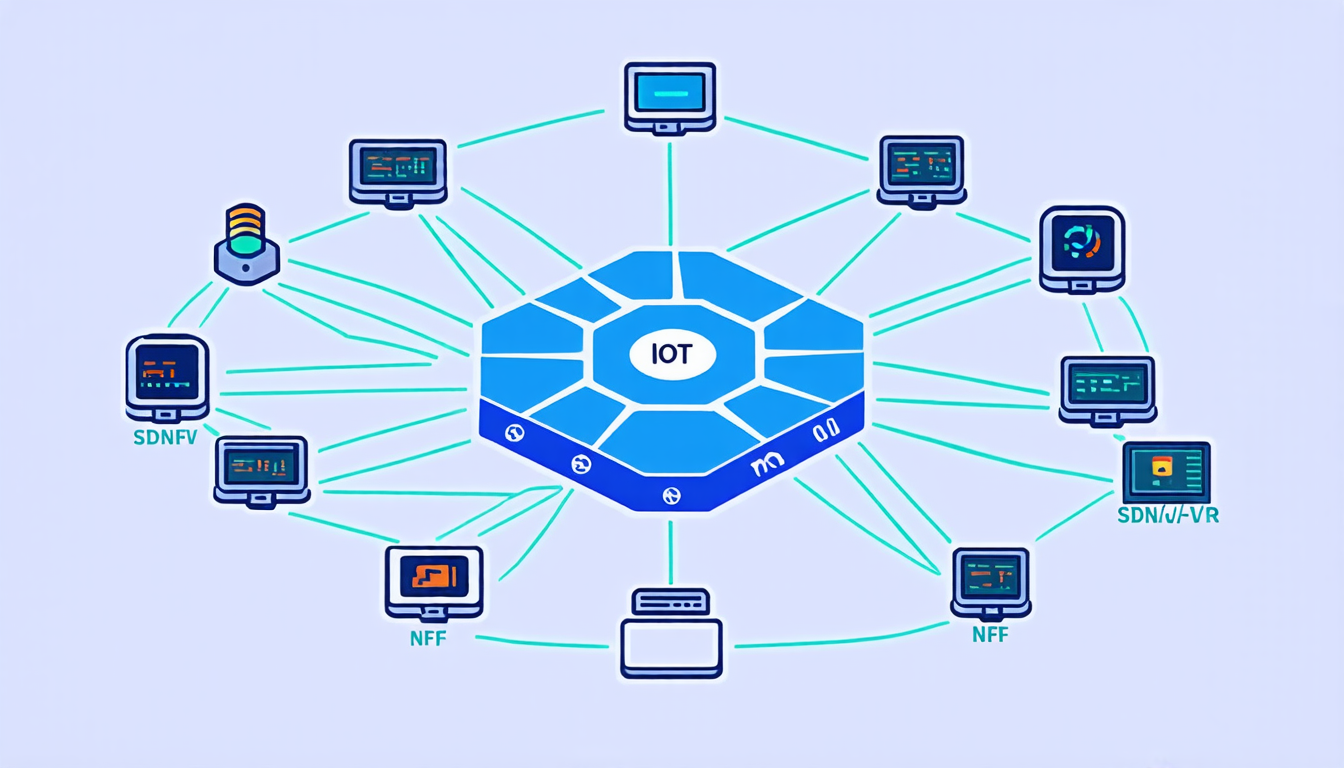
Researchers have been working on developing new solutions to tackle this challenge, and one promising approach is the use of software-defined networking (SDN) and network function virtualization (NFV). SDN allows for centralized control over networks, while NFV enables the creation of virtualized network functions that can be easily deployed and managed.
A recent study proposes a novel approach that combines these two technologies with deep reinforcement learning (DRL), a type of artificial intelligence (AI) that can learn from experience and adapt to changing conditions. The researchers designed a distributed intelligent network softwarization architecture that uses DRL to optimize routing in IoT networks.
The system is based on a federated learning framework, where multiple nodes or controllers work together to train a shared model. Each node collects data about its local environment and sends it to the central controller, which uses this information to make decisions about how to route traffic and allocate resources.
In a simulation, the researchers tested their approach using two common network topologies found in IoT scenarios: Abilene and GEANT. They compared the performance of their DRL-based routing method with traditional shortest path routing (SPR) and found that it significantly outperformed SPR in terms of delay, throughput, and loss ratio.
One of the key advantages of this approach is its ability to adapt to changing network conditions and optimize routing in real-time. This is particularly important in IoT networks, where devices may be connected and disconnected frequently, or where traffic patterns change rapidly.
The researchers also demonstrated that their approach can be scaled up to large-scale IoT networks with thousands of nodes, making it a promising solution for real-world applications. Furthermore, they showed that the system can be used to optimize routing in networks with different types of services, such as video streaming and voice calls.
While this study is still in its early stages, it represents an important step towards developing more efficient and adaptive network management systems for IoT devices. As the number of connected devices continues to grow, the need for innovative solutions that can manage and optimize their communication becomes increasingly pressing.
Cite this article: “Optimizing IoT Network Routing with Software-Defined Networking and Deep Reinforcement Learning”, The Science Archive, 2025.
Internet Of Things, Software-Defined Networking, Network Function Virtualization, Deep Reinforcement Learning, Artificial Intelligence, Iot Networks, Routing Optimization, Federated Learning, Distributed Systems, Real-Time Adaptation





