

Tuesday 11 March 2025
Scientists have made a significant discovery in the field of astrophysics, shedding new light on the behavior of gravitational waves in star-forming regions. According to recent research, these waves can trigger a phenomenon known as gravitational instability, which leads to the formation of spiral structures and even turbulence within these regions.
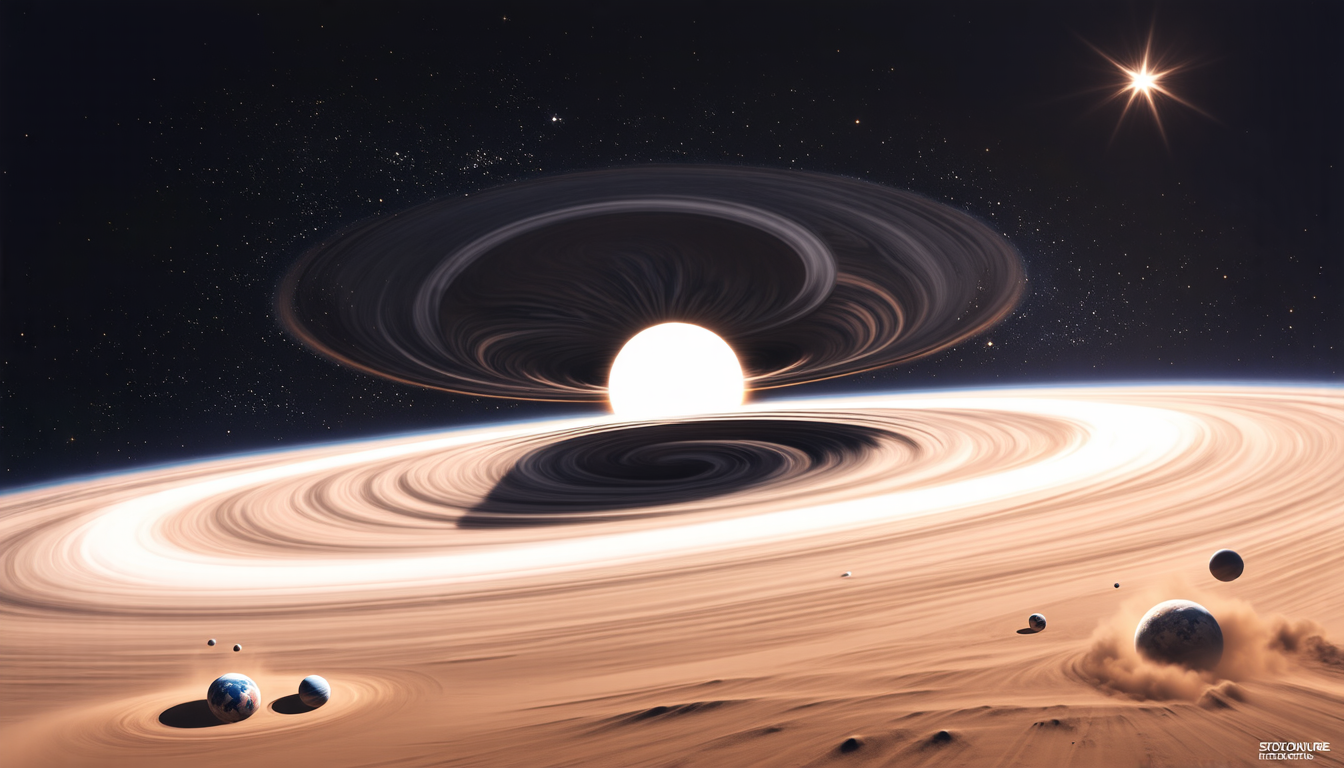
The study focused on the dynamics of gas and dust in protoplanetary disks, which are massive rotating systems that surround newly formed stars. The researchers used advanced computer simulations to model the behavior of these systems and discovered that gravitational waves can have a profound impact on their structure and evolution.
When a star forms, it creates a disk of swirling gas and dust around itself. As this material spins outward from the center of the system, it begins to cool and condense into small particles called planetesimals. These particles eventually merge to form larger bodies, such as planets and asteroids.
However, the process of planetary formation is not without its challenges. The disk must be able to cool and dissipate heat in order for the material to condense and form solid particles. This cooling process can be disrupted by gravitational waves, which are ripples in the fabric of spacetime that are produced by massive cosmic events.
The researchers found that when a star forms in a region with high levels of turbulence, the gravitational waves it produces can trigger a cascade of instabilities within the disk. These instabilities can cause the material to become more turbulent and chaotic, leading to the formation of spiral structures and even turbulence within the system.
This new understanding has significant implications for our understanding of star formation and planetary evolution. It suggests that gravitational waves may play a much larger role in shaping the structure and evolution of protoplanetary disks than previously thought.
The study also highlights the importance of considering the complex dynamics of these systems when trying to understand the process of planetary formation. By incorporating gravitational waves into their models, scientists can gain a more accurate understanding of how stars and planets form and evolve over time.
Overall, this research has significant implications for our understanding of the universe and its many mysteries. It demonstrates the power of advanced computer simulations in helping us unravel the complexities of cosmic phenomena and sheds new light on the behavior of gravitational waves in star-forming regions.
Cite this article: “Gravitational Waves Shape Star Formation and Planetary Evolution”, The Science Archive, 2025.
Astrophysics, Gravitational Waves, Star-Forming Regions, Protoplanetary Disks, Turbulence, Planetary Formation, Spiral Structures, Computer Simulations, Cosmic Events, Spacetime





