

Tuesday 11 March 2025
A recent study has shed new light on the complex world of temporal graphs, shedding insight into how different definitions of time can impact our understanding of connectivity and reachability.
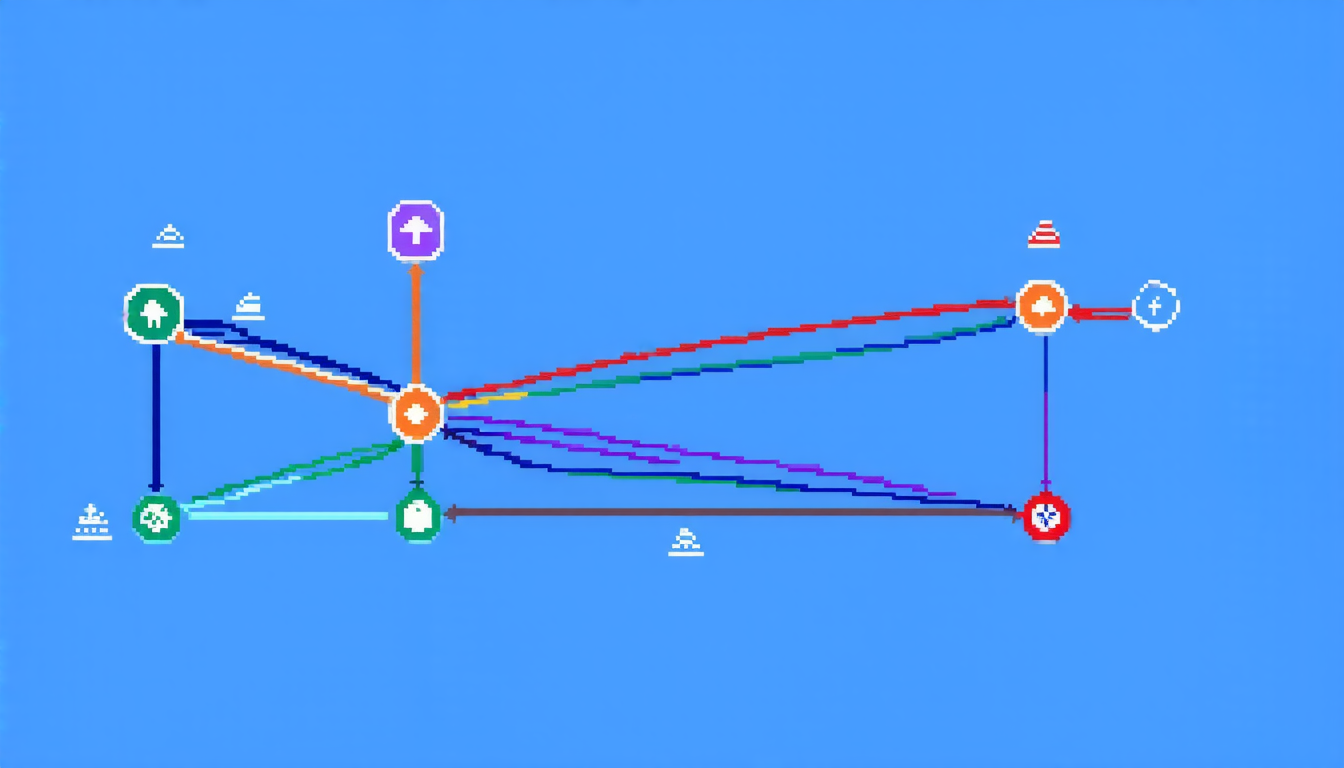
Temporal graphs are a type of network that evolves over time, where nodes and edges change or disappear as time progresses. This concept is crucial in many real-world applications, such as social media networks, transportation systems, and even the spread of diseases. However, the complexity of temporal graphs makes it challenging to analyze and understand their behavior.
The researchers have identified four different settings for temporal graphs: strict, non-strict, simple, and proper. The strict setting requires that edges only appear in a single direction over time, while the non-strict setting allows for multiple directions. Simple and proper settings refer to the labeling of edges, with simple meaning each edge can only be traversed once and proper meaning adjacent edges cannot share the same label.
By examining these different settings, the researchers found that strict temporal graphs are the most expressive, allowing for the representation of any reachability graph. On the other hand, undirected temporal graphs in the proper setting are the least expressive, unable to capture certain types of connectivity.
The study also highlights the differences between directed and undirected temporal graphs. Directed graphs can be more expressive than their undirected counterparts, as they allow for a greater range of edge labeling possibilities. However, this increased expressiveness comes at the cost of added complexity, making it more challenging to analyze and understand.
One of the key findings is that there is no transformation that can convert an undirected temporal graph in the non-strict setting into a directed temporal graph in the proper setting. This means that certain types of connectivity cannot be captured using simple and proper labeling schemes in undirected graphs.
The researchers’ work has significant implications for many fields, from computer science to biology. Understanding how different definitions of time impact our understanding of networks can help us develop more effective algorithms for analyzing and predicting behavior. Additionally, this knowledge can inform the design of more efficient communication systems and transportation networks.
In the future, further research is needed to fully understand the properties of temporal graphs and their applications. However, this study has taken a significant step forward in shedding light on the complex world of temporal graphs, providing valuable insights for researchers and practitioners alike.
Cite this article: “Temporal Graphs: Unpacking the Complexity of Evolving Networks”, The Science Archive, 2025.
Temporal Graphs, Network Analysis, Time Evolving Networks, Reachability, Connectivity, Directed Graphs, Undirected Graphs, Edge Labeling, Graph Theory, Temporal Complexity





