

Wednesday 12 March 2025
The quest for effective digraph representation learning has long been a thorn in the side of data scientists and machine learning engineers. Directed graphs, which feature edges that have direction, are ubiquitous in many real-world applications, including social networks, citation networks, and recommendation systems. However, traditional graph neural network (GNN) architectures were designed with undirected graphs in mind, making them less effective when applied to directed graphs.
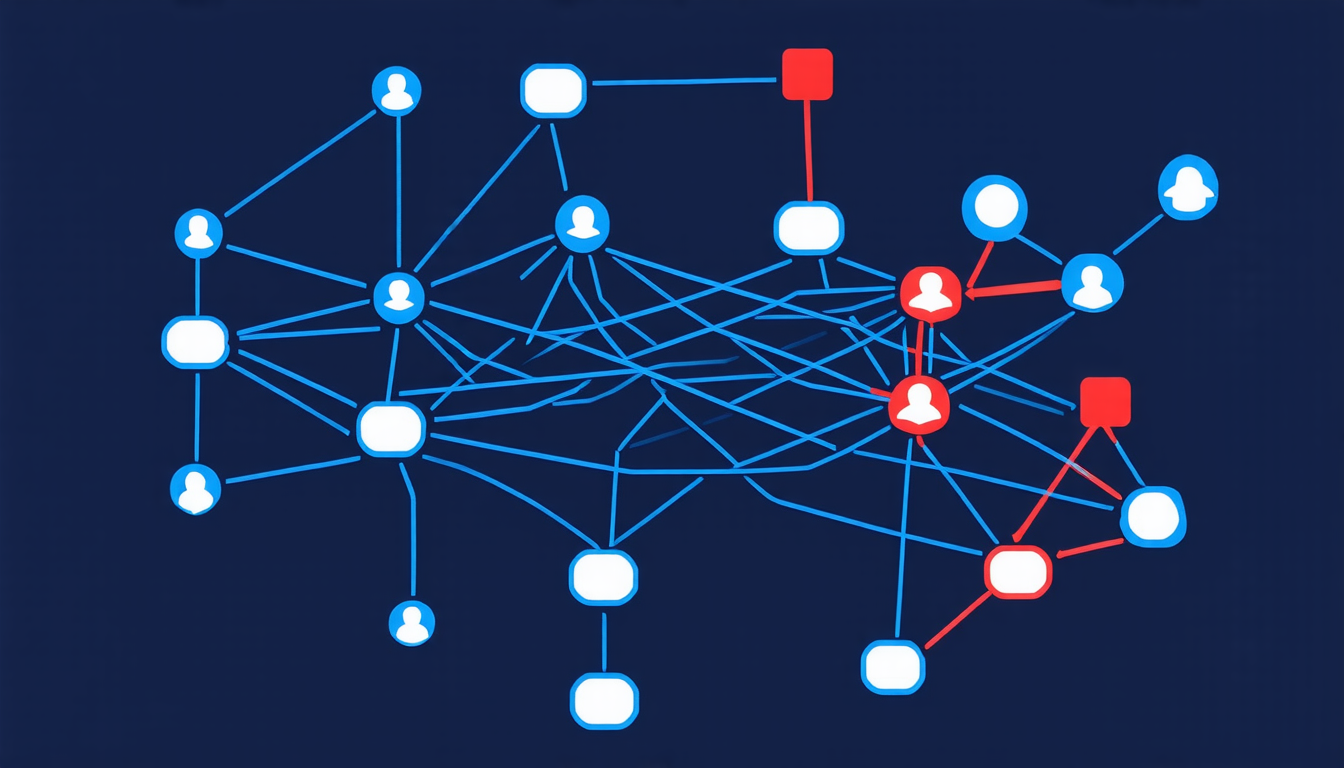
Enter the magnetic adaptive propagation (MAP) framework, a new approach that leverages the complex domain to learn node representations from directed graph data. By encoding edge directions using complex numbers and exploiting the properties of the magnetic Laplacian, MAP is able to capture the nuanced relationships between nodes in directed graphs more accurately than traditional GNNs.
The MAP framework consists of two key components: a novel propagation mechanism that adapts to the directionality of edges, and an adaptive phase matrix that learns to encode the complex phases of node features. The propagation mechanism uses a combination of first-order and second-order neighbor proximity to gather information from neighboring nodes, while the adaptive phase matrix ensures that node features are encoded in a way that takes into account the directed nature of the graph.
Experiments on 12 benchmark datasets demonstrate the effectiveness of MAP in learning high-quality node representations from directed graph data. Compared to traditional GNNs and other digraph-specific architectures, MAP achieves superior performance on tasks such as node classification, link prediction, and graph clustering.
One of the key advantages of MAP is its ability to learn robust node representations that are invariant to edge directionality. This is particularly important in applications where directed graphs are used to model relationships between entities, such as social networks or citation networks. By ignoring edge directions and focusing on the underlying structural patterns in the graph, traditional GNNs can struggle to capture the nuances of these relationships.
In contrast, MAP’s adaptive propagation mechanism and phase matrix enable it to learn node representations that are sensitive to edge directionality, allowing it to better capture the complex relationships between nodes in directed graphs. This is particularly evident in tasks such as link prediction, where MAP outperforms traditional GNNs by a significant margin.
The MAP framework also offers several benefits in terms of computational efficiency and scalability. By leveraging the properties of the magnetic Laplacian, MAP can perform graph propagation in parallel, reducing the computational cost of training and inference.
Cite this article: “Effective Representation Learning for Directed Graphs with Magnetic Adaptive Propagation”, The Science Archive, 2025.
Graph Neural Networks, Directed Graphs, Magnetic Adaptive Propagation, Node Representations, Complex Domain, Edge Directions, Neighbor Proximity, Phase Matrix, Link Prediction, Scalability





