

Wednesday 12 March 2025
In a breakthrough that sheds new light on the behavior of quantum systems, researchers have developed a mathematical framework for understanding the dynamics of free fermions subject to random projective measurements.
The study focuses on the phenomenon known as measurement-induced entanglement transitions, where the interactions between particles can lead to the emergence of entangled states. In the context of quantum many-body systems, this process is crucial for understanding phenomena such as superconductivity and superfluidity.
To tackle this complex problem, the researchers employed a combination of mathematical techniques, including the Keldysh path integral formalism and the replica trick. This allowed them to derive an analytical solution to the hydrodynamic equation governing the Wigner function, which describes the correlations between particles.
The Wigner function is a powerful tool for understanding the behavior of quantum systems, as it provides a way to visualize the evolution of particle correlations in phase space. In this study, the researchers used the Wigner function to analyze the dynamics of free fermions subject to random projective measurements.
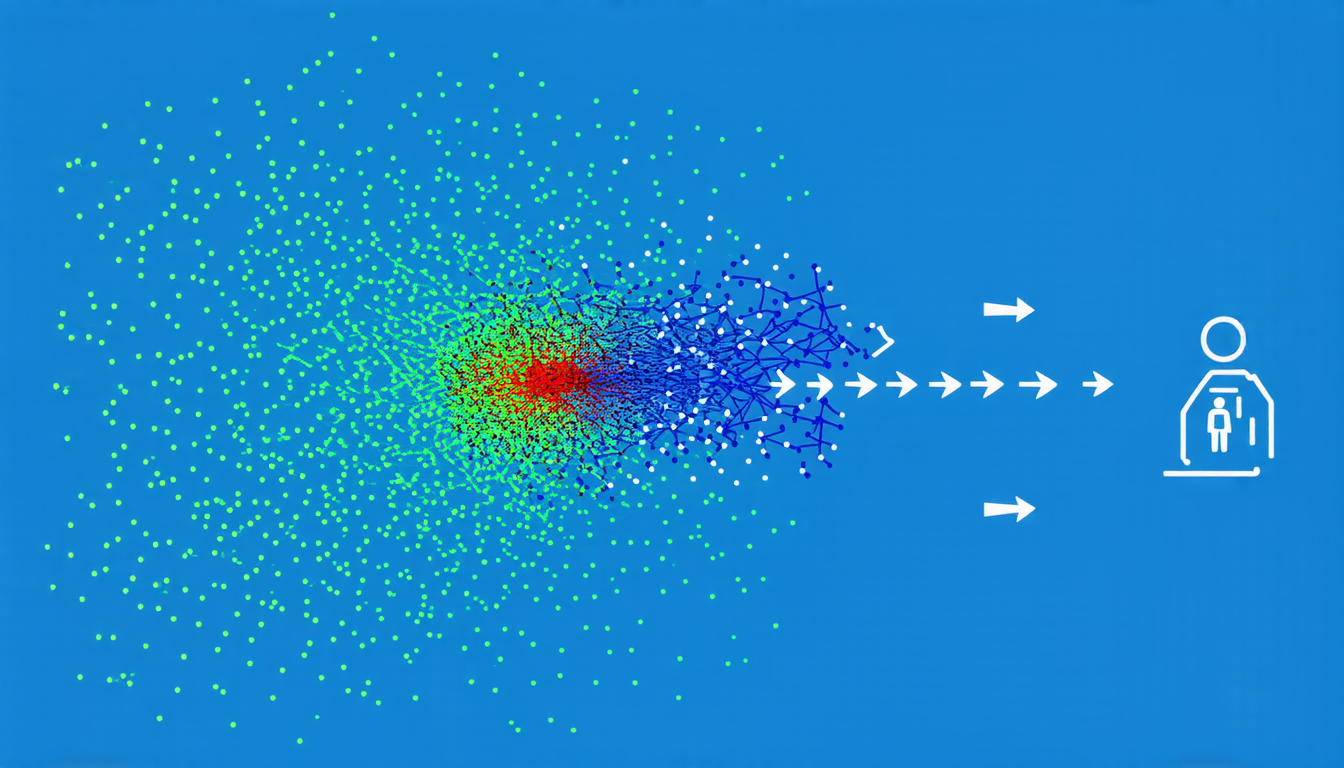
Their results show that the Wigner function exhibits a non-trivial structure, characterized by the emergence of quasiparticle excitations and the breakdown of local thermalization. This behavior is in stark contrast to the usual expectation of thermal equilibrium in classical systems.
The implications of this study are far-reaching, with potential applications in fields such as quantum computing, quantum cryptography, and quantum simulation. The researchers’ analytical framework provides a new tool for understanding the dynamics of complex quantum systems, allowing scientists to better predict and control their behavior.
One of the key challenges in studying measurement-induced entanglement transitions is the need to account for the effects of dephasing noise on the system. This type of noise can lead to the loss of quantum coherence and the emergence of classical correlations.
To address this issue, the researchers employed a stochastic sampling approach, which allows them to simulate the behavior of the system in the presence of dephasing noise. Their results show that even in the presence of significant noise, the Wigner function exhibits a non-trivial structure, characterized by the emergence of quasiparticle excitations.
The study also highlights the importance of understanding the role of classical run-and-tumble processes in quantum systems. These processes, which are commonly observed in biological systems such as bacteria, can lead to the emergence of complex patterns and structures.
In summary, this breakthrough study provides new insights into the behavior of quantum systems subject to random projective measurements.
Cite this article: “Quantum Systems Behavior Under Random Measurements Unveiled”, The Science Archive, 2025.
Quantum Dynamics, Measurement-Induced Entanglement, Free Fermions, Random Projective Measurements, Wigner Function, Quasiparticle Excitations, Thermalization, Dephasing Noise, Stochastic Sampling, Quantum Simulation.





