

Wednesday 12 March 2025
Researchers have made a significant breakthrough in developing tiny magnetic sensors that could revolutionize our ability to detect and measure magnetic fields. By creating suspended trampolines from a special type of oxide material, scientists have been able to craft ultra-sensitive devices that can detect even the weakest magnetic signals.
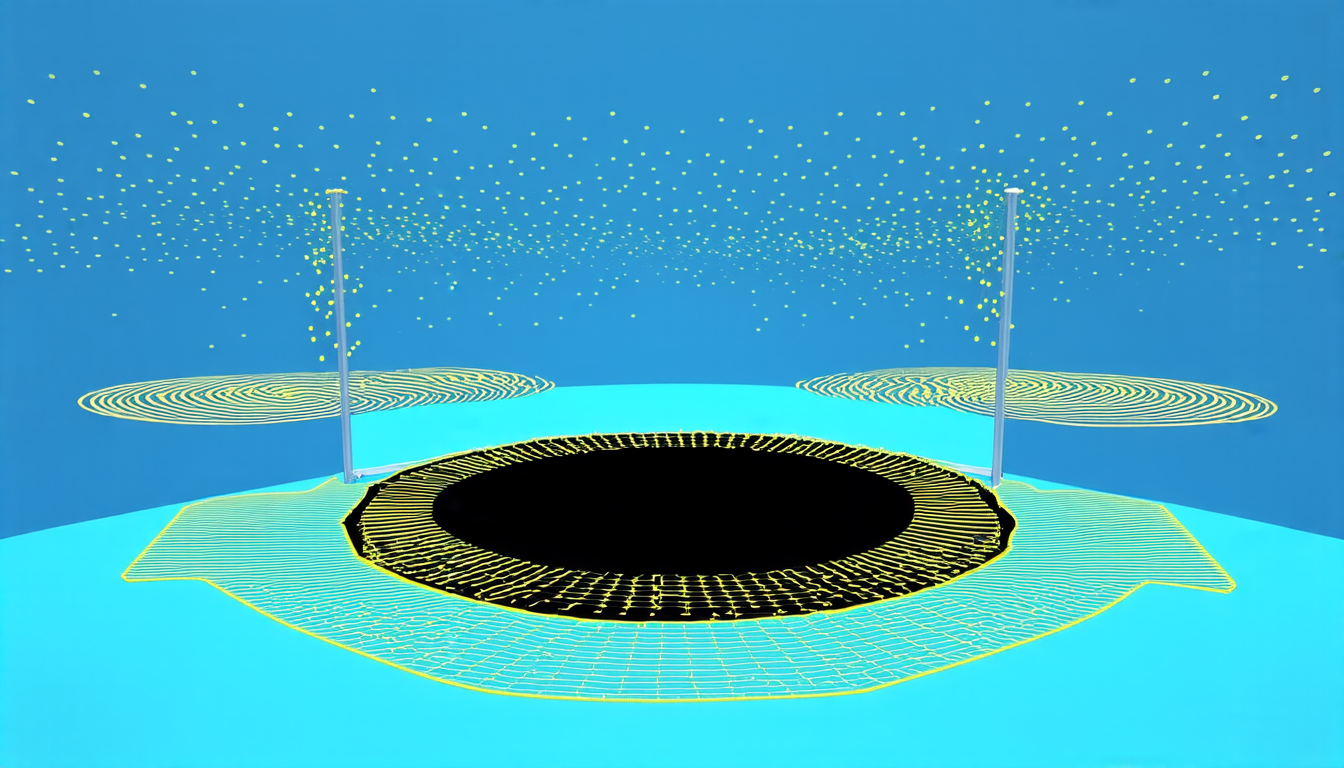
The new sensors are made from a thin film of (La, Sr)MnO3, a complex oxide material known for its unique properties. The researchers created these films by depositing layers of the material onto a substrate using a technique called pulsed laser deposition. They then used UV photolithography to pattern the film into tiny trampolines, suspended in mid-air by thin tethers.
These trampolines are incredibly sensitive because they can detect even slight changes in the magnetic field around them. This is due to the way that the oxide material responds to magnetic fields, which causes the trampoline’s shape to change ever so slightly. By monitoring these tiny changes using advanced microscopy techniques, scientists can accurately measure the strength and direction of the magnetic field.
The potential applications of these new sensors are vast. They could be used in a wide range of fields, from medicine to industry, to detect and analyze complex phenomena such as brain activity or magnetic fields generated by electric currents. The sensors could also be used to develop more precise navigation systems, allowing us to better understand our surroundings and navigate through complex environments.
One of the most exciting aspects of these new sensors is their potential to enable the development of portable, low-power devices that can detect magnetic fields in real-time. This would open up a wide range of possibilities for applications such as biomedical imaging, environmental monitoring, or even search-and-rescue operations.
The researchers achieved remarkable results with their new sensors, demonstrating a mechanical quality factor of up to 60,000 and a sensitivity to magnetic fields of just 1 millitesla per root hertz. These figures are significantly better than those achieved by existing sensors, which typically have much lower sensitivities and are less precise.
While there is still much work to be done before these sensors can be widely deployed, the potential benefits are undeniable. The ability to accurately detect and measure magnetic fields could revolutionize our understanding of complex phenomena and enable new technologies that improve our daily lives.
Cite this article: “Breakthrough in Magnetic Sensing: Tiny Trampolines Unlock New Capabilities”, The Science Archive, 2025.
Magnetic Sensors, Oxide Material, Trampolines, Pulsed Laser Deposition, Uv Photolithography, Microscopy Techniques, Biomedical Imaging, Environmental Monitoring, Search-And-Rescue Operations, Navigation Systems.





