

Wednesday 12 March 2025
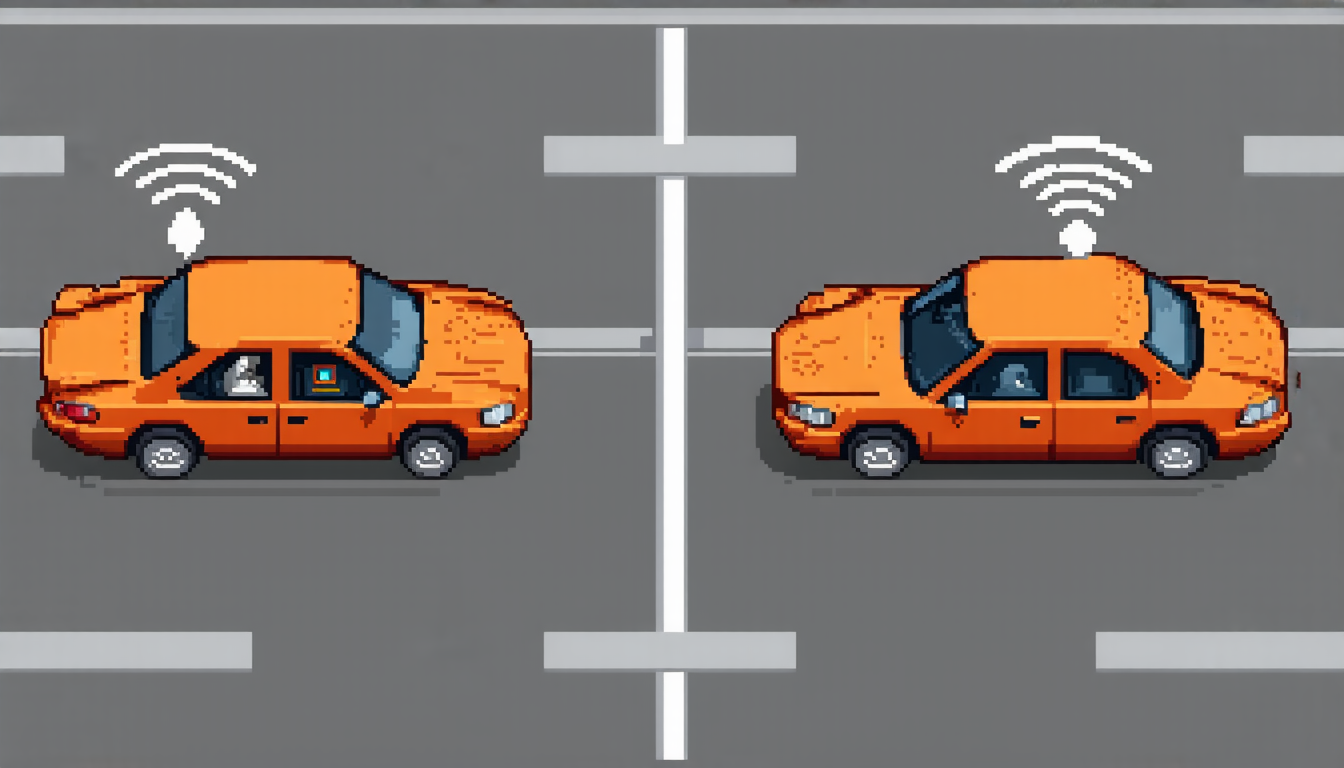
Autonomous vehicles rely on a complex web of sensors and communication systems to navigate the road safely and efficiently. One crucial component in this ecosystem is cooperative perception, where multiple vehicles share data to improve each other’s situational awareness. A new paper from researchers proposes an innovative approach to enhance cooperative perception, leveraging multi-agent collaboration to achieve better results.
The authors developed a system called mmCooper, which enables vehicles to share and fuse information more effectively. This fusion process is critical in dealing with the inherent uncertainties and noise present in real-world sensor data. The team’s solution involves a hierarchical architecture that incorporates multiple stages of feature extraction, filtering, and calibration.
The first stage involves each vehicle generating its own 3D point cloud representation of the environment. These clouds are then broadcast to neighboring vehicles, which receive and filter them using a multi-scale offset-aware attention mechanism. This process ensures that important features are emphasized while noise is suppressed.
The filtered features are then fused across multiple scales to produce a more comprehensive understanding of the surroundings. The authors use a novel approach called deformable bounding box attention to refine the fusion process, allowing vehicles to adapt to changing conditions and correct for potential misalignments.
In the final stage, each vehicle generates its own detection output by combining the fused features with information from its onboard sensors. This output is then refined through a calibration process that takes into account the contributions of neighboring vehicles.
The researchers tested mmCooper on two challenging datasets: OPV2V and DAIR-V2X. The results show significant improvements in detection accuracy, particularly in scenarios involving multiple objects or complex environments. The system’s robustness to localization errors, transmission delays, and heading noise was also demonstrated.
One of the key advantages of mmCooper is its ability to adapt to changing conditions and correct for potential misalignments. This is achieved through the deformable bounding box attention mechanism, which allows vehicles to adjust their fusion process in real-time. The system’s hierarchical architecture also enables it to handle complex scenarios by breaking them down into smaller sub-problems.
The mmCooper system has significant implications for the development of autonomous vehicles and other applications that rely on cooperative perception. By improving the accuracy and robustness of vehicle-to-vehicle communication, the technology can help reduce accidents and enhance overall road safety.
As the automotive industry continues to push the boundaries of autonomous driving, innovative solutions like mmCooper are essential for overcoming the challenges posed by complex real-world scenarios.
Cite this article: “Enhancing Cooperative Perception in Autonomous Vehicles with Multi-Agent Collaboration”, The Science Archive, 2025.
Autonomous Vehicles, Cooperative Perception, Sensor Data, Multi-Agent Collaboration, Hierarchical Architecture, Feature Extraction, Filtering, Calibration, Vehicle-To-Vehicle Communication, Road Safety.





