

Wednesday 12 March 2025
A team of researchers has made a significant breakthrough in the field of medical imaging, developing a new approach to tracking devices during interventional procedures. The innovative method uses self-supervised learning and supplementary cues to improve the accuracy and stability of device tracking, which is crucial for successful interventions.
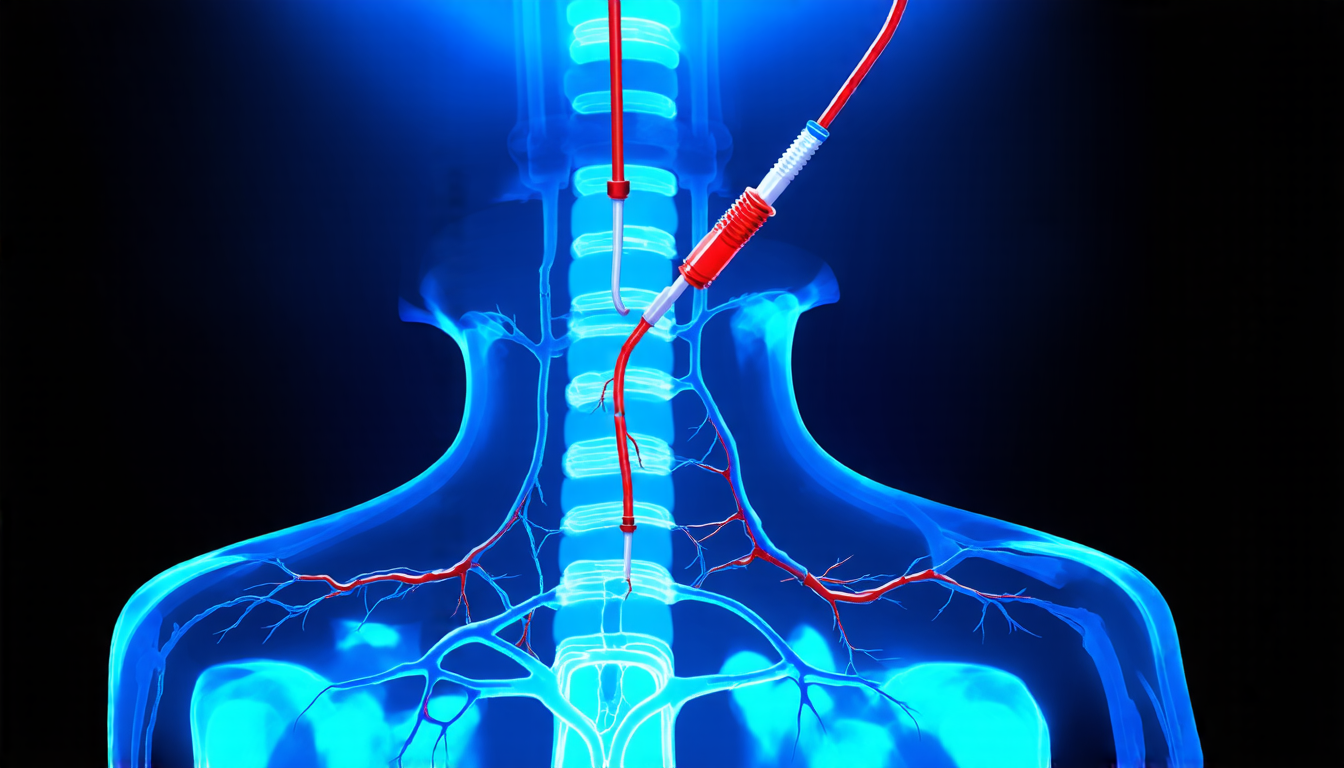
The study focused on developing a framework that can track small objects, such as balloon markers and catheter tips, in X-ray sequences. These objects are often difficult to track due to their small size and the complexity of the image data. The researchers used a combination of spatial encoding and attention mechanisms to improve the tracking performance.
One of the key innovations is the use of supplementary cues, which are weak labels generated by a vessel segmentation model. This approach allows the network to learn features across multiple representation spaces, enhancing its ability to understand the relationships between different parts of the image.
The researchers evaluated their method on two downstream datasets: balloon marker tracking and catheter tip tracking. The results showed that their approach outperformed state-of-the-art methods in both tasks, with significant reductions in maximum error for both applications.
The study also explored the effect of appearance and trajectory tokens on the tracking performance. The results indicated that attending to both types of tokens is essential for achieving high accuracy. While the appearance tokens are important for understanding the visual features of the objects, the trajectory tokens provide crucial information about their motion.
The researchers believe that their approach has the potential to improve the accuracy and stability of device tracking in interventional procedures. This could lead to better outcomes for patients undergoing these procedures, as well as reduced costs and improved efficiency for healthcare providers.
Overall, this study demonstrates the power of self-supervised learning and supplementary cues in improving medical image analysis tasks. The innovative approach developed by the researchers has significant potential for real-world applications in interventional medicine and other fields where accurate tracking is critical.
Cite this article: “Advanced Device Tracking in Medical Imaging Using Self-Supervised Learning and Supplementary Cues”, The Science Archive, 2025.
Medical Imaging, Device Tracking, Self-Supervised Learning, Supplementary Cues, X-Ray Sequences, Spatial Encoding, Attention Mechanisms, Vessel Segmentation, Balloon Markers, Catheter Tips





