

Wednesday 12 March 2025
The quest for faster and higher-quality X-ray computed tomography (CT) scans has been an ongoing challenge in medical imaging research. Traditional methods, such as model-based iterative reconstruction (MBIR), can produce excellent results but are often computationally expensive and resource-intensive. Meanwhile, deep learning-based approaches like U-Nets have shown promise, but they’re limited by their dependence on large amounts of training data and can struggle with out-of-distribution scenarios.
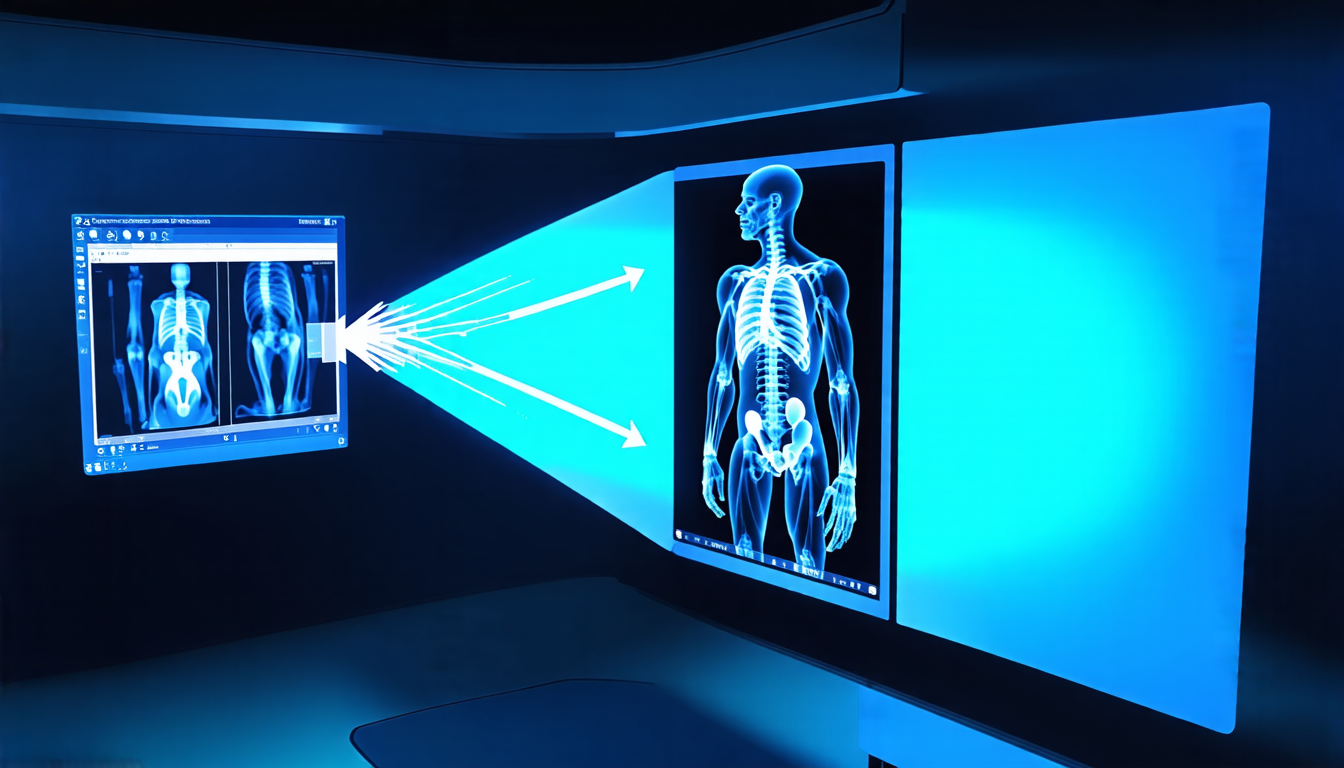
A recent paper proposes a novel hybrid approach that combines the strengths of both MBIR and deep learning to achieve faster and more accurate CT reconstruction. The authors present a learnt half-quadriatic splitting-based algorithm, which uses convolutional neural networks (CNNs) as regularizers and incorporates physical constraints from the imaging process.
The key innovation is in how the algorithm alternates between two steps: a data-consistency step that ensures the reconstructed image aligns with the measured projection data, and a CNN regularization step that denoises the image. This hybrid approach allows the algorithm to leverage the strengths of both MBIR and deep learning while mitigating their respective weaknesses.
The authors demonstrate the effectiveness of their approach using publicly available CBCT data from the Walnut dataset, which includes sparse-view measurements with varying subsampling factors. The results show that the proposed algorithm outperforms traditional MBIR and U-Net approaches in terms of peak signal-to-noise ratio (PSNR) and structural similarity index measure (SSIM), even when tested on out-of-distribution data.
One of the most significant advantages of this approach is its memory efficiency, which makes it suitable for large-scale problems. By training separate CNNs for each iteration and using a fixed number of outer iterations, the algorithm can reduce the computational requirements while maintaining high reconstruction quality.
The authors also highlight the flexibility of their approach, which allows them to easily adapt to different imaging conditions and measurement scenarios. This is particularly important in industrial CT applications, where scan times and detector sizes can vary widely depending on the specific use case.
While this research may not revolutionize the field of medical imaging overnight, it does represent a significant step forward in terms of practicality and scalability. As researchers continue to push the boundaries of what’s possible with X-ray CT scans, approaches like this one will play an increasingly important role in advancing our understanding of human health and disease.
Cite this article: “Hybrid Approach Combines Strengths of Model-Based and Deep Learning Methods for Faster and More Accurate CT Reconstruction”, The Science Archive, 2025.
X-Ray Computed Tomography, Ct Scans, Model-Based Iterative Reconstruction, Deep Learning, U-Nets, Convolutional Neural Networks, Hybrid Approach, Image Reconstruction, Peak Signal-To-Noise Ratio, Structural Similarity Index Measure.





