

Thursday 13 March 2025
The quest for a more intelligent, autonomous robot has long been a holy grail of robotics research. For years, scientists have been trying to crack the code on how to equip machines with the ability to learn and adapt in complex environments. Recently, a team of researchers made significant strides towards achieving this goal by developing a mobile robotic system that can interactively explore its environment, construct an actionable 3D relational object graph, and perform manipulation tasks.
At first glance, this might seem like a laundry list of buzzwords from the robotics world, but bear with me. The key innovation here is the creation of a system that can seamlessly integrate perception, action, and reasoning to enable robots to learn about their environment in a more human-like way.
The system, dubbed CuriousBot, consists of three main components: an interactive exploration module, a 3D relational object graph construction module, and a manipulation module. The first component allows the robot to explore its environment through active interaction, such as opening cabinets or lifting objects. This information is then fed into the second component, which constructs a detailed 3D model of the environment, including relationships between objects.
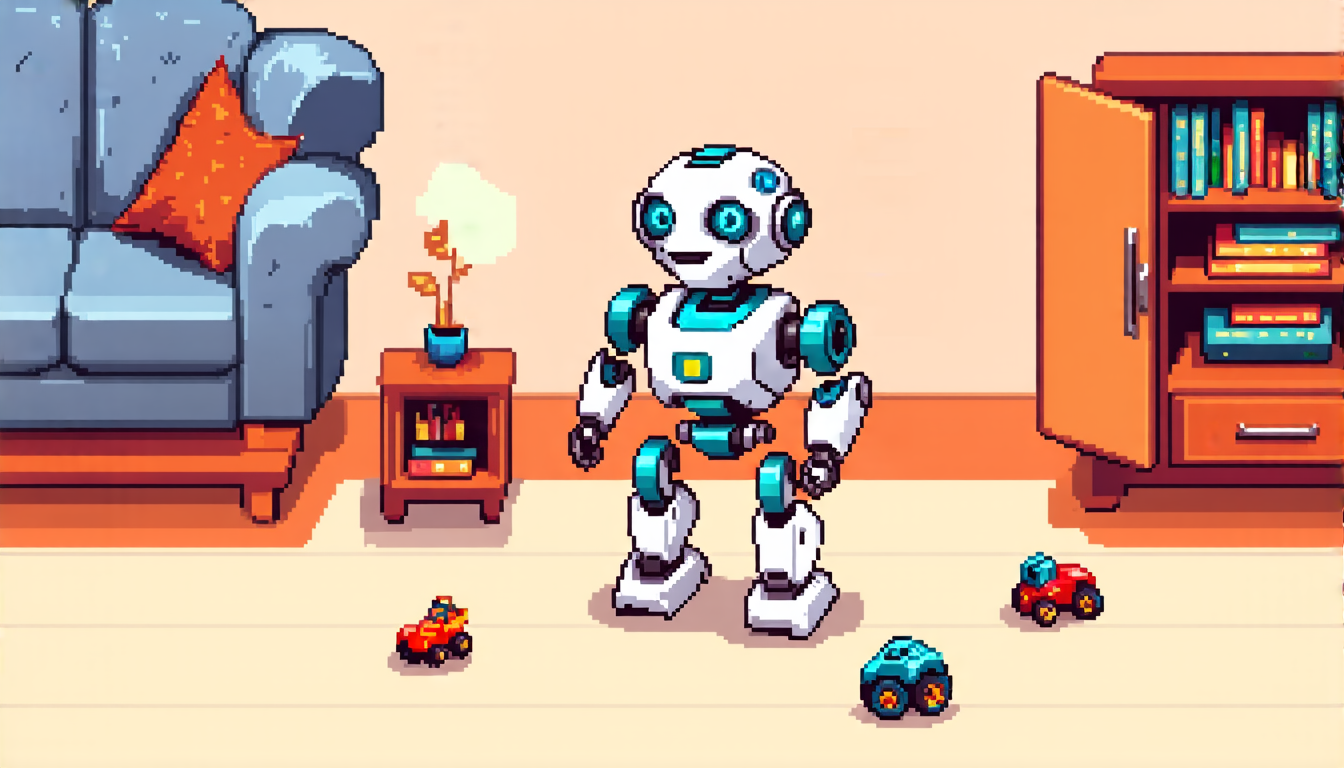
The manipulation module takes this 3D model and uses it to perform tasks such as collecting toys from around the room. But what’s truly remarkable about CuriousBot is that it doesn’t just rely on pre-programmed instructions or rigid rules; instead, it learns through experience and adapts to new situations.
One of the most impressive aspects of CuriousBot is its ability to generalize across different environments. In other words, it can learn to navigate a kitchen in one scenario and then apply those skills to a living room or office without needing explicit instructions. This is a major step forward for robotics research, as it could potentially enable robots to be deployed in a wide range of settings without the need for extensive reprogramming.
The potential applications of CuriousBot are vast and varied. In the home, it could assist with chores like cleaning or organization; in industry, it could streamline manufacturing processes or help with maintenance tasks. And in healthcare, it could potentially aid in rehabilitation or provide companionship to patients.
Of course, there’s still much work to be done before CuriousBot is ready for prime time. The system currently relies on a combination of computer vision and lidar technology, which can be limited by the quality of the data they collect. Additionally, the manipulation module could benefit from further refinement to improve its accuracy and speed.
Cite this article: “CuriousBot: A Mobile Robotic System Capable of Interactive Exploration and Manipulation”, The Science Archive, 2025.
Robotics, Artificial Intelligence, Autonomous, Mobile Robot, Exploration, 3D Modeling, Object Recognition, Manipulation, Learning, Generalization





