

Thursday 13 March 2025
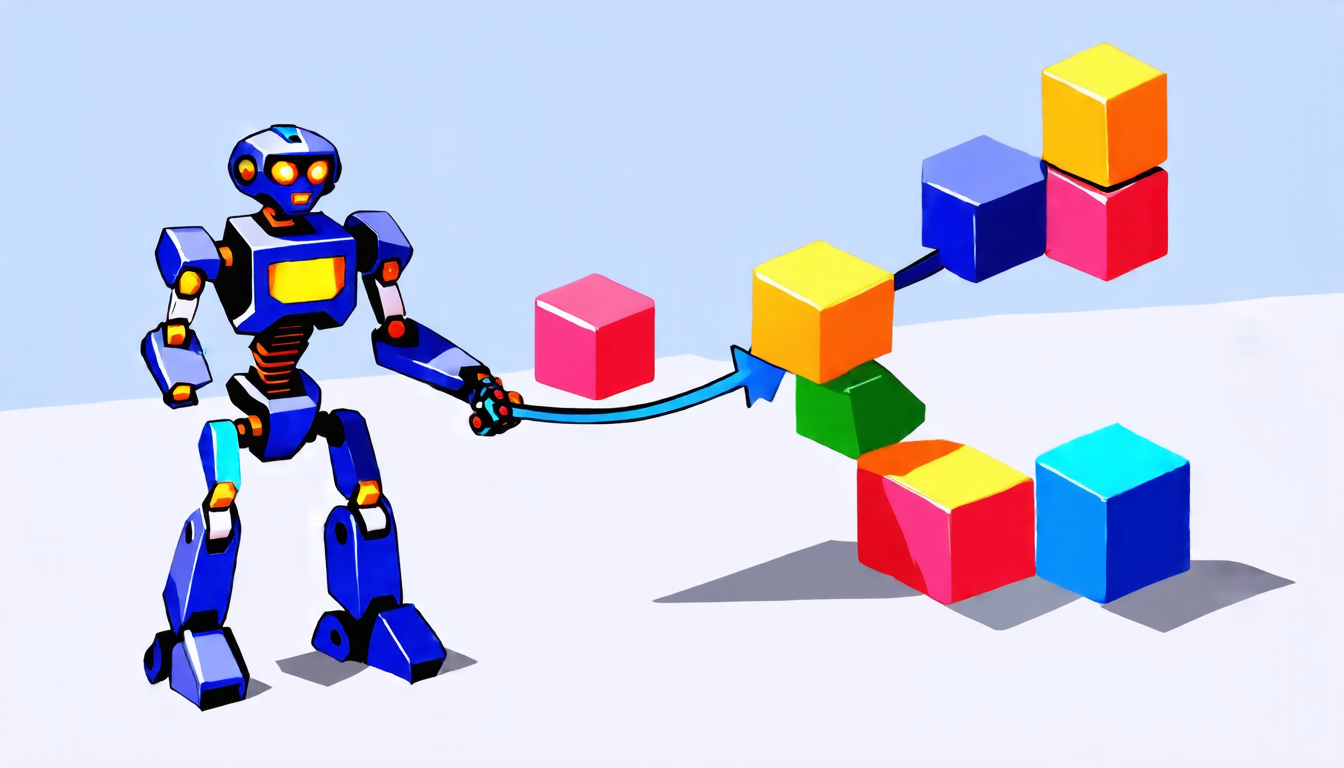
Robotics has long been fascinated by the art of herding, where machines attempt to gather and manipulate groups of objects or particles in a controlled manner. A new approach has recently emerged, using Fourier-based shape control and action trees to guide and manipulate multiple particles as a cohesive unit. This innovative technique has far-reaching implications for fields such as manufacturing, logistics, and even search and rescue operations.
The key innovation lies in the use of Fourier series to represent the complex shapes of particle groups, allowing for more precise control over their manipulation. This is achieved by decomposing the shape into its constituent frequencies, which can then be adjusted to achieve specific effects. The action tree, meanwhile, provides a framework for planning and executing the necessary actions to achieve the desired outcome.
In practical terms, this means that a robot equipped with this technology can be programmed to herd particles of varying sizes and shapes into a single cohesive unit, without needing to individually manipulate each particle. This is particularly useful in situations where precision is crucial, such as in manufacturing or medical applications.
The researchers behind this development have demonstrated the effectiveness of their approach through a series of experiments using a dual-arm robotic platform. In these tests, the robot was able to successfully herd and shape particles into complex forms, including circles, squares, and rectangles. The results showed that the Fourier-based shape control allowed for more accurate manipulation than traditional methods, while the action tree provided a robust framework for planning and execution.
One of the most promising applications of this technology is in the field of manufacturing, where it could be used to automate tasks such as material handling or assembly. By allowing robots to efficiently manipulate groups of particles, manufacturers could reduce labor costs and improve product quality. The potential benefits extend beyond manufacturing, however, with possibilities for search and rescue operations, environmental monitoring, and even artistic applications.
The use of Fourier-based shape control and action trees also opens up new avenues for research in robotics and artificial intelligence. As machines become increasingly adept at manipulating complex shapes and groups of particles, they may be able to tackle tasks that were previously considered the exclusive domain of humans. This could have significant implications for our understanding of intelligence and cognition, as well as the development of more advanced robotic systems.
In a world where robots are becoming increasingly autonomous, the ability to manipulate and control groups of particles is a crucial step forward in the field of robotics.
Cite this article: “Robotics Breakthrough: Manipulating Particle Groups with Fourier-Based Shape Control”, The Science Archive, 2025.
Robotics, Herding, Fourier Series, Shape Control, Action Trees, Manufacturing, Logistics, Search And Rescue, Artificial Intelligence, Particle Manipulation





