

Thursday 13 March 2025
A team of researchers has made a significant breakthrough in understanding how noise can synchronize the behavior of complex systems, such as the human brain or financial markets. The study, published in a recent issue of the journal Physical Review E, uses mathematical techniques to analyze the synchronization of pulse-like solutions in stochastic partial differential equations.
The concept of synchronization is not new, but it’s often studied in the context of simple systems like pendulums or oscillators. However, real-world complex systems can be much more challenging to understand, as they involve multiple interacting components and are inherently noisy. The researchers aimed to develop a theoretical framework that could explain how noise affects the behavior of these systems.
To tackle this problem, the team used a mathematical technique called phase reduction, which allows them to describe the dynamics of a complex system by focusing on the position of its pulse-like solutions rather than their entire trajectory. This approach is particularly useful when dealing with noisy systems, as it can help isolate the effects of noise and identify patterns that might otherwise be obscured.
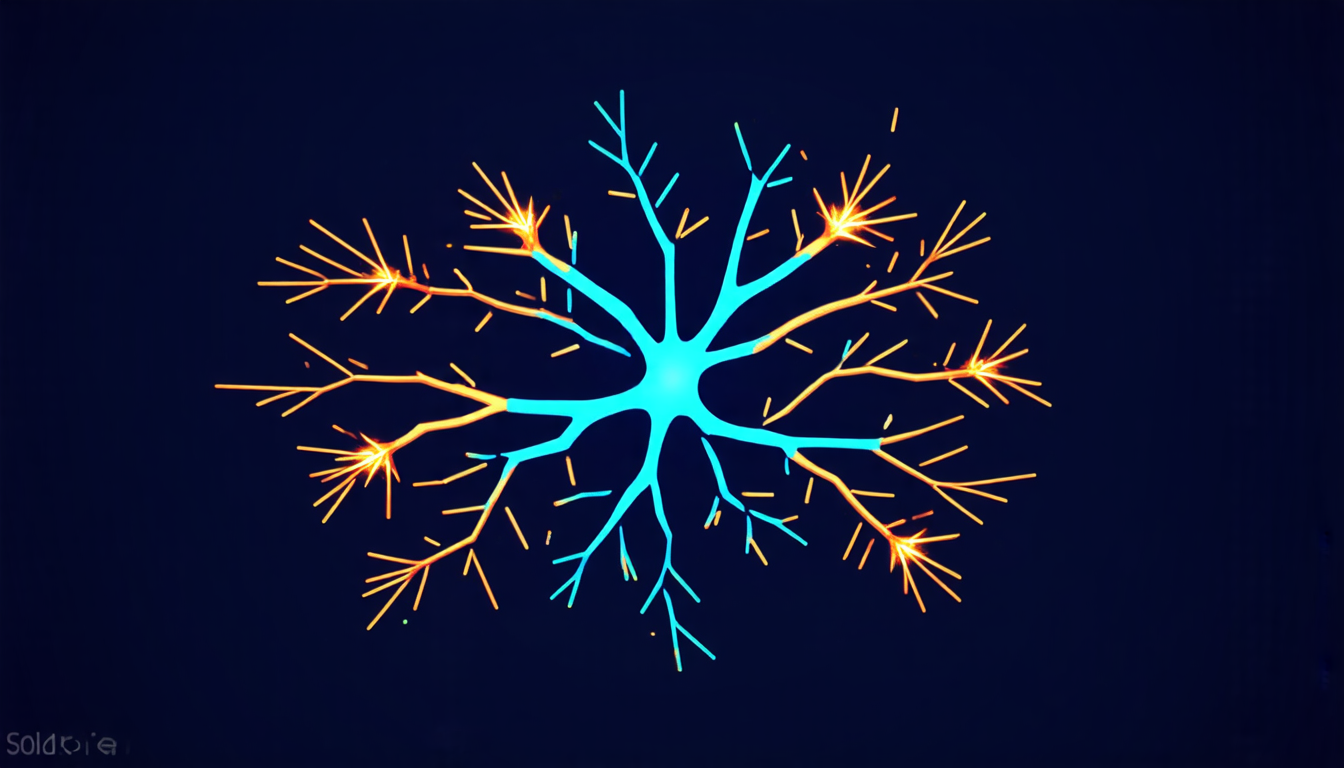
The researchers applied this technique to a stochastic version of the FitzHugh-Nagumo equation, a mathematical model commonly used to describe the behavior of neurons in the brain. By analyzing the synchronization of pulse-like solutions in this system, they found that even small amounts of noise can induce synchronization, leading to a loss of individuality and a uniform behavior among the pulses.
This finding has significant implications for our understanding of complex systems and how they respond to noise. In many cases, noise is an inherent part of these systems, and it’s often difficult to distinguish between noise-induced synchronization and other forms of synchronization that arise from more deterministic mechanisms. The researchers’ work provides a new tool for analyzing these systems and better understanding the role of noise in their behavior.
The study also has potential applications in fields such as neuroscience, where understanding how neurons interact with each other is crucial for developing treatments for neurological disorders. By studying the synchronization of pulse-like solutions in stochastic partial differential equations, researchers may be able to develop new models that can better capture the complex dynamics of brain activity and lead to more effective therapies.
Overall, this research provides a significant advance in our understanding of how noise affects complex systems and has the potential to inform a wide range of applications across fields.
Cite this article: “Unraveling the Role of Noise in Synchronizing Complex Systems”, The Science Archive, 2025.
Noise, Synchronization, Complex Systems, Stochastic Partial Differential Equations, Mathematical Modeling, Neuroscience, Brain Activity, Fitzhugh-Nagumo Equation, Phase Reduction, Pulse-Like Solutions
Reference: Christian Kuehn, Joris van Winden, “Synchronization by noise for traveling pulses” (2025).





