

Thursday 13 March 2025
Scientists have made a significant breakthrough in developing an algorithm that enables multiple robots or agents to work together safely and efficiently, even in complex and dynamic environments.
The new algorithm, called Scalable Safe Multi-Agent Reinforcement Learning (SS- MARL), is designed to address the challenges of multi-agent systems, where individual agents must navigate their surroundings while also taking into account the actions and goals of other agents. This can be particularly challenging when multiple agents are working together towards a common goal.
Traditional algorithms for multi-agent reinforcement learning often rely on simple reward functions that encourage cooperation between agents. However, these approaches can lead to suboptimal solutions and even catastrophic failures in complex environments. SS-MARL, on the other hand, incorporates cost constraints into its optimization process, ensuring that agents learn to work together safely and effectively.
The algorithm uses a novel framework that combines graph neural networks with constrained policy optimization techniques. The graph neural network is trained to learn the intrinsic graph structure of the environment, which represents the relationships between agents and obstacles. This allows the algorithm to efficiently aggregate local observations and communications from multiple agents, enabling it to make informed decisions about their actions.
The constrained policy optimization component ensures that the learned policy satisfies the cost constraints, which are defined by the environment. These constraints can include safety constraints, such as avoiding collisions with other agents or obstacles, as well as performance constraints, such as completing tasks efficiently and effectively.
To demonstrate the effectiveness of SS-MARL, scientists conducted a series of experiments in simulation environments and on real-world robots. The results showed that the algorithm was able to learn safe and efficient policies for multiple agents working together in complex scenarios, including cooperative navigation and formation control.
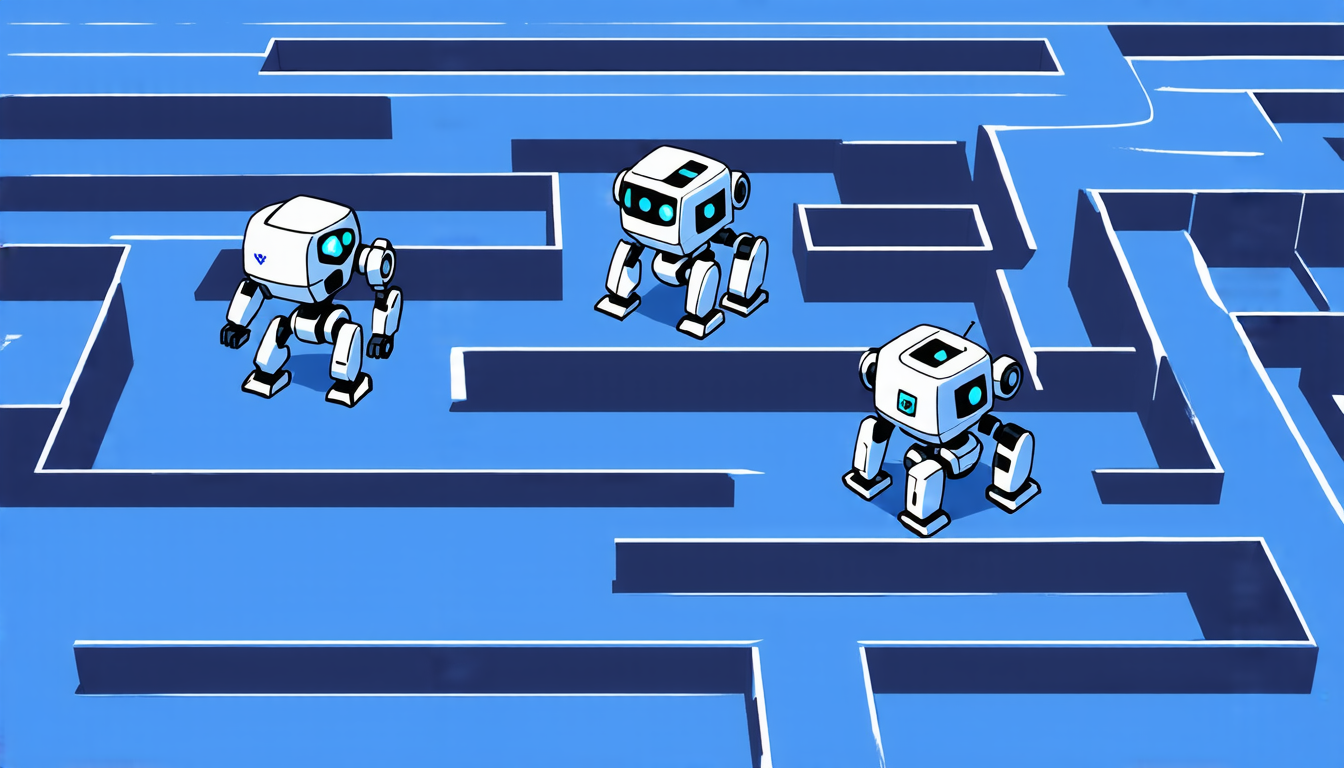
In one experiment, researchers trained an SS-MARL model on a cooperative navigation task with three agents, where they had to work together to navigate through a maze while avoiding obstacles. The results showed that the algorithm was able to learn a policy that allowed all three agents to successfully complete the task without colliding with each other or the obstacles.
The scientists also tested SS-MARL on real-world robots in a hardware experiment, where they used miniature vehicles with Mecanum wheels to demonstrate the algorithm’s ability to control multiple agents in a complex environment. The results showed that the algorithm was able to learn safe and efficient policies for the robots, allowing them to work together effectively without colliding or getting stuck.
Cite this article: “Scalable Safe Multi-Agent Reinforcement Learning Algorithm Enables Efficient Cooperation in Complex Environments”, The Science Archive, 2025.
Robotics, Artificial Intelligence, Multi-Agent Systems, Reinforcement Learning, Scalable Safe Multi-Agent Reinforcement Learning, Graph Neural Networks, Constrained Policy Optimization, Safety Constraints, Performance Constraints, Cooperative Navigation.





