

Friday 14 March 2025
A team of researchers has made a significant breakthrough in the field of artificial intelligence, developing a new framework for predicting the movement of objects in complex environments. The system, known as TrajFlow, uses a combination of machine learning and physics-based models to forecast the trajectories of vehicles, pedestrians, and other objects.
Traditionally, AI systems have struggled to accurately predict the movements of multiple agents in crowded spaces, such as city streets or concert halls. This is because they often rely on simplistic assumptions about how individuals will behave, such as assuming that people will follow predetermined routes or move at constant speeds.
TrajFlow takes a different approach, using a technique called normalizing flows to model the complex interactions between objects in a scene. Normalizing flows are a type of machine learning algorithm that can learn to represent high-dimensional probability distributions, allowing it to capture subtle patterns and correlations in data.
In the case of TrajFlow, the algorithm is trained on large datasets of video footage or sensor readings, which provide information about the movements of objects in a scene. The system uses this data to learn the underlying physics of the environment, such as the laws of motion and the interactions between different agents.
Once trained, TrajFlow can be used to predict the future movements of objects in a scene, taking into account factors such as the position, velocity, and acceleration of each object, as well as the physical constraints of the environment. This allows it to generate highly accurate predictions of where objects will move over time.
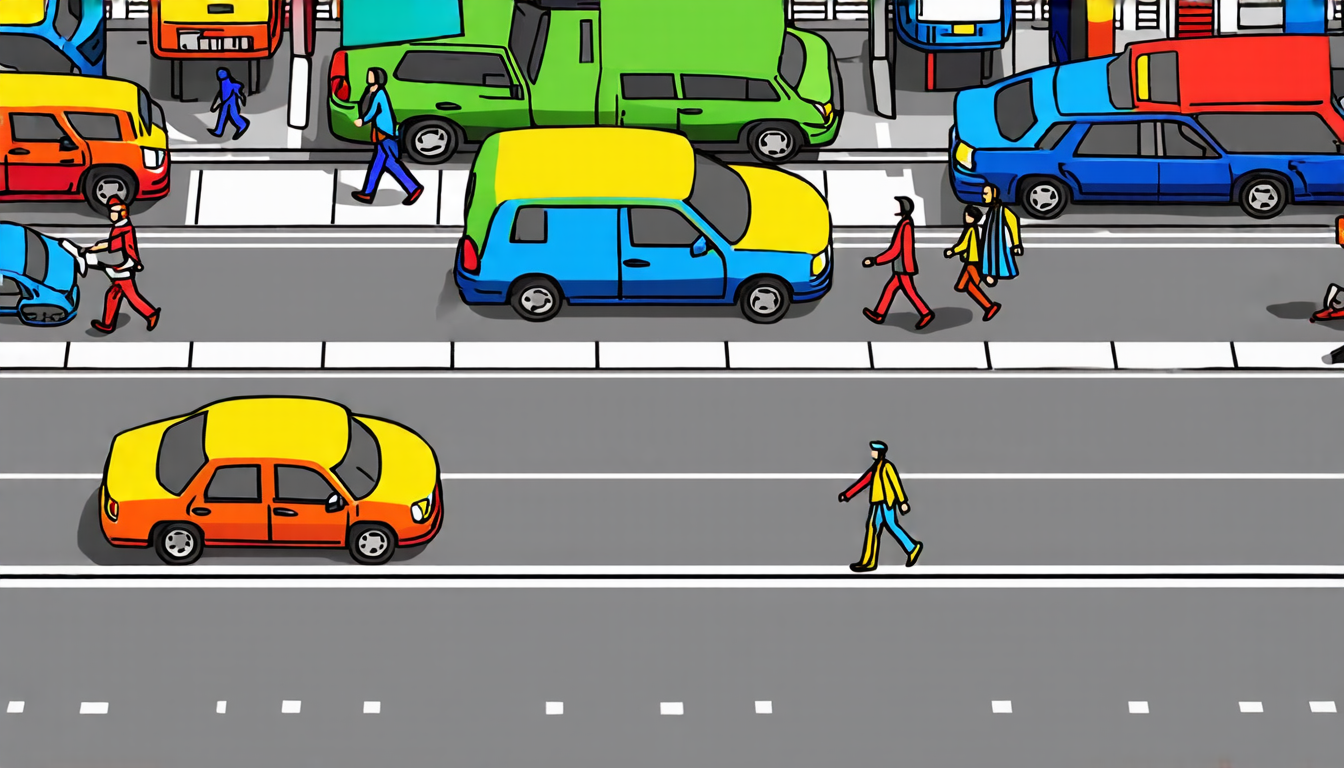
One of the key advantages of TrajFlow is its ability to handle complex, crowded environments with ease. While traditional AI systems may struggle to keep track of multiple agents in a busy scene, TrajFlow can accurately predict the movements of dozens or even hundreds of objects at once.
This makes it particularly useful for applications such as autonomous vehicles, where the system needs to be able to anticipate and respond to the actions of other road users. It could also be used to improve the safety and efficiency of public transportation systems, such as traffic lights and pedestrian crossings.
In addition to its practical applications, TrajFlow has also shed new light on our understanding of complex systems and the behavior of individual agents within them. By studying how TrajFlow learns to represent high-dimensional probability distributions, researchers may be able to gain insights into how humans and other animals perceive and interact with their environments.
Cite this article: “Predicting Complex Object Movement: Introducing TrajFlow AI Framework”, The Science Archive, 2025.
Artificial Intelligence, Machine Learning, Physics-Based Models, Normalizing Flows, Trajectory Prediction, Object Movement, Complex Environments, Autonomous Vehicles, Public Transportation, Traffic Safety.





