

Friday 14 March 2025
Road damage detection is a crucial task in maintaining infrastructure and ensuring public safety. With the rise of deep learning-based object detection methods, researchers have been developing more accurate and efficient algorithms to detect cracks, potholes, and other forms of road damage. However, most existing approaches focus on detecting damage from a side view, which can be limiting.
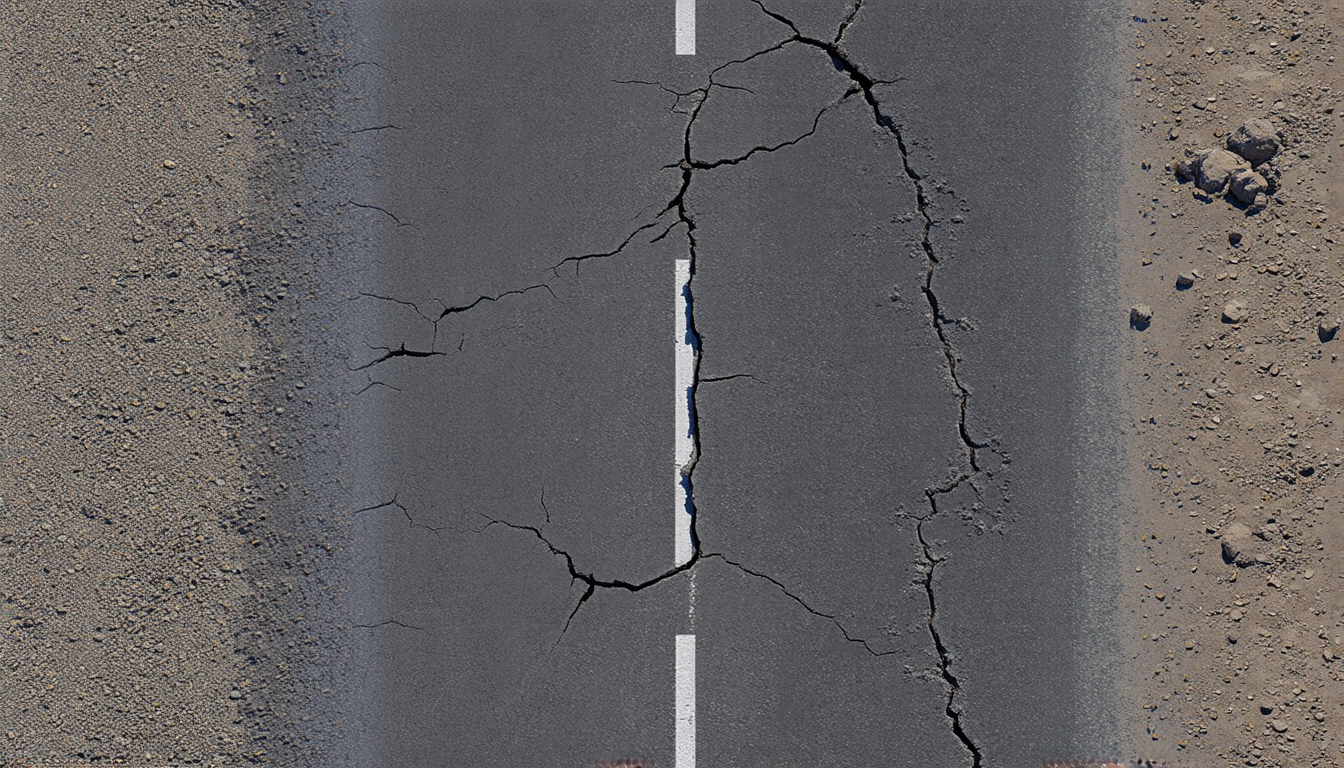
A recent study proposes a novel approach by introducing a top-down perspective to road damage detection. The research team developed a benchmark dataset, called TD-RD, comprising 7,088 high-resolution images with clearly identifiable damage instances. This dataset is designed to advance the field of road damage detection by incorporating a top-down view information.
The researchers also introduced a new real-time object detection framework, TD-YOLOV10, which leverages a Multi-Scale Attention with Positional Squeeze-and-Excitation (MAPSE) module and a Vision-based Global Attention Upsampling (VGAU) module. These innovations enable the detector to capture long-range dependencies and contextual information, leading to improved performance in detecting road damage.
The MAPSE module is responsible for capturing fine-grained features and contextual relationships between different parts of an image. It does this by processing input images through a series of convolutional and attention mechanisms. The VGAU module, on the other hand, enhances the model’s ability to capture global context information by incorporating attention mechanisms that focus on specific regions of interest.
The researchers tested their framework on three datasets: TD-RD, CNRDD, and CRDDC’22. The results showed that TD-YOLOV10 outperformed existing state-of-the-art models in terms of mean average precision (mAP) and precision. For instance, on the TD-RD dataset, TD-YOLOV10 achieved an mAP of 88.1% and a Precision of 88.5%, surpassing competing models by a significant margin.
The study’s findings have significant implications for the development of real-time road damage detection systems. The proposed framework can be used to detect damage in a wide range of environments, from urban roads to rural highways. Moreover, the top-down perspective introduced in this research has the potential to improve accuracy and efficiency in detecting road damage.
In addition to its technical contributions, this study highlights the importance of incorporating diverse perspectives into computer vision research. By exploring new angles and viewpoints, researchers can develop more comprehensive and accurate models that better capture the complexities of real-world scenes.
Cite this article: “Top-Down Road Damage Detection with MAPSE and VGAU Modules”, The Science Archive, 2025.
Road Damage Detection, Deep Learning, Object Detection, Top-Down Perspective, Computer Vision, Image Processing, Convolutional Neural Networks, Attention Mechanisms, Precision, Mean Average Precision





