

Friday 14 March 2025
Mathematicians have made a significant breakthrough in understanding the fundamental nature of reality, and it’s all thanks to some clever algebra.
For decades, scientists have been trying to reconcile two seemingly incompatible theories: quantum mechanics and general relativity. Quantum mechanics describes the behavior of particles at an atomic level, where things get weird and probabilities reign supreme. General relativity, on the other hand, is a theory of gravity that governs the large-scale universe.
The problem is that these two theories don’t play nicely together. Quantum mechanics predicts that tiny particles can be in multiple places at once, while general relativity says that massive objects warp space-time in predictable ways. It’s like trying to merge two different languages into one coherent story.
But a team of mathematicians has found a way to bridge this gap using a type of algebra called hypercompositional structures. In essence, they’ve created a mathematical framework that allows for the combination of both theories in a single, consistent language.
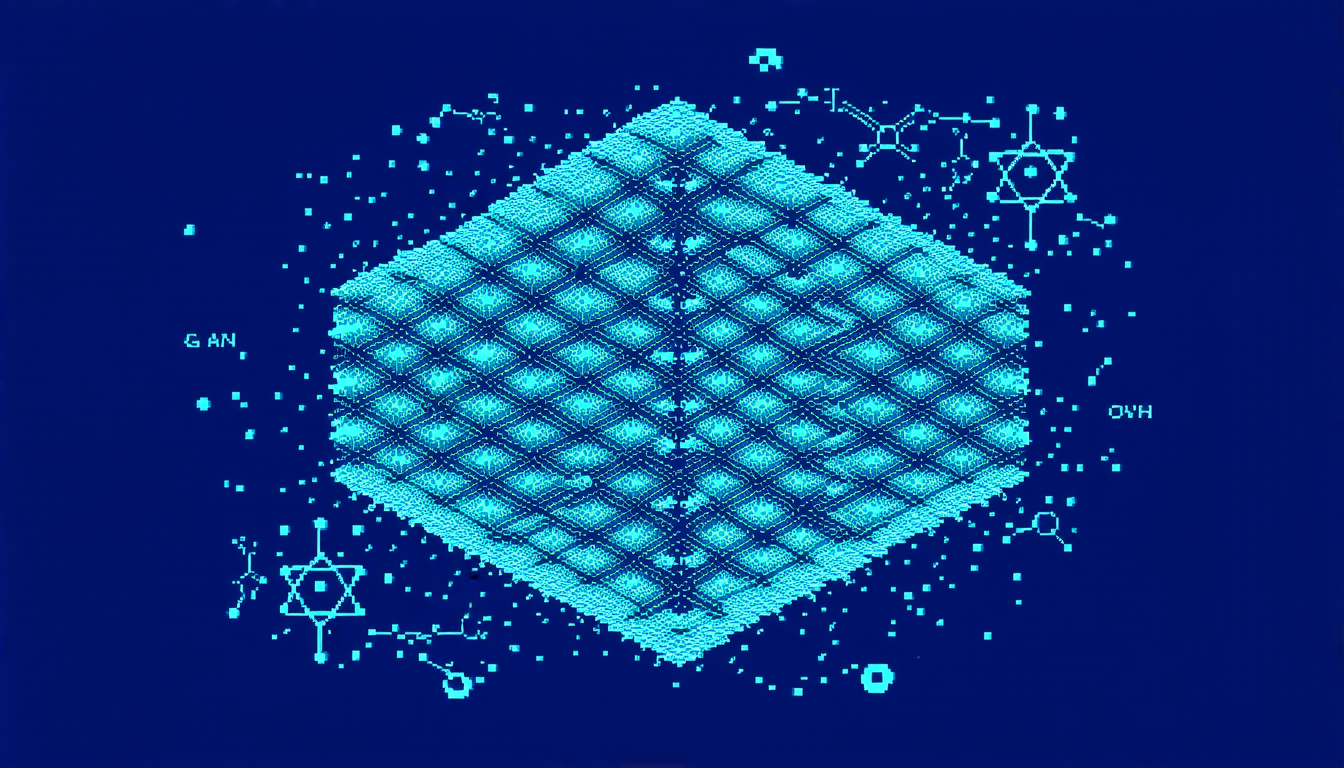
The key insight came from recognizing that certain types of algebraic structures can be used to describe both quantum mechanics and general relativity. By applying these structures to the problem at hand, mathematicians were able to create a new kind of lattice – think of it like a geometric framework for understanding reality.
This lattice, known as an L-mosaic, is capable of capturing both the probabilistic nature of quantum mechanics and the gravitational forces described by general relativity. It’s a mathematical construct that can be used to model complex systems, from subatomic particles to entire galaxies.
The implications are far-reaching. For one, this breakthrough could lead to new insights into the fundamental laws of physics, potentially resolving some of the long-standing paradoxes in quantum mechanics. Additionally, it may pave the way for more accurate models of black holes and other extreme astrophysical phenomena.
But what’s truly exciting is that this work has opened up new avenues for exploring the connections between mathematics and the physical world. By combining seemingly disparate mathematical structures, researchers can create novel frameworks for understanding complex systems – a true marriage of art and science.
As our understanding of reality continues to evolve, it’s clear that algebra will play an increasingly important role in shaping our comprehension of the universe. And who knows? Maybe one day, we’ll find ourselves pondering the mysteries of the cosmos through the lens of hypercompositional structures – a mathematical framework that once seemed obscure but now holds the key to unlocking the secrets of existence.
Cite this article: “Unlocking Realitys Secrets with Algebraic Breakthroughs”, The Science Archive, 2025.
Mathematics, Algebra, Quantum Mechanics, General Relativity, Hypercompositional Structures, L-Mosaic, Lattice, Physics, Black Holes, Astrophysics
Reference: Nicolò Cangiotti, Alessandro Linzi, Enrico Talotti, “L-mosaics and orthomodular lattices” (2025).





