

Friday 14 March 2025
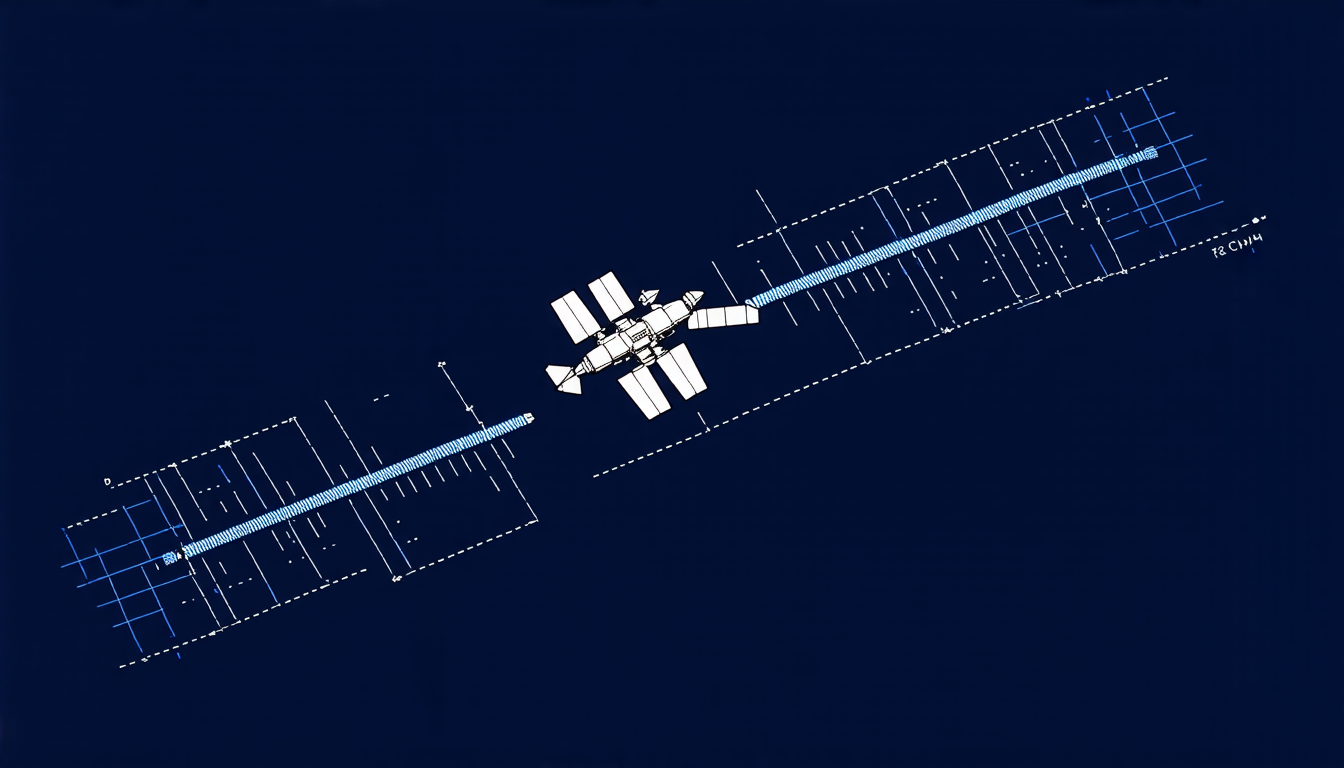
As spacecraft become increasingly complex, the challenge of accurately modeling their behavior has grown more daunting. A new approach uses machine learning and reinforcement learning to optimize actuation sequences, potentially revolutionizing our ability to control these vessels.
The problem is that traditional methods rely on simplifying assumptions about a spacecraft’s dynamics, which can lead to inaccuracies. By using a combination of time-series clustering and reinforcement learning, researchers have developed a system that can learn the optimal sequence of thruster firings or other actuators needed to achieve a specific goal.
In this case, the goal is to accurately identify the inertial tensor of a spacecraft after it deploys its payload. This information is crucial for navigating the craft and making adjustments as needed. The researchers trained their model using simulated data from a variety of scenarios, including different types of payloads and actuation sequences.
The reinforcement learning algorithm, known as Proximal Policy Optimization (PPO), was used to optimize the actuation sequence. PPO is designed to balance exploration and exploitation, allowing the model to both try new approaches and refine its existing knowledge.
The results are impressive: the system was able to accurately identify the inertial tensor in a variety of scenarios, even when faced with noise and disturbances. The researchers also tested their system’s robustness by increasing the level of noise and found that it remained effective.
This approach has significant implications for the field of spacecraft control. By using machine learning and reinforcement learning, engineers can develop more sophisticated models of spacecraft behavior and optimize actuation sequences to achieve specific goals. This could lead to improved navigation, reduced fuel consumption, and increased overall efficiency.
The potential applications are vast. For example, this technology could be used to improve the accuracy of satellite imaging or to enable more precise control over robotic arms on planetary missions. As our reliance on spacecraft continues to grow, developing more advanced methods for controlling them will be essential.
One of the key advantages of this approach is its ability to handle complex, non-linear systems. Traditional methods often rely on linear assumptions, which can lead to inaccuracies in real-world scenarios. By using machine learning and reinforcement learning, engineers can develop models that are better suited to the complexities of spacecraft behavior.
The researchers’ system is also highly adaptable, able to learn from new data and adjust its approach as needed. This makes it an attractive solution for a wide range of applications, from planetary missions to satellite communications.
Cite this article: “Machine Learning Revolutionizes Spacecraft Control”, The Science Archive, 2025.
Spacecraft Control, Machine Learning, Reinforcement Learning, Actuation Sequences, Inertial Tensor, Navigation, Fuel Consumption, Satellite Imaging, Robotic Arms, Planetary Missions.





