

Saturday 15 March 2025
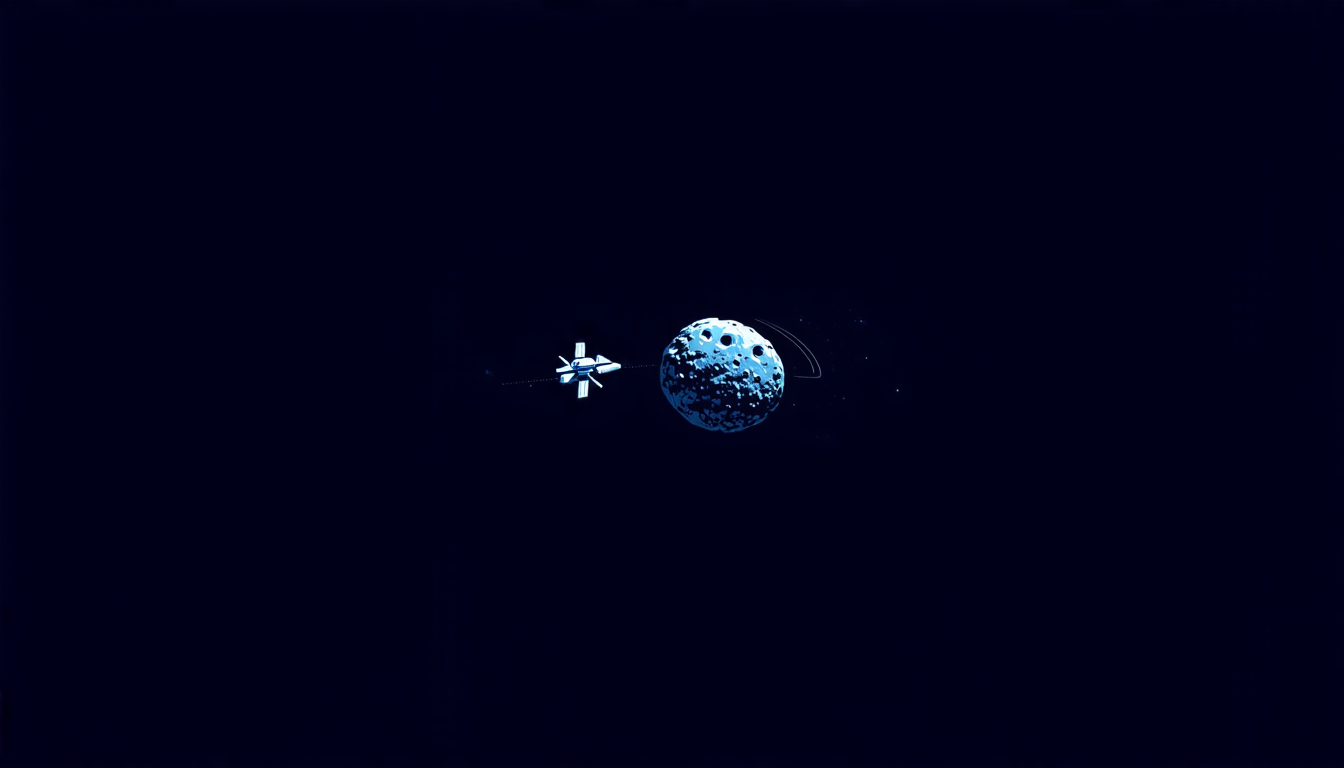
As scientists continue to explore the vastness of space, they’re constantly finding new ways to navigate the complex and unpredictable environments of asteroids. A recent study has shed light on a crucial aspect of asteroid navigation: ensuring that spacecraft can maintain a stable and accurate position while orbiting these small celestial bodies.
Asteroids are notoriously tricky to navigate due to their irregular shapes, weak gravitational fields, and unpredictable movements. To make matters worse, the distances between Earth and asteroids are vast, making real-time communication challenging. As a result, autonomous navigation methods have become essential for successful asteroid missions.
One key technique used by spacecraft is optical navigation (OpNav), which relies on visual observations of the asteroid’s horizon to determine its position and velocity. However, this method can be affected by factors such as atmospheric distortion, sensor noise, and changes in the asteroid’s shape or orientation.
To improve OpNav accuracy, researchers have developed an observability-constrained algorithm that generates orbital maneuvers for spacecraft to follow trajectories allowing continuously usable optical measurements. This approach enables autonomous targeting of various orbits around the asteroid, ensuring a stable and accurate position throughout the mission.
The study’s findings have significant implications for future asteroid missions. By developing more sophisticated navigation systems, scientists can reduce the reliance on long observation periods or human-in-the-loop processes, making missions more efficient and reliable.
One potential application of this research is the OSIRIS-REx mission, which successfully returned samples from asteroid Bennu in 2020. The mission’s optical navigation system was crucial in ensuring the spacecraft’s safe approach and departure from the asteroid.
The development of autonomous navigation systems like OpNav also has broader implications for space exploration. As humanity continues to push the boundaries of space travel, reliable and efficient navigation will become increasingly important. By overcoming the challenges of navigating asteroids, scientists can pave the way for future missions to explore even more distant and complex celestial bodies.
Ultimately, the success of asteroid missions depends on our ability to navigate these unpredictable environments with precision and accuracy. The advancements made in OpNav technology are a crucial step towards achieving this goal, and will undoubtedly play a key role in shaping the future of space exploration.
Cite this article: “Stable Navigation in Unpredictable Environments: Advances in Asteroid Orbiting Technology”, The Science Archive, 2025.
Asteroid Navigation, Optical Navigation, Autonomous Systems, Spacecraft, Orbital Maneuvers, Observability-Constrained Algorithm, Asteroid Missions, Osiris-Rex, Space Exploration, Precision Navigation





