

Saturday 15 March 2025
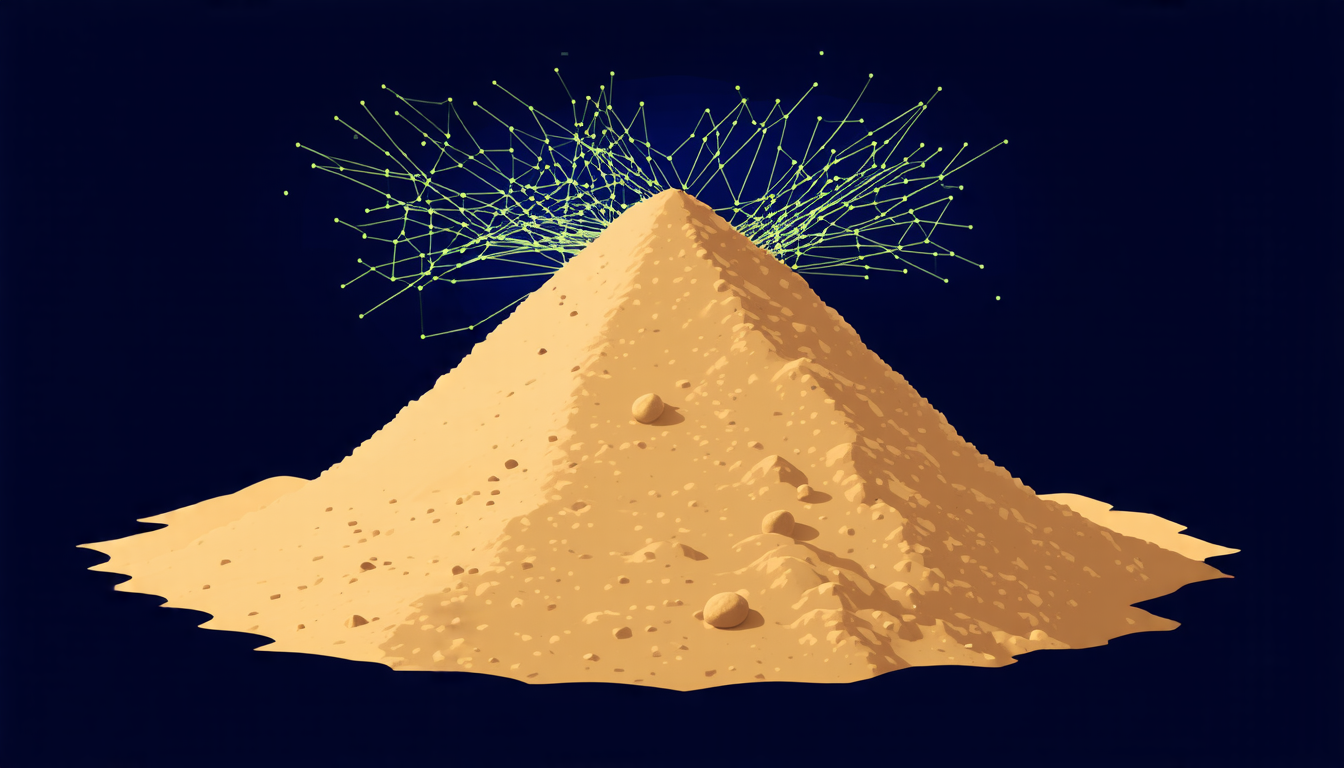
The intricate dance of complex networks has long fascinated scientists, who have been trying to crack the code behind their behavior for decades. In a recent study, researchers have made significant progress in understanding the properties of these systems by mapping them onto another well-studied phenomenon: sandpiles.
Sandpiles are classic examples of self-organized criticality, where particles gradually accumulate and then suddenly collapse, releasing energy in a cascade of events. The resulting patterns and distributions have been extensively studied, but researchers have now discovered that they can be used to model complex networks with surprising accuracy.
The team behind the study began by analyzing the properties of sandpiles, including their degree centrality – a measure of how connected each node is within the system. They found that this distribution followed a generalized gamma distribution (GGD), which is commonly observed in natural systems. But what’s remarkable is that this same distribution also appears in complex networks, such as those found in social media or biological systems.
The researchers used statistical techniques to analyze the properties of these networks and found that they exhibit many of the same characteristics as sandpiles. For example, the degree centrality of nodes within the network follows a similar GGD pattern, indicating that the networks are organized in a way that is reminiscent of sandpile structures.
But what does this mean for our understanding of complex systems? The study suggests that the principles underlying sandpiles can be used to better understand how these networks function and evolve over time. This could have significant implications for fields such as epidemiology, where understanding the spread of diseases through social networks is crucial.
The researchers also explored the relationship between entropy – a measure of disorder or randomness within a system – and the properties of complex networks. They found that entropy decreases with increasing γ, which controls the filtration process used to convert a weighted network into a binary one. This suggests that as networks become more organized and structured, they also become less random and unpredictable.
The study’s findings have important implications for our understanding of complex systems and how they behave over time. By mapping sandpiles onto these networks, researchers can gain valuable insights into the underlying mechanisms that drive their behavior, allowing them to make more accurate predictions about how they will evolve in the future.
In practical terms, this could mean developing new models for predicting the spread of diseases or understanding the behavior of financial markets.
Cite this article: “Unlocking the Secrets of Complex Networks through Sandpiles”, The Science Archive, 2025.
Complex Networks, Sandpiles, Self-Organized Criticality, Degree Centrality, Generalized Gamma Distribution, Statistical Analysis, Entropy, Network Properties, Predictive Modeling, Epidemiology.





