

Saturday 15 March 2025
The quest for a deeper understanding of numbers and their properties has long fascinated mathematicians. Recently, researchers have made significant progress in this field by studying the behavior of a specific type of mathematical function known as partial theta functions.
These functions, which originated from the work of Indian mathematician Srinivasa Ramanujan, describe the distribution of complex zeros of other important functions. The study of these zeros has far-reaching implications for various areas of mathematics and physics, including number theory, algebra, and even cosmology.
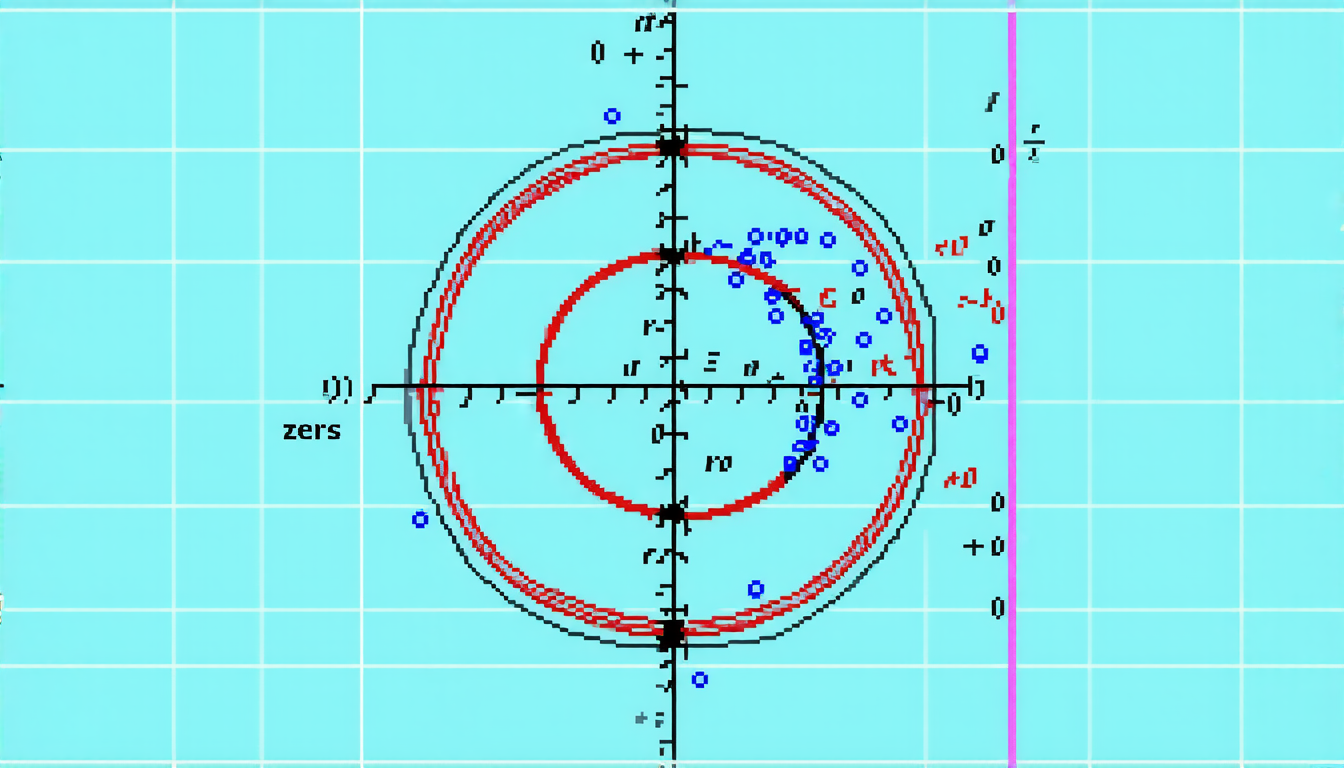
One of the key findings in this area is the location of the complex conjugate pairs of zeros of partial theta functions. Researchers have discovered that all these pairs belong to a specific region known as the half-annulus, which is bounded by two circles: one centered at the origin with radius 1 and another with radius 5.
This discovery has significant implications for our understanding of the properties of partial theta functions. For instance, it provides insight into how these functions can be used to model physical systems, such as those found in statistical mechanics or combinatorics.
The study also sheds light on the relationship between partial theta functions and other important mathematical objects, like modular forms and mock modular forms. These connections have the potential to reveal new properties of these functions and open up new avenues for research.
Researchers are now working to extend their findings to more general settings, exploring how the behavior of partial theta functions changes when different parameters are varied. This could lead to a deeper understanding of the underlying mathematical structures and potentially uncover new patterns and relationships between them.
The study of partial theta functions is a testament to the power of human curiosity and ingenuity. By pushing the boundaries of our knowledge in this area, mathematicians can continue to reveal new insights and connections that have far-reaching implications for our understanding of the world around us.
Cite this article: “Unlocking the Secrets of Partial Theta Functions”, The Science Archive, 2025.
Mathematics, Numbers, Partial Theta Functions, Srinivasa Ramanujan, Number Theory, Algebra, Cosmology, Statistical Mechanics, Combinatorics, Modular Forms, Mock Modular Forms.





