

Saturday 15 March 2025
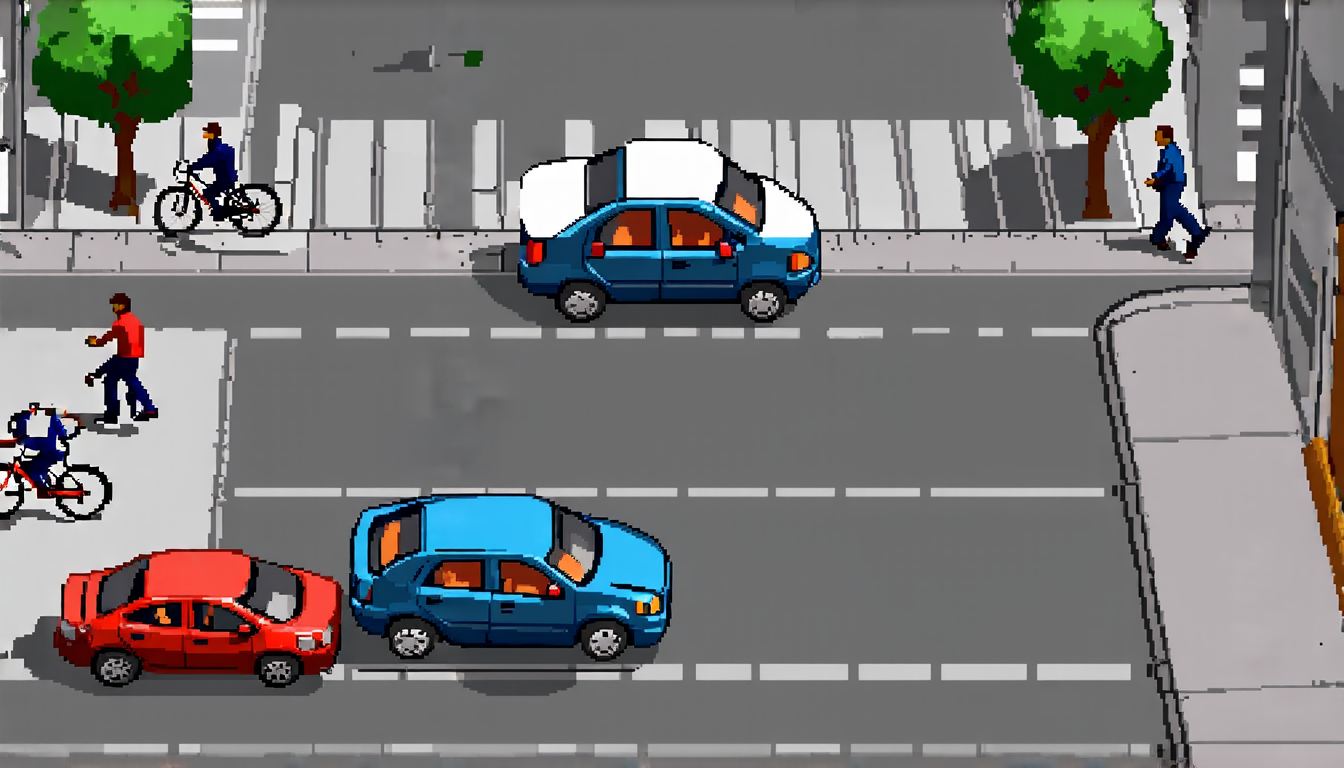
The future of autonomous vehicles is rapidly approaching, and with it comes a host of complex challenges that need to be addressed. One of the most pressing issues is predicting where other cars, pedestrians, and cyclists will move in the next few seconds. This requires not only accurate mapping of the environment but also an understanding of how all these moving objects interact with each other.
To tackle this problem, researchers have developed a modular framework for uncertainty prediction in autonomous vehicle motion forecasting. The framework is designed to capture the complexities of real-world traffic scenarios, where vehicles and pedestrians move in unpredictable ways.
At its core, the framework uses a combination of machine learning algorithms and probabilistic modeling to predict the future movements of all objects on the road. This includes not only cars but also bicycles, pedestrians, and even construction workers or emergency responders who may be present.
The framework is modular in design, meaning that different components can be trained independently and then combined to produce a comprehensive picture of the traffic scene. This allows researchers to fine-tune each component separately, rather than having to retrain the entire system from scratch.
One key innovation of the framework is its use of probabilistic heatmaps to represent the uncertainty associated with each object’s movement. These heatmaps provide a visual representation of the probability that an object will move into a particular area of the road at a given time.
The researchers tested their framework using real-world data from the Argoverse 2 dataset, which provides detailed information on the movements of vehicles and pedestrians in a variety of urban environments. They found that their system was able to accurately predict the movements of all objects involved, even in complex scenarios such as intersections and lane changes.
Perhaps most impressively, the framework was able to handle situations where objects moved in unexpected ways, such as when a pedestrian suddenly stepped into the road or a car changed lanes without signaling. In these cases, the system’s probabilistic heatmaps helped it to adjust its predictions accordingly, providing a more accurate picture of what might happen next.
The implications of this research are significant for the development of autonomous vehicles. By providing a more accurate and nuanced understanding of the traffic scene, the framework could help self-driving cars make better decisions on the road, reducing the risk of accidents and improving overall safety.
In the future, researchers plan to build upon this work by incorporating additional data sources and sensors into their system. This will enable them to capture even more detailed information about the environment and improve the accuracy of their predictions.
Cite this article: “Predicting Uncertainty in Autonomous Vehicle Motion Forecasting”, The Science Archive, 2025.
Autonomous Vehicles, Motion Forecasting, Uncertainty Prediction, Machine Learning Algorithms, Probabilistic Modeling, Traffic Scenario, Road Scene Understanding, Object Tracking, Sensor Data Fusion, Urban Environment.





