

Sunday 16 March 2025
The quest for a more accurate understanding of gravitational waves has taken another significant step forward, as researchers have found that selecting events based on signal-to-noise ratio (SNR) can lead to biased results. This discovery highlights the importance of carefully considering the limitations of current detection methods and developing new strategies to mitigate these biases.
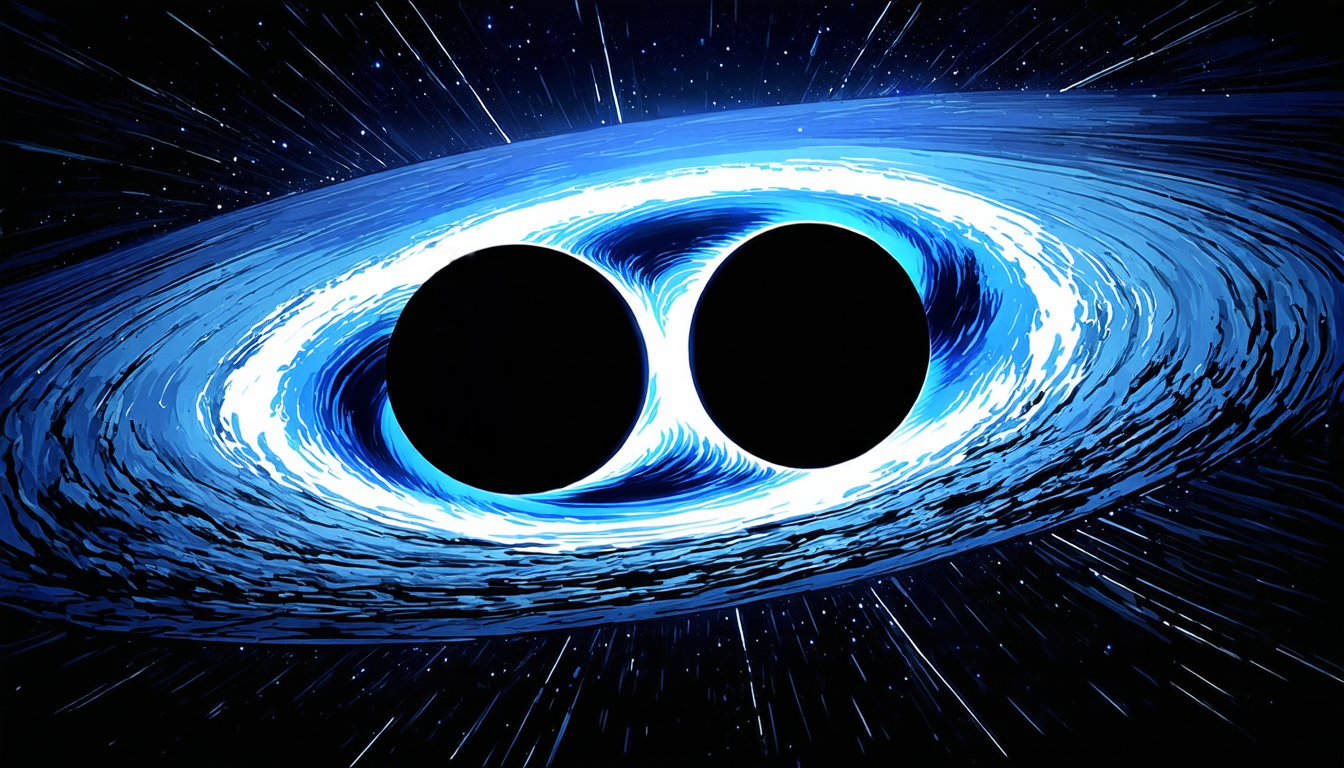
Gravitational waves are ripples in spacetime produced by massive cosmic events, such as the merger of two black holes or neutron stars. The observation of these waves has opened a new window into the universe, allowing scientists to study the most violent and energetic phenomena in the cosmos with unprecedented precision. However, detecting gravitational waves is an extremely challenging task, requiring incredibly sensitive instruments capable of picking up tiny distortions in spacetime.
One of the primary challenges facing researchers is the need to filter out background noise and identify events that are strong enough to be detected. This is typically done by selecting events based on their signal-to-noise ratio (SNR), which measures the strength of the gravitational wave signal relative to the background noise. However, this approach has a significant flaw: it can lead to biased results.
By analyzing simulated data, researchers have found that selecting events based solely on SNR can result in an overestimation of the amplitude of the scalar dipole mode and an underestimation of the inclination angle. This is because the SNR is more sensitive to the strength of the signal than its orientation or polarization properties.
This bias has significant implications for our understanding of gravitational waves and their sources. For example, it can lead to incorrect conclusions about the properties of black holes or neutron stars, which could in turn affect our understanding of the universe as a whole.
To mitigate these biases, researchers are developing new strategies for selecting events based on multiple criteria, rather than relying solely on SNR. This includes incorporating information about the detector network and the expected distribution of sources into the analysis, as well as using more sophisticated statistical methods to account for the complexities of gravitational wave detection.
The development of these new strategies is essential for ensuring that our understanding of gravitational waves is accurate and reliable. As researchers continue to push the boundaries of what is possible with gravitational wave detection, it is crucial that they also address the limitations and biases inherent in their methods.
In recent years, the observation of gravitational waves has opened up a new era of discovery in astrophysics and cosmology.
Cite this article: “Gravitational Wave Detection: Overcoming Biases and Limitations”, The Science Archive, 2025.
Gravitational Waves, Black Holes, Neutron Stars, Signal-To-Noise Ratio, Snr, Spacetime, Noise Reduction, Detector Network, Statistical Methods, Astrophysics, Cosmology.





