

Sunday 16 March 2025
Scientists have been studying the intricate dance between ocean waves and coral reefs for years, but a new study has shed light on the complex interactions that occur within these underwater ecosystems.
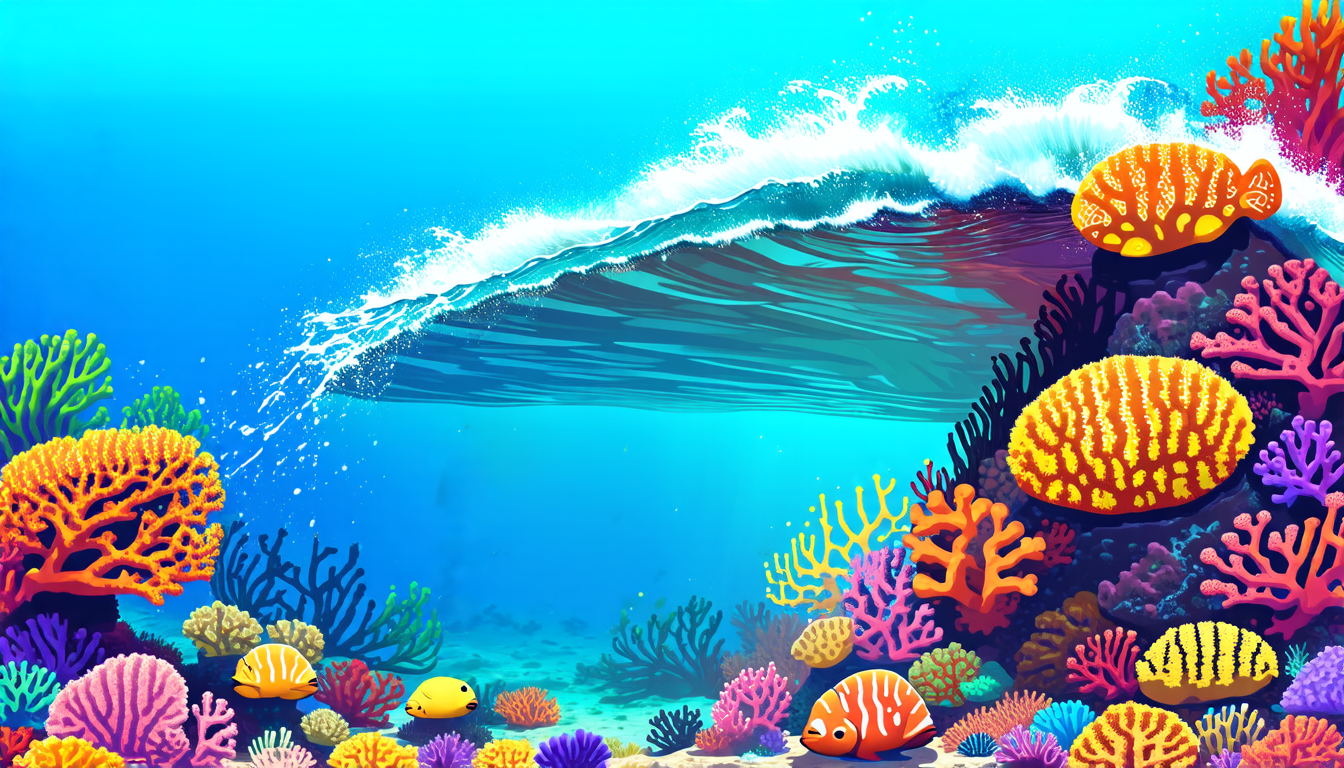
Coral reefs are often thought of as static structures, but in reality, they are dynamic systems that are influenced by the movement of water above them. Waves crashing against the reef create turbulence, which can have a profound impact on the ecosystem’s delicate balance.
Researchers used high-performance computing simulations to model the flow of water over synthetic coral reefs with varying levels of complexity. They found that the majority of turbulent kinetic energy dissipation occurs within the canopy region – the area just above the reef – where the peak dissipation of turbulence is observed.
The study also revealed that the vertical Reynolds stress, which measures the transfer of momentum between different layers of water, peaks during the forward stroke of the wave cycle. This has important implications for our understanding of sediment transport and mass transfer rates within coral reefs.
One of the key findings was the observation that most of the turbulent kinetic energy is produced by the interaction between the wave motion and the reef itself, rather than external factors such as wind or ocean currents. This highlights the importance of considering the complex interactions between waves and coral reefs when trying to understand these ecosystems.
The study’s authors used a novel approach to generate synthetic coral geometries, which allowed them to simulate a wide range of scenarios without being limited by physical constraints. This enabled them to explore the effects of different reef morphologies on the flow of water above and within the reef.
The research has important implications for our understanding of how coral reefs respond to environmental changes, such as sea level rise or increased wave activity. By better understanding the complex interactions between waves and coral reefs, scientists can develop more effective strategies for conserving these critical ecosystems.
In addition to its scientific significance, the study’s findings also have practical applications in fields such as coastal engineering and marine conservation. For example, by understanding how waves impact coral reefs, engineers can design more effective structures to protect these ecosystems from wave damage.
Overall, this research has significantly advanced our knowledge of the complex interactions between ocean waves and coral reefs, and has important implications for our understanding of these critical ecosystems.
Cite this article: “Unraveling the Complex Interactions Between Ocean Waves and Coral Reefs”, The Science Archive, 2025.
Ocean Waves, Coral Reefs, Turbulence, Water Flow, Sediment Transport, Mass Transfer, Reynolds Stress, Wave Motion, Reef Morphology, Coastal Engineering.





