

Wednesday 19 March 2025
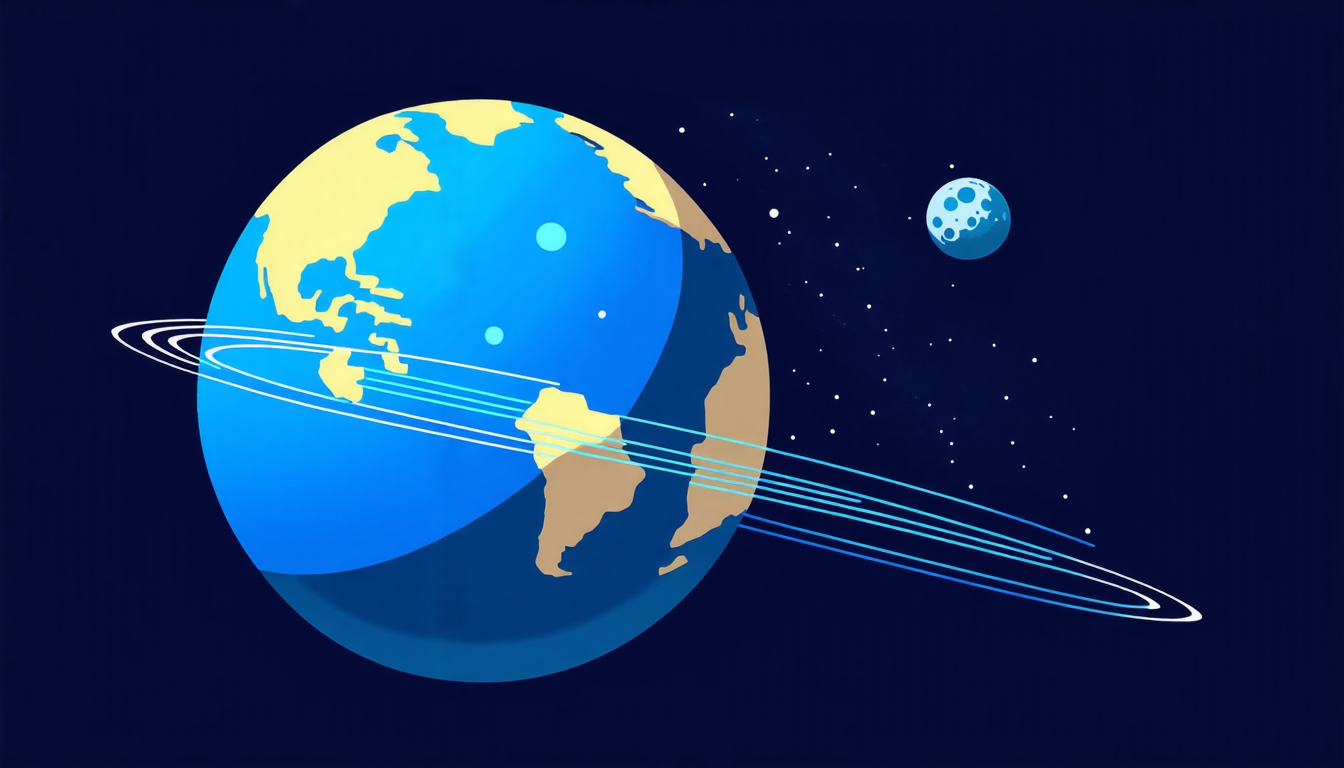
The Moon’s gravitational pull on Earth has been a well-studied phenomenon, but new research suggests that there’s more to this celestial dance than meets the eye. A team of scientists has discovered that the tidal forces exerted by the Moon are not just a one-way street – they’re also influencing the way our planet spins.
Traditionally, astronomers have focused on the effects of the Moon’s gravity on Earth’s oceans and tides. But what about the other way around? Can the Moon’s gravitational pull actually affect the Earth’s rotation? The answer is yes, and it’s all to do with a phenomenon called dynamical tide.
Dynamical tide refers to the waves that form in the Earth’s oceans as the Moon orbits our planet. These waves are not just simple water sloshing around – they’re complex patterns of movement that can interact with the Earth’s rotation. In fact, researchers have found that when these waves resonate with the Earth’s spin, it can actually speed up or slow down the rate at which our planet rotates.
One of the key findings of this research is that the Moon’s gravitational pull on the Earth can actually increase tidal dissipation – the energy lost by the oceans as they respond to the tides. This may seem counterintuitive, but think about it like a dance between the two celestial bodies. As the Moon pulls on the Earth, it creates waves in the oceans that then interact with the planet’s rotation. When these waves resonate with the spin of the Earth, it can create a feedback loop that increases tidal dissipation.
The implications of this research are significant. For one thing, it suggests that the rate at which the Earth spins may be influenced by the Moon’s gravitational pull in ways we’re not yet fully understood. This could have important consequences for our understanding of geological and astronomical phenomena on both the Earth and Moon.
In addition to its theoretical significance, this research also has practical applications. For example, it could help us better understand the complex interactions between the Earth’s oceans and atmosphere – crucial knowledge for predicting weather patterns and mitigating the effects of climate change.
The study used a combination of mathematical modeling and computer simulations to investigate the interactions between the Moon’s gravitational pull and the Earth’s rotation. By analyzing the results, researchers were able to identify specific resonant frequencies at which the tidal waves interact with the planet’s spin.
Cite this article: “The Moons Hidden Influence on Earths Rotation”, The Science Archive, 2025.
Moon, Gravity, Earth, Tides, Dynamical Tide, Oceans, Rotation, Tidal Dissipation, Resonance, Astronomy
Reference: Xing Wei, “Coupling of dynamical tide and orbital motion” (2025).





