

Wednesday 19 March 2025
A recent discovery in mathematics has shed new light on a long-standing problem in the field of geometry. Researchers have found a way to construct generalized quadrangles, complex geometric shapes that have been difficult to create and study.
For centuries, mathematicians have been fascinated by quadrilaterals, four-sided shapes with interesting properties. Generalized quadrangles take this concept further, adding new dimensions and complexities to the mix. However, creating these intricate structures has proven to be a challenging task, as they require specific conditions to exist.
The breakthrough came when scientists stumbled upon a connection between gain graphs and Steiner systems. Gain graphs are mathematical objects that describe how edges in a graph interact with each other, while Steiner systems are sets of points and lines that meet certain criteria. By combining these two concepts, researchers were able to construct generalized quadrangles using a novel approach.
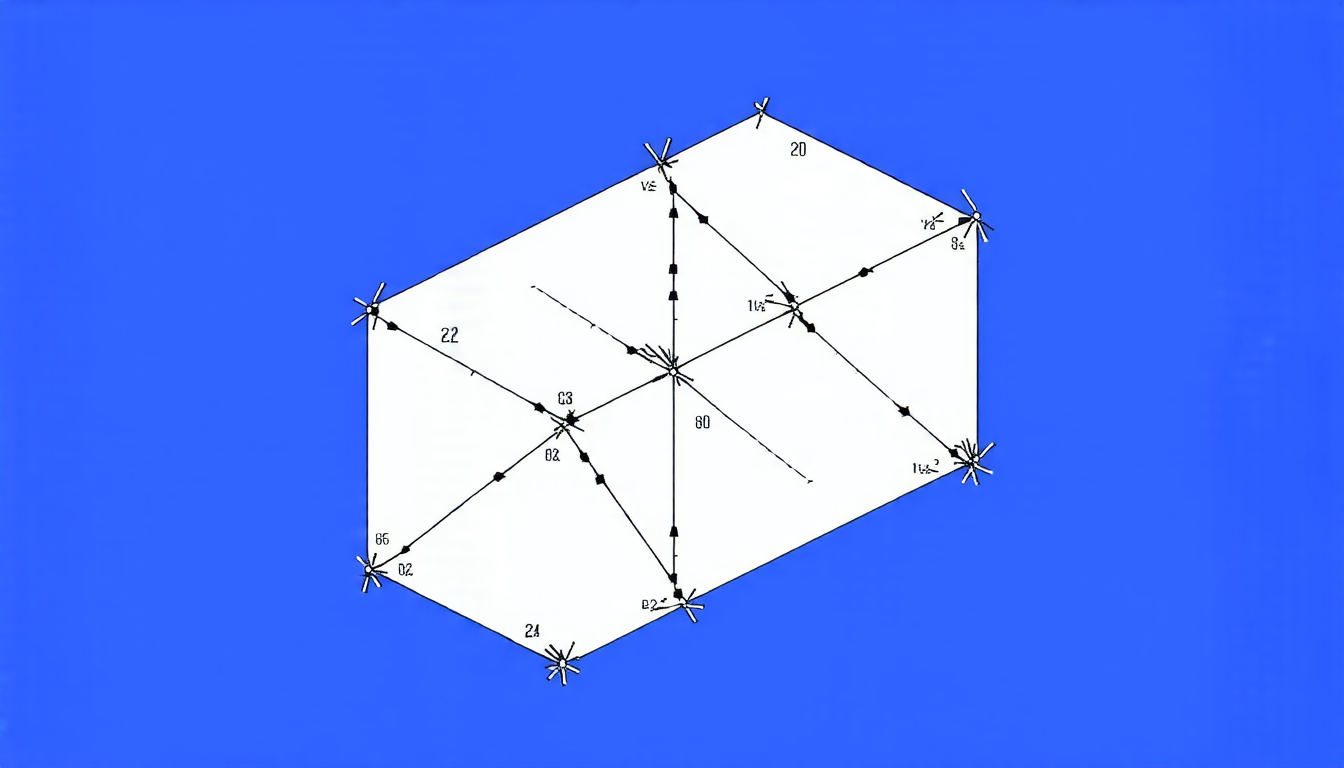
The method involves creating a specific type of gain graph, called an incidence gain graph, which is based on the geometry of an affine plane over a field. An affine plane is a geometric structure that can be visualized as a set of points and lines that meet at specific angles. The researchers then used this gain graph to define a Steiner system, a set of points and lines that satisfy certain properties.
The result was a generalized quadrangle with remarkable properties. Unlike traditional quadrilaterals, these shapes have unique features such as ovoids, which are sets of points that are not incident with any line. The discovery has opened up new avenues for research in geometry and mathematics, allowing scientists to explore the properties and behavior of these complex structures.
One potential application of generalized quadrangles is in coding theory, where mathematicians use geometric shapes to create error-correcting codes. By understanding the properties of these complex shapes, researchers may be able to develop more efficient and reliable codes for data transmission.
The discovery has also sparked interest among computer scientists, who see potential applications in areas such as cryptography and network design. The ability to construct generalized quadrangles could lead to new methods for encrypting data or designing secure networks.
While the implications of this breakthrough are still being explored, one thing is clear: the discovery of generalized quadrangles using gain graphs and Steiner systems has opened up a new frontier in mathematics. As researchers continue to study these complex shapes, they may uncover even more surprising properties and applications that will shape our understanding of geometry and beyond.
Cite this article: “Breaking New Ground: The Discovery of Generalized Quadrangles in Mathematics”, The Science Archive, 2025.
Geometry, Mathematics, Quadrangles, Gain Graphs, Steiner Systems, Incidence, Affine Planes, Ovoids, Coding Theory, Cryptography
Reference: Ryan McCulloch, “Incidence Gain Graphs and Generalized Quadrangles” (2025).





