

Wednesday 19 March 2025
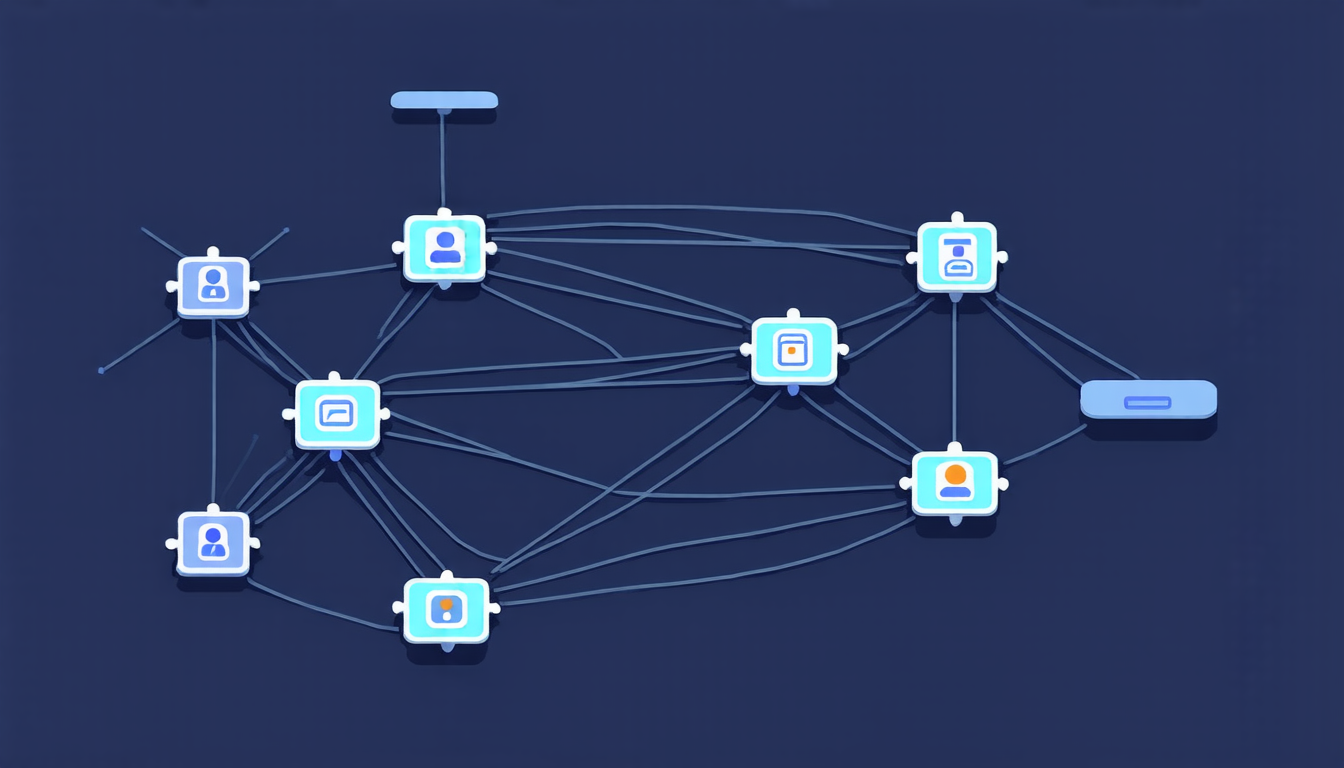
A new approach to understanding complex networks has emerged, one that could revolutionize our ability to analyze and predict their behavior. By applying techniques from algebraic geometry and topological data analysis, researchers have developed a method for studying multilayer networks – complex systems composed of multiple interconnected layers.
These networks are ubiquitous in modern life, appearing in everything from social media platforms to transportation systems. However, as the number of connections between nodes grows, so too does the complexity of the system. Traditional methods of analysis can quickly become overwhelmed by the sheer scale and intricacy of these networks.
The new approach, developed by researchers at the University of Valencia, uses a combination of algebraic geometry and topological data analysis to study multilayer networks. The method involves constructing a lattice of multigraphs – complex structures that combine elements of graphs and lattices – and then applying techniques from persistent homology to analyze their properties.
Persistent homology is a branch of mathematics that studies the evolution of topological features over time or scale. By applying this technique to multilayer networks, researchers can gain a deeper understanding of how these systems change and adapt as new connections are formed.
The method has been tested on a variety of real-world networks, including social media platforms and transportation systems. The results show that the approach is able to capture subtle patterns and relationships within the network that were previously invisible.
One key advantage of this approach is its ability to handle complex networks with multiple layers of interconnected nodes. Traditional methods often struggle to account for the interactions between these different layers, leading to a simplified view of the system as a whole.
By contrast, the new approach takes into account the intricate relationships between all the nodes and edges within the network, providing a more nuanced understanding of how it functions. This could have significant implications for fields such as sociology, economics, and biology, where complex networks play a crucial role in shaping behavior and outcomes.
The researchers behind this work hope to continue refining their approach, exploring its potential applications in areas such as disease spread modeling and network security. As our world becomes increasingly interconnected, the ability to analyze and understand these complex systems will become ever more critical.
The development of new methods for analyzing multilayer networks is an exciting step forward in our understanding of these complex systems. By combining algebraic geometry and topological data analysis, researchers have created a powerful tool for uncovering hidden patterns and relationships within these networks.
Cite this article: “Unlocking Complexity: A New Approach to Analyzing Multilayer Networks”, The Science Archive, 2025.
Algebraic Geometry, Topological Data Analysis, Multilayer Networks, Complex Systems, Social Media Platforms, Transportation Systems, Persistent Homology, Lattice Of Multigraphs, Network Analysis, Data Science
Reference: Joaquin Diaz Boils, “Persistent Homology on a lattice of multigraphs” (2025).





