

Thursday 20 March 2025
The intricate dance of hyperplane arrangements has long fascinated mathematicians, and a recent discovery is shedding new light on this complex phenomenon. By examining the properties of these arrangements, researchers have uncovered a hidden pattern that reveals their underlying structure.
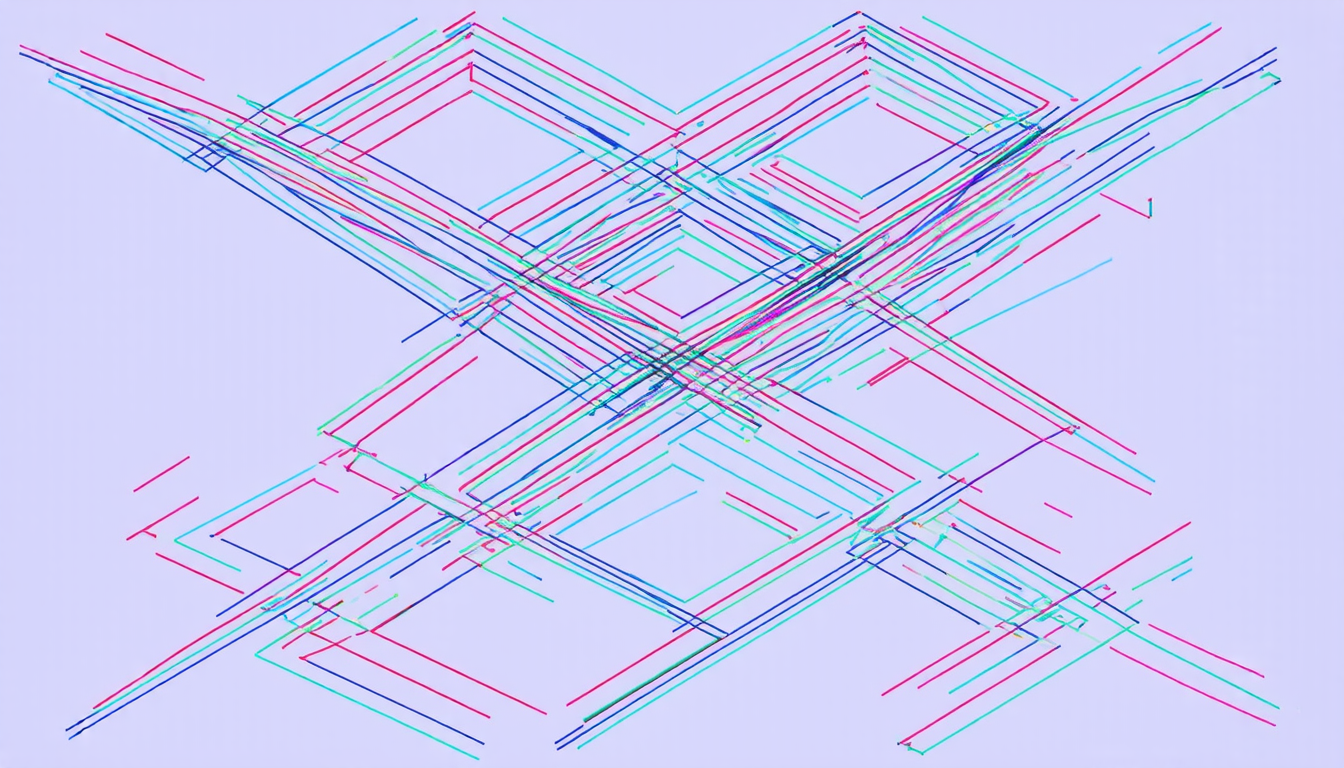
Hyperplane arrangements are sets of planes in higher-dimensional space that intersect at specific points. They can be thought of as a kind of geometric puzzle, where each plane is like a piece of a larger jigsaw. The arrangement’s properties depend on the way these planes fit together, and mathematicians have long sought to understand this relationship.
In recent years, researchers have made significant progress in understanding the freeness of hyperplane arrangements. Freeness refers to an arrangement’s ability to be decomposed into smaller, more manageable pieces. This property is crucial for solving many mathematical problems, as it allows researchers to break down complex calculations into simpler ones.
The latest discovery reveals that certain types of hyperplane arrangements are not only free but also combinatorially formal. Combinatorial formality refers to an arrangement’s ability to be represented by a specific algebraic structure called a poset. This structure is like a hierarchical ladder, where each rung represents a particular plane in the arrangement.
By examining the properties of these combinatorially formal arrangements, researchers have identified a pattern that links their freeness to their underlying geometry. Specifically, they found that an arrangement’s freeness is closely tied to the way its planes intersect at specific points called exponents.
The discovery has significant implications for various fields, including algebraic geometry and topology. Algebraic geometers study the properties of geometric shapes, while topologists examine the properties of spaces that are not necessarily Euclidean. The new understanding of hyperplane arrangements will allow researchers in these fields to tackle complex problems with greater ease.
In addition to its theoretical significance, the discovery has practical applications in computer science and physics. For instance, it could aid in the development of more efficient algorithms for solving complex mathematical problems. In physics, it may help researchers better understand the behavior of particles in high-energy collisions.
The study’s findings highlight the intricate relationships between different branches of mathematics. By exploring the properties of hyperplane arrangements, researchers have uncovered a hidden pattern that reveals the underlying structure of these geometric puzzles. As mathematicians continue to explore this phenomenon, they are likely to uncover even more surprising connections and applications.
Cite this article: “Unlocking the Secrets of Hyperplane Arrangements”, The Science Archive, 2025.
Mathematics, Hyperplane Arrangements, Geometry, Algebraic Geometry, Topology, Combinatorics, Freeness, Poset, Exponents, Computer Science, Physics





