

Thursday 20 March 2025
For years, scientists have been trying to figure out how to get artificial intelligence (AI) and humans to work together seamlessly. It’s a tricky problem – after all, AI systems are designed to make decisions based on logic and data, while humans are driven by emotions, intuition, and complex social dynamics.
One approach is called Ad Hoc Teamwork (AHT), which involves training AI agents to collaborate with each other and with humans in unpredictable situations. But AHT has a major flaw: it doesn’t account for the possibility that the agents might not know each other’s strengths and weaknesses beforehand.
That’s where a new paper comes in. Researchers have developed a novel approach called minimax-Bayes, which uses game theory to optimize policies against an adversarial prior over partners. In simpler terms, this means that the AI agents are trained to make decisions based on the assumption that their teammates might not be trustworthy or reliable.
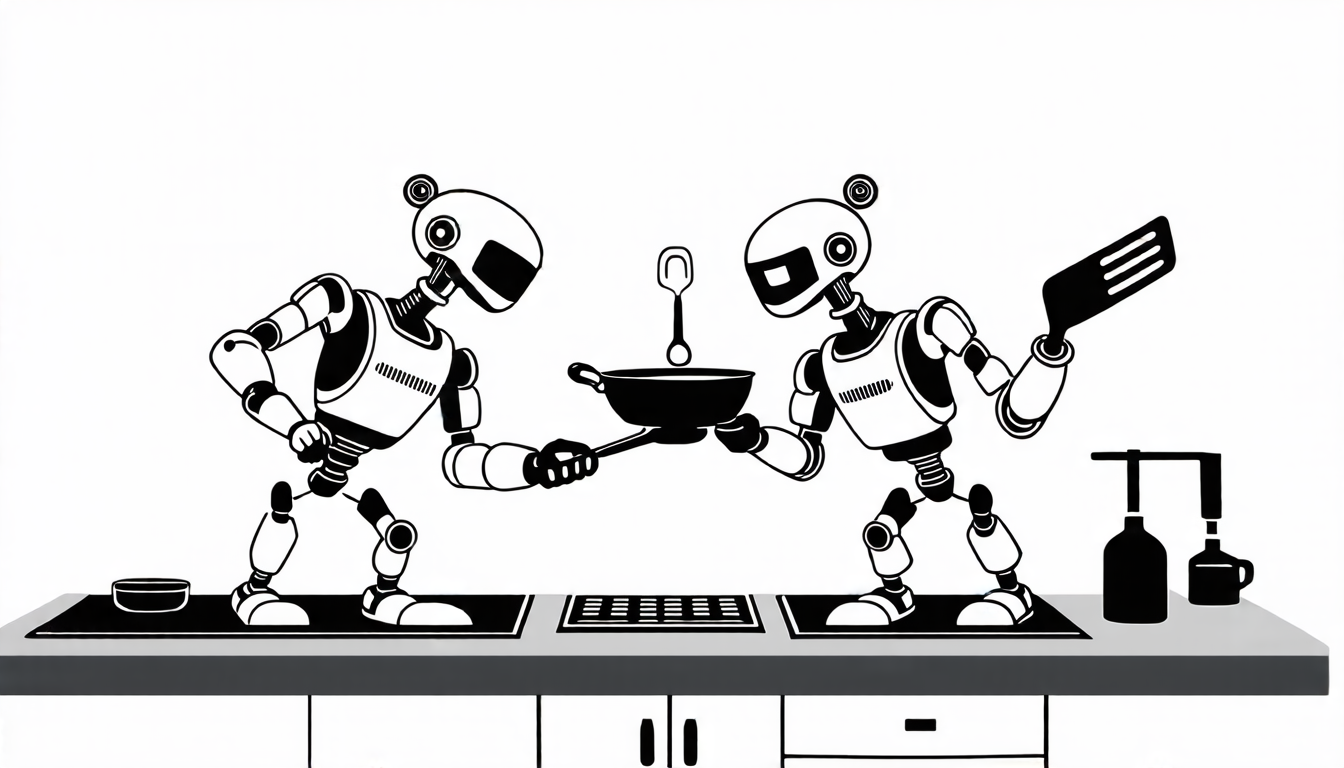
The team used a simulation of a cooking task to test their algorithm. In this scenario, two agents had to work together to prepare a meal while following certain rules and constraints. The twist was that each agent didn’t know what the other one knew about cooking, and they had to figure out how to work together despite these uncertainties.
The results were impressive: the minimax-Bayes algorithm outperformed traditional methods in terms of worst-case utility and regret. This means that the AI agents were better able to adapt to unexpected situations and make decisions that maximized their chances of success, even when faced with unreliable teammates.
But what does this mean for real-world applications? The researchers hope that their approach could be used in areas such as robotics, where autonomous systems need to work together with humans to achieve a common goal. For example, imagine a robot and a human working together to assemble a piece of furniture – the minimax-Bayes algorithm could help them coordinate their efforts more effectively.
The team also experimented with different scenarios, including one where the agents had to collaborate on a cooking task in a cramped kitchen layout. In this case, the minimax-Bayes algorithm performed particularly well, showing that it’s robust and adaptable to changing circumstances.
Overall, the paper offers an exciting new direction for AHT research, one that could lead to more effective collaboration between AI and humans in a wide range of applications.
Cite this article: “AI Agents Learn to Trust No One: New Algorithm Enables Effective Collaboration with Unreliable Teammates”, The Science Archive, 2025.
Ai, Artificial Intelligence, Human-Ai Collaboration, Ad Hoc Teamwork, Minimax-Bayes Algorithm, Game Theory, Simulation, Cooking Task, Robotics, Autonomous Systems, Teamwork





