

Thursday 20 March 2025
The intricate dance of swimming microorganisms and their surroundings has long fascinated scientists. These tiny creatures, ranging from bacteria to protozoa, propel themselves through fluids using a variety of techniques, from flagella to cilia. But what happens when they encounter boundaries? The answers lie in the complex interplay between fluid dynamics, deformation, and propulsion.
Researchers have long sought to understand how microswimmers interact with surfaces, including rigid walls and deformable membranes. In a recent study, scientists have shed light on this phenomenon by modeling the behavior of pushers and pullers – two types of microorganisms that propel themselves through fluids using different mechanisms.
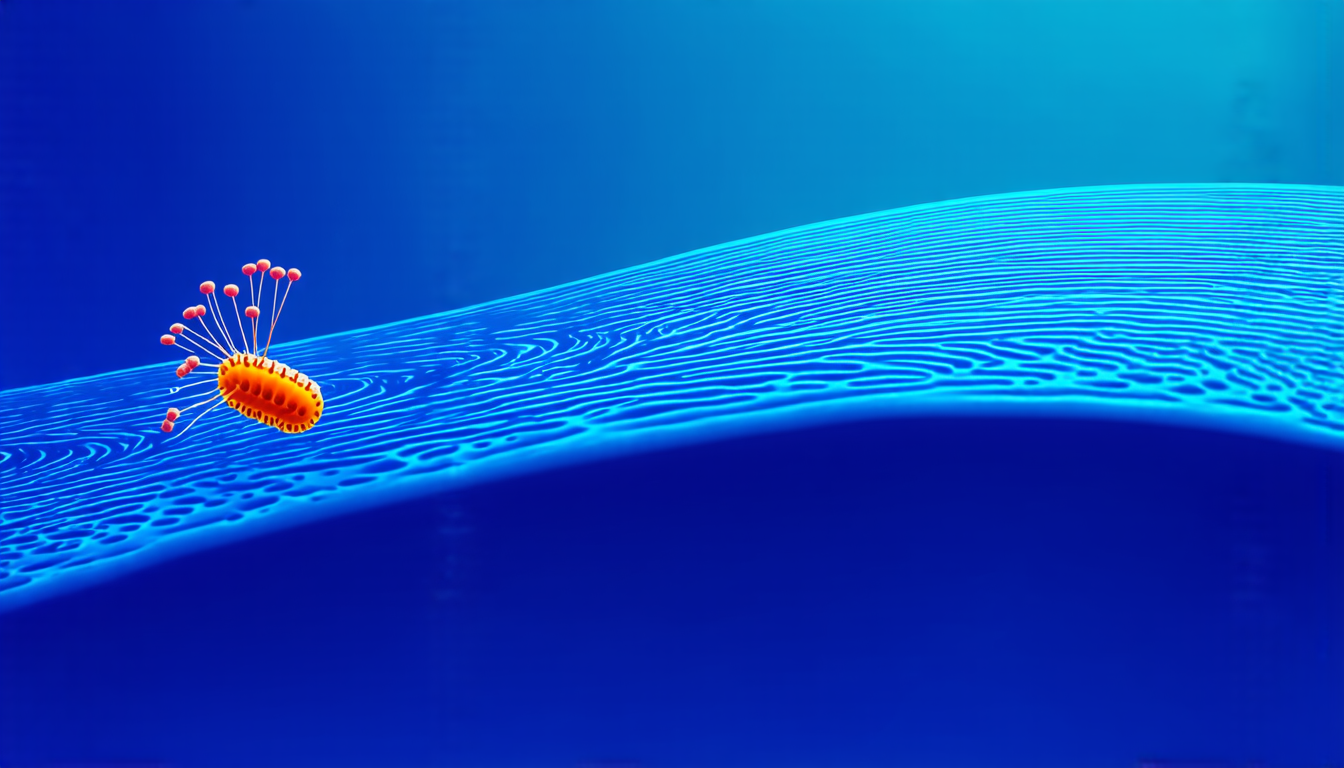
The researchers employed a perturbation theory to investigate the swimming dynamics of pushers and pullers near instantaneously deforming boundaries. These boundaries are endowed with a bending rigidity and surface tension, mimicking real-world scenarios such as biological membranes or soft surfaces. The study reveals that both types of microswimmers can exhibit complex behaviors when interacting with these deformable boundaries.
Pushers, which use their flagella to push against the surrounding fluid, can either reorient away from the boundary or become trapped by it. This trapping phenomenon is enhanced for pullers, which use their cilia to create a flow that pulls them through the fluid. In both cases, the interactions between the microswimmer and the deformable boundary give rise to intriguing phase diagrams, showcasing the complex interplay between swimming speed, boundary deformation, and initial orientation.
The study’s findings have significant implications for our understanding of microbial behavior in natural environments. Microorganisms often inhabit confined spaces, such as biofilms or soil aggregates, where they interact with surfaces that can deform under their motion. By better grasping these interactions, scientists can gain insights into the mechanisms driving microbial colonization and community structure.
Furthermore, the study’s results could inform the design of novel micro-robots or cargo-carrying devices that mimic the swimming behavior of microorganisms. These artificial swimmers would need to interact with deformable surfaces in a way that allows them to propel themselves efficiently while avoiding trapping or reorientation.
The researchers’ work also highlights the importance of considering the mechanical properties of boundaries when studying microbial behavior. By accounting for the deformation and bending rigidity of these boundaries, scientists can develop more realistic models that better capture the intricate dance between microswimmers and their surroundings.
Ultimately, this study offers a fascinating glimpse into the complex world of microbial swimming and its interactions with deformable surfaces.
Cite this article: “Microswimmers Intricate Dance: Uncovering the Interplay Between Swimming Dynamics and Deformable Boundaries”, The Science Archive, 2025.
Microorganisms, Microswimming, Fluid Dynamics, Deformation, Propulsion, Bacteria, Protozoa, Flagella, Cilia, Biofilms.





