

Thursday 20 March 2025
The intricate dance of celestial mechanics has long fascinated astronomers, and a new study sheds light on the complex interplay between galaxy bars and spiral arms. Researchers have discovered that the regular overlap of these structures can induce radial migration in stars, leading to star formation bursts.
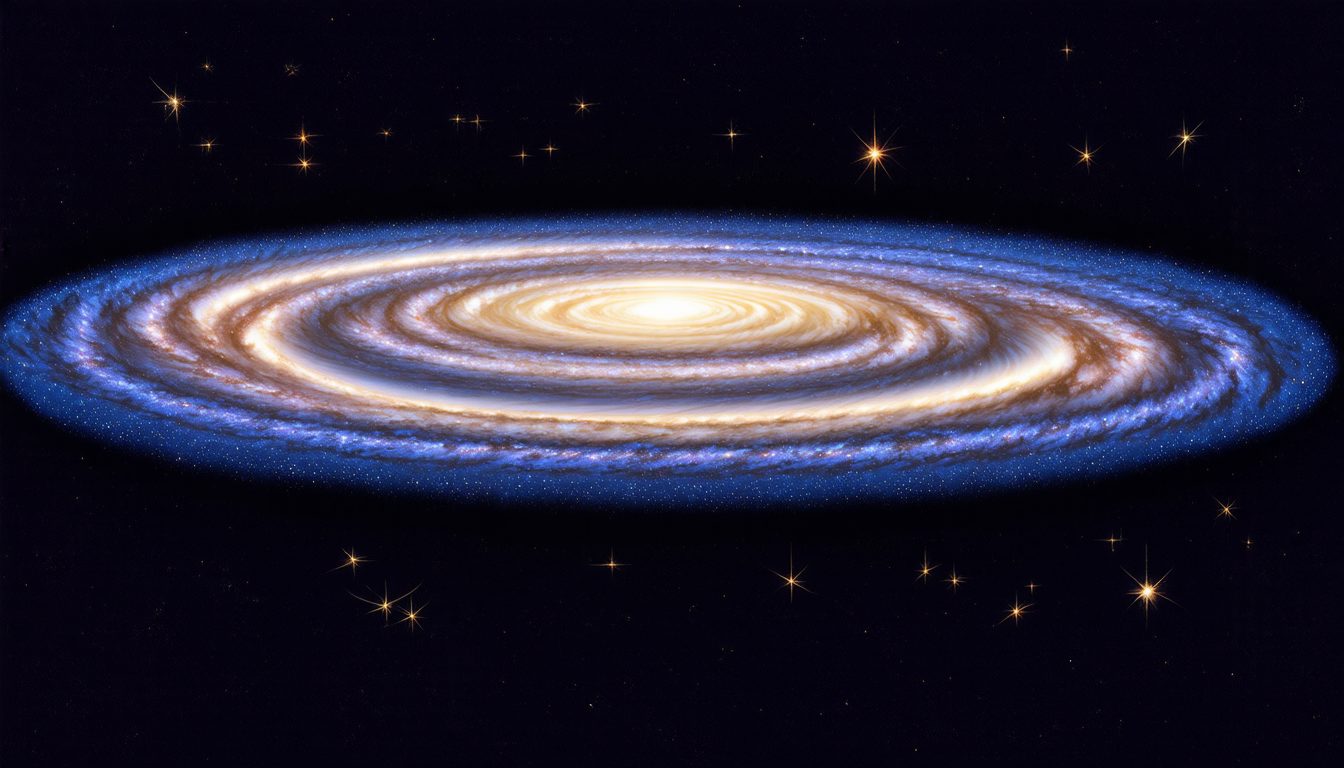
Galaxies are known for their stunning visual displays, with sweeping arms of gas and dust curling around central bulges of older stars. At the heart of many galaxies lies a bar-shaped structure, formed when material accumulates along a specific axis. Bars play a crucial role in shaping galaxy evolution, influencing the growth and formation of new stars.
In this latest study, scientists used computer simulations to investigate the interaction between bars and spiral arms. By modeling the dynamic behavior of stars within these structures, researchers were able to identify a previously unknown mechanism driving radial migration. This process occurs when the bar and spiral arm overlap, causing stars to move inward or outward along specific paths.
The results show that this overlap induces periodic boosts in stellar radial migration, leading to net inward movement along the leading edge of the bar and outward motion along its trailing edge. This phenomenon is most pronounced between the bar’s inner Lindblad resonance and its corotation radius, beyond which other drivers take over.
One fascinating aspect of this study is its implications for star formation. The simulations suggest that stars born near the bar vicinity can migrate out to the solar radius while remaining on cold orbits. In fact, analysis of APOGEE data reveals that approximately 13% of stars in the solar neighborhood were born inside the bar, compared to 5-20% predicted by simulations.
The researchers also found that this overlap leads to periodic starbursts at the ends of the bar, with an enhancement factor of up to four depending on the strength of the spiral structure. These bursts occur when material is compressed and triggered into forming new stars.
This study not only provides insight into the intricate dynamics of galaxy evolution but also underscores the importance of considering these processes in understanding the history of our own Milky Way galaxy. By examining the interactions between bars and spiral arms, scientists can gain a deeper appreciation for the complex mechanisms shaping the universe around us.
The findings have significant implications for ongoing research into galaxy evolution, star formation, and the role of bars in shaping their host galaxies. As astronomers continue to explore the mysteries of the cosmos, this study serves as a valuable reminder of the intricate relationships between celestial structures and the stars that inhabit them.
Cite this article: “Galactic Dance: Uncovering the Cosmic Interplay Between Bars and Spiral Arms”, The Science Archive, 2025.
Galaxy Evolution, Spiral Arms, Galaxy Bars, Star Formation, Radial Migration, Stellar Dynamics, Celestial Mechanics, Milky Way, Astronomy, Cosmology





