

Thursday 20 March 2025
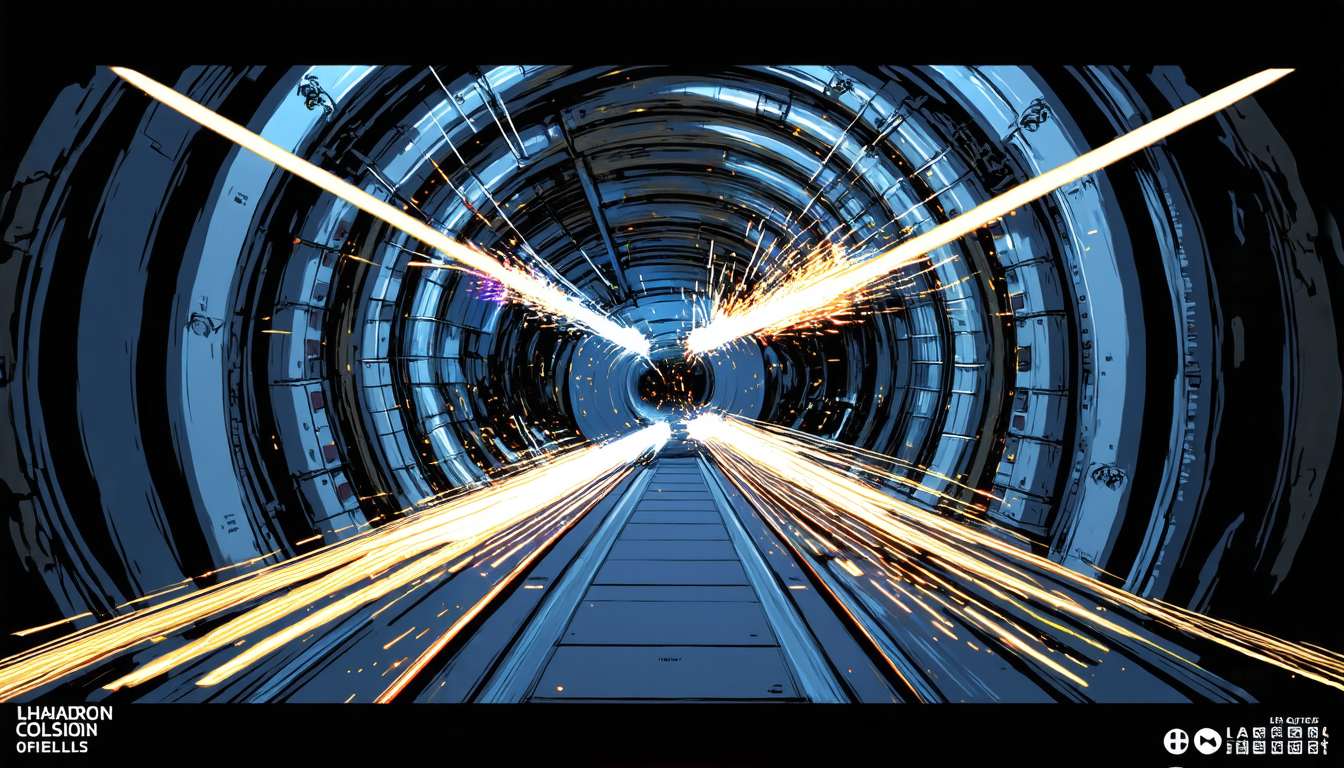
The quest for a more precise measurement of the fundamental forces that govern our universe has led scientists to develop innovative methods for analyzing particle collisions at the Large Hadron Collider (LHC). In a recent study, researchers have demonstrated a novel approach using deep learning techniques to improve the detection of top quarks in high-energy collisions. This breakthrough could significantly enhance our understanding of the strong nuclear force and shed light on some of the universe’s most enduring mysteries.
At the LHC, physicists collide protons at nearly the speed of light, generating a plethora of particles that scientists then study to better comprehend the fundamental forces of nature. One crucial aspect of this analysis involves identifying top quarks, which are among the most massive known particles and play a vital role in our understanding of the strong nuclear force.
Traditionally, researchers have employed machine learning algorithms, such as boosted decision trees, to identify top quarks. However, these methods often rely on manual feature engineering, where human analysts carefully select and combine various particle properties to improve detection accuracy. This approach can be time-consuming and may not always yield optimal results.
The recent study introduces a novel deep learning-based method called DiSaJa (Deep SaJa), which leverages the power of neural networks to identify top quarks with unprecedented precision. By utilizing a multi-domain input scheme, DiSaJa combines various particle properties, such as jet constituents, leptons, and missing transverse momentum, in a single model.
The researchers trained their DiSaJa models on simulated data generated by the popular particle physics software package Pythia, which accurately replicates the conditions of high-energy collisions. The models were then tested on real-world collision data collected during the LHC’s Run 2 period.
The results are striking: DiSaJa outperformed traditional machine learning methods in identifying top quarks with a significant margin. By leveraging the strengths of deep learning, DiSaJa demonstrated improved performance even when faced with complex and noisy data.
This breakthrough has far-reaching implications for particle physics research. The ability to accurately identify top quarks will enable scientists to make more precise measurements of the strong nuclear force, which is essential for understanding a range of phenomena, from the behavior of subatomic particles to the properties of dark matter.
Furthermore, the DiSaJa approach can be applied to other areas of high-energy physics, such as quark-gluon discrimination and jet charge analysis.
Cite this article: “Deep Learning Breakthrough Enhances Top Quark Detection at Large Hadron Collider”, The Science Archive, 2025.
Large Hadron Collider, Particle Physics, Deep Learning, Top Quarks, Strong Nuclear Force, Machine Learning, Neural Networks, Jet Constituents, Leptons, Missing Transverse Momentum.





