

Thursday 20 March 2025
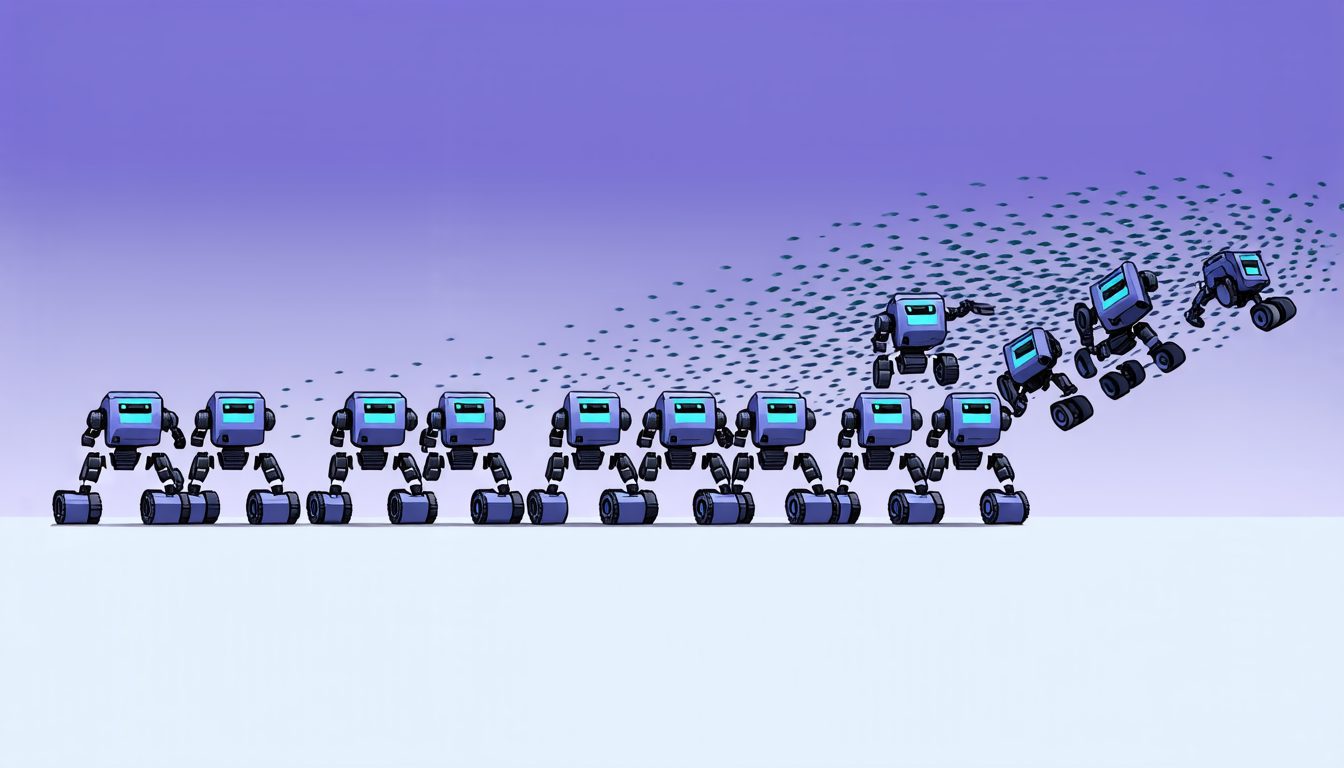
A team of researchers has made a significant breakthrough in developing a new method for controlling swarms of robots, which could have major implications for fields such as search and rescue, environmental monitoring, and agriculture.
The traditional approach to controlling robot swarms is based on complex algorithms that require a lot of computational power and can be difficult to implement. However, the researchers have developed a new method that uses a type of mathematical model called a Gibbs Random Field (GRF) to simplify the process.
A GRF is a statistical model that describes how different variables are related to each other. In this case, the researchers used a GRF to model the behavior of individual robots in the swarm and how they interact with each other. The model takes into account factors such as the position and velocity of each robot, as well as its sensors and actuators.
The beauty of the GRF approach is that it allows the researchers to use reinforcement learning techniques to train the robots without having to explicitly program them. Reinforcement learning involves rewarding or punishing the robots for their actions in order to teach them what behavior is desired.
In this case, the researchers used a type of reinforcement learning called Proximal Policy Optimization (PPO) to train the robots. PPO is an algorithm that uses a combination of exploration and exploitation to find the best policy for achieving a goal.
The results were impressive: the robots were able to learn complex behaviors such as flocking, where they moved together in a coordinated manner, and even learned to avoid obstacles. The researchers also tested their method with different numbers of robots and found that it worked well even with large swarms.
This breakthrough has significant implications for many fields. For example, search and rescue teams could use robot swarms to quickly and efficiently search for survivors after a disaster. Environmental monitoring teams could use robot swarms to track the movement of animals or monitor water quality. And farmers could use robot swarms to monitor crop health and detect pests.
The researchers are already working on applying their method to real-world problems, such as using robots to monitor ocean currents and marine life. They believe that their approach has the potential to revolutionize the field of robotics and make it possible for robots to work together more effectively in a wide range of applications.
Cite this article: “New Method for Controlling Robot Swarms Simplifies Complex Algorithms”, The Science Archive, 2025.
Robotics, Swarm Robotics, Gibbs Random Field, Reinforcement Learning, Proximal Policy Optimization, Artificial Intelligence, Search And Rescue, Environmental Monitoring, Agriculture, Automation





