

Thursday 20 March 2025
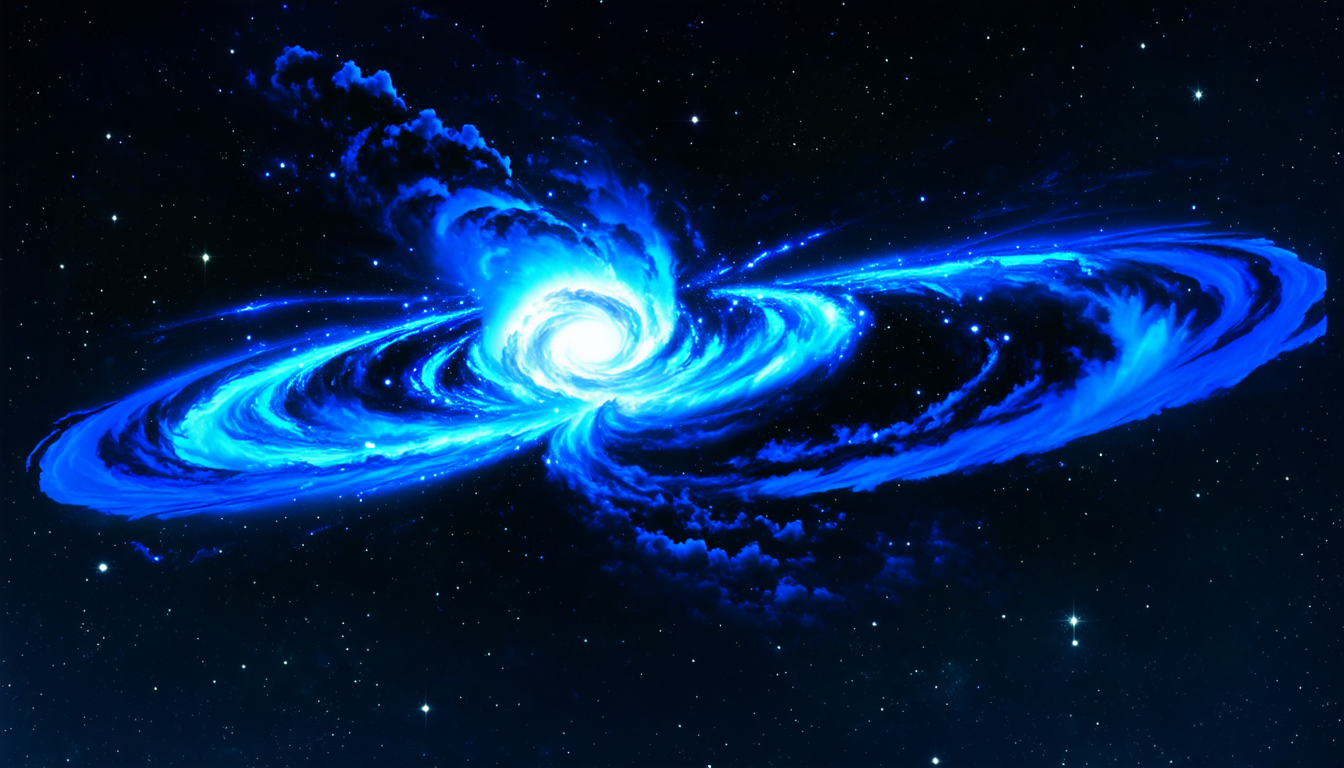
Scientists have been studying a fascinating phenomenon in space – the pulsar wind nebula CTB 87, located about 10,000 light-years away from us. This nebula is a type of astronomical object that forms when a massive star explodes and its energy is released into space.
The researchers used data collected by the Fermi Large Area Telescope to study the gamma-ray emissions from CTB 87. Gamma-rays are high-energy particles that can travel long distances without being absorbed by matter, making them ideal for studying distant objects in space.
By analyzing the data, the scientists found that the pulsar wind nebula is emitting gamma-rays with energies higher than 10 TeV, which is extremely high energy. This suggests that the nebula is home to a powerful particle accelerator that can accelerate particles to incredible speeds.
The researchers also used computer simulations to model the behavior of the particles in the nebula. They found that the particles are injected into the nebula by the pulsar, which is a rapidly rotating neutron star at its center. The particles then interact with each other and with magnetic fields in the nebula, producing the observed gamma-ray emissions.
One of the most interesting findings from this study is that the particles can be accelerated to energies as high as 2.4 PeV, which is an incredibly high energy. For comparison, the highest-energy particles ever detected on Earth are only about 1/100th of this energy.
This research has important implications for our understanding of particle acceleration in space. The pulsar wind nebula CTB 87 is one of the most powerful particle accelerators in the universe, and studying it can help us learn more about how particles are accelerated and what kinds of particles are produced.
The scientists also found that the nebula’s energy output varies over time, which may be due to changes in the pulsar’s rotation rate or magnetic field. This variability could provide important clues about the physics of particle acceleration in the nebula.
Overall, this study provides new insights into the workings of a fascinating object in space and highlights the importance of continued research into the mysteries of the universe.
Cite this article: “Pulsar Wind Nebula Unveils Secrets of Particle Acceleration”, The Science Archive, 2025.
Pulsar Wind Nebula, Ctb 87, Gamma-Rays, Particle Acceleration, High-Energy Particles, Tev, Pev, Neutron Star, Magnetic Fields, Space Research





