

Thursday 20 March 2025
The world of mathematics is full of complex patterns and behaviors that can be difficult to grasp, but a recent discovery has shed new light on the intricate workings of a particular phenomenon known as the Hastings-Levitov process.
This process is a type of aggregation model, where particles grow together in a random manner. It’s often used to study the behavior of materials at the atomic level, and it has been found to exhibit some fascinating properties. For instance, researchers have discovered that the Hastings-Levitov process can create intricate patterns and structures as the particles grow.
One of the most interesting aspects of this process is its ability to mimic real-world phenomena, such as the growth of crystals or the formation of biological cells. This has led scientists to use the Hastings-Levitov process as a tool for modeling complex systems in fields like materials science and biology.
Recently, a team of researchers made a significant breakthrough in understanding the behavior of the Hastings-Levitov process. They discovered that the fluctuations in the growth of the particles can be described using a mathematical formula, known as the logarithmic correlation function.
This formula provides a precise way to predict how the particles will grow and interact with each other over time. It’s a major step forward in understanding this complex phenomenon, and it has far-reaching implications for fields like materials science and biology.
The researchers used advanced mathematical techniques to analyze the data and derive the logarithmic correlation function. They also developed new methods for simulating the Hastings-Levitov process using computers, which allowed them to generate high-quality visualizations of the growth patterns.
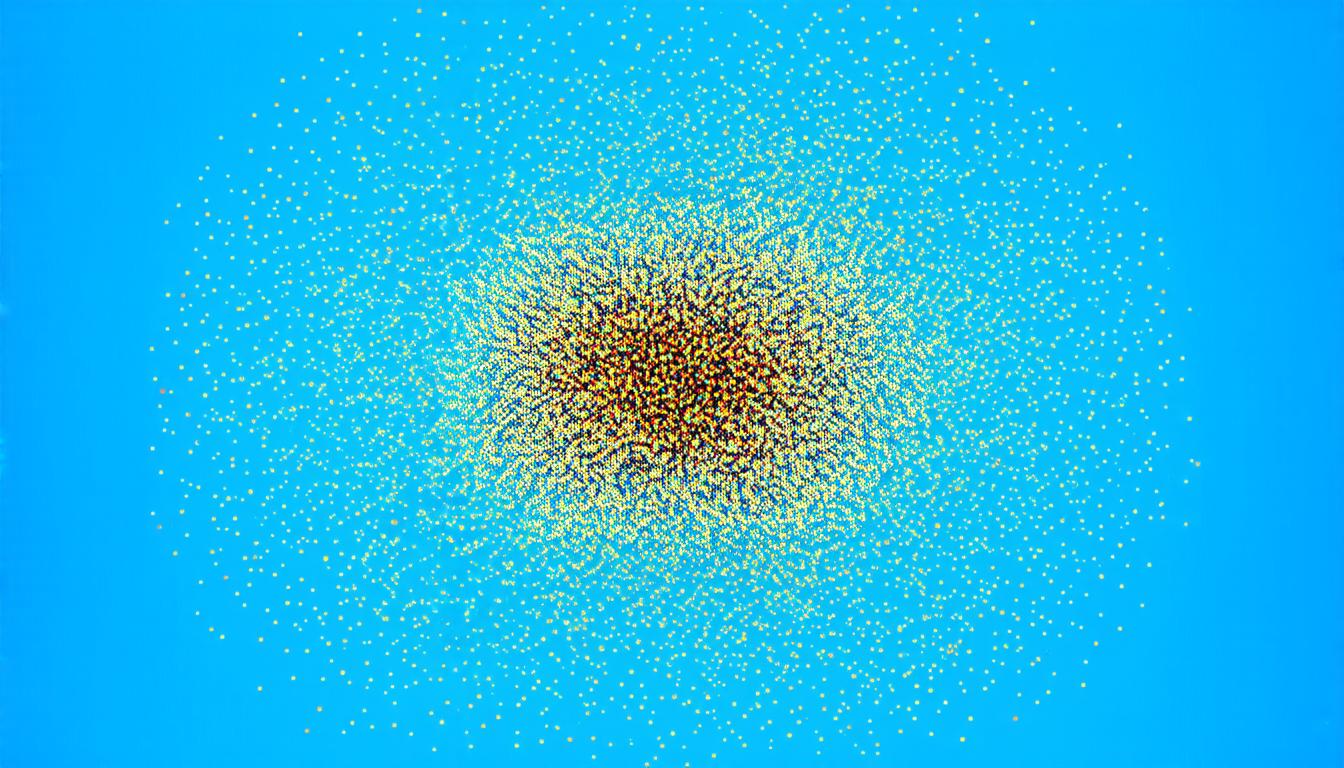
One of the most striking features of this research is its ability to reveal the intricate details of the growth patterns at a microscopic level. The visualizations show how the particles grow and interact with each other in a highly organized manner, creating complex structures that are reminiscent of real-world phenomena like crystal growth or biological cell formation.
The discovery also has important implications for our understanding of the fundamental laws of physics. It provides new insights into the behavior of particles at the atomic level, which could lead to breakthroughs in fields like materials science and energy production.
In addition, the research highlights the importance of interdisciplinary collaboration between mathematicians, physicists, and biologists. By combining their expertise and knowledge, researchers can tackle complex problems that require a deep understanding of multiple disciplines.
Overall, this research is an exciting development in the field of mathematical physics, and it has the potential to lead to new breakthroughs and discoveries in the years to come.
Cite this article: “Unlocking the Secrets of the Hastings-Levitov Process”, The Science Archive, 2025.
Mathematics, Physics, Biology, Materials Science, Energy Production, Hastings-Levitov Process, Aggregation Model, Logarithmic Correlation Function, Complex Systems, Interdisciplinary Research
Reference: Noam Berger, Eviatar B. Procaccia, “Logarithmic fluctuations of Stationary Hastings-Levitov” (2025).





