

Friday 21 March 2025
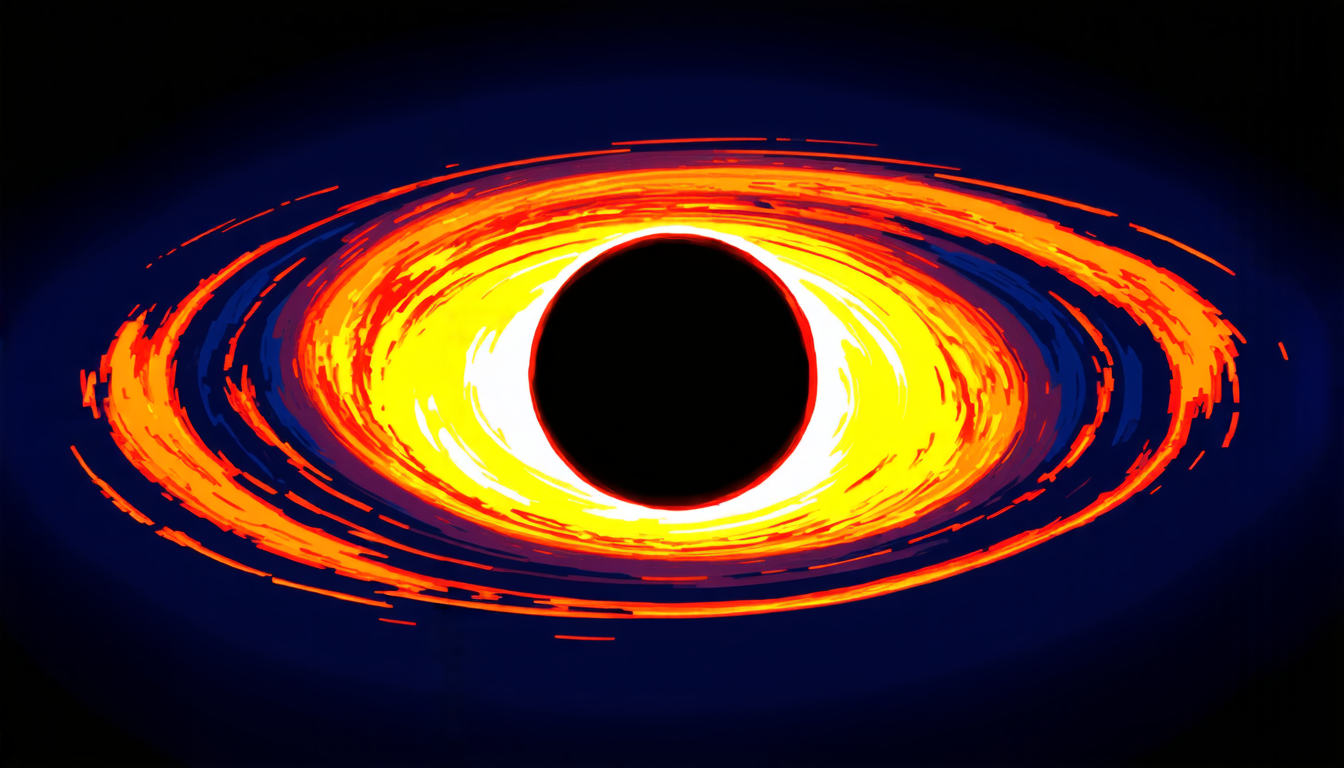
A team of scientists has made a significant discovery in the field of astrophysics, shedding new light on the behavior of black holes and their accretion disks. According to their research, the parameter lambda (λ) plays a crucial role in determining the physical properties of these disks.
In essence, λ is a measure of how much space-time is warped by the presence of mass and energy. The researchers found that as λ increases, the disk becomes hotter and more compact, with higher radiation pressure and faster inward drift velocities. These effects are particularly pronounced near the innermost stable circular orbit (ISCO), where the gravitational pull of the black hole is strongest.
The team used a combination of theoretical models and observational data to explore the impact of λ on accretion disks. They found that smaller values of λ lead to more noticeable eects in the inner disk regions, while larger values result in a more extended disk with lower temperatures and pressures.
One of the key implications of this research is that it provides a new way to test theories of gravity, such as general relativity and modified gravity theories. By comparing the predictions of these theories with observations of accretion disks, scientists can gain insights into the fundamental nature of space-time.
The discovery also has significant implications for our understanding of black hole behavior. Accretion disks are thought to be responsible for many of the energetic phenomena observed in the universe, including quasars and active galactic nuclei. By studying these disks, scientists can learn more about the properties of black holes themselves, such as their spin and mass.
The research was made possible through a combination of theoretical modeling and observational data. The team used computer simulations to model the behavior of accretion disks in different gravitational environments, and then compared their predictions with observations of real black hole systems.
The discovery is an important step forward in our understanding of black holes and accretion disks, and has significant implications for the field of astrophysics as a whole. By studying these phenomena, scientists can gain insights into the fundamental nature of space-time and the behavior of massive objects in the universe.
Cite this article: “Unveiling the Secrets of Black Hole Accretion Disks”, The Science Archive, 2025.
Astrophysics, Black Holes, Accretion Disks, Gravity Theories, General Relativity, Modified Gravity, Space-Time, Quasars, Active Galactic Nuclei, Gravitational Environments





