

Friday 21 March 2025
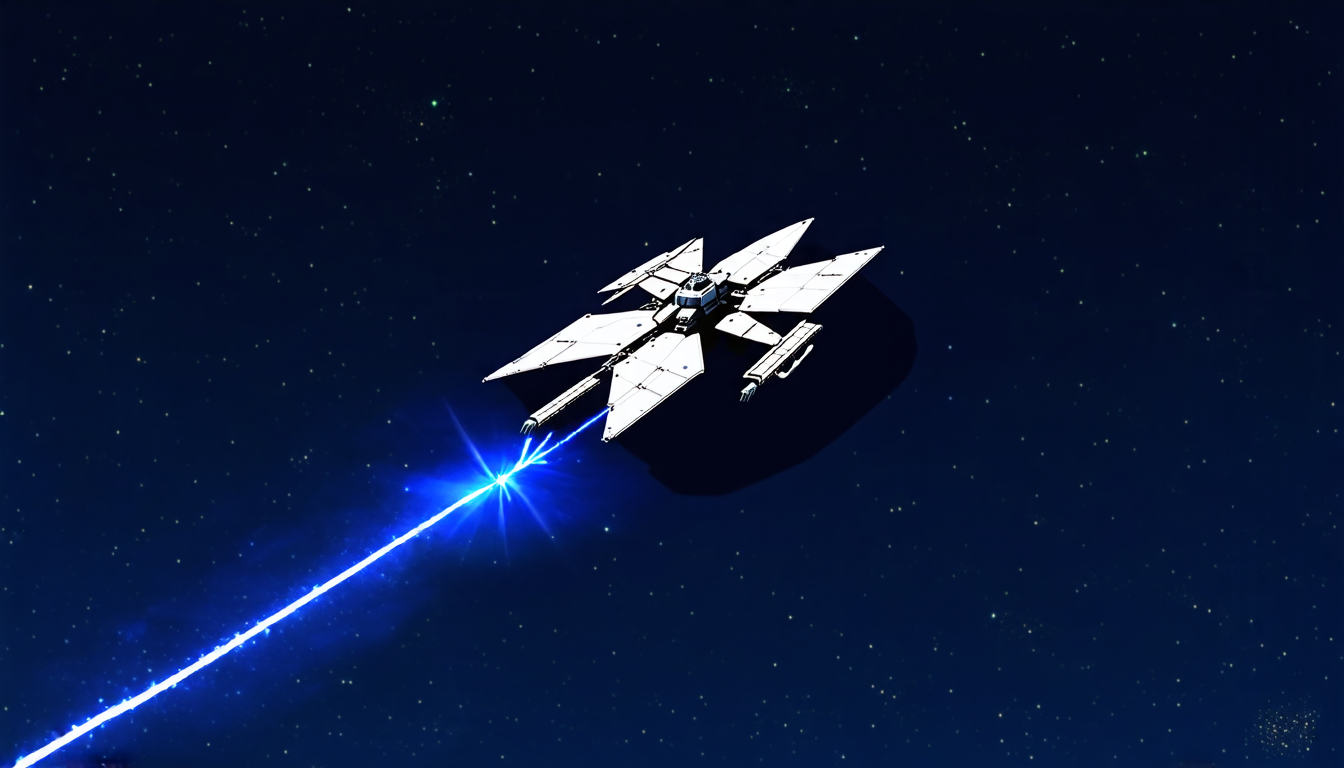
The quest for interstellar travel has long been a topic of fascination and debate. With the Breakthrough Starshot project aiming to send a tiny spacecraft to Proxima Centauri, researchers are delving deeper into the complexities of propelling such small vessels at incredible speeds.
One crucial aspect is the energy required to accelerate these mini-mirrors, as they are often referred to. The study reveals that the commonly cited formula for calculating this energy is actually an approximation, and a more accurate approach is needed.
The researchers have derived two formulas for estimating the laser energy necessary to propel the spacecraft. However, it’s the second formula that provides a more precise calculation, taking into account the instantaneous velocity of the craft as it changes over time. This is crucial because the speed of the craft affects the frequency and intensity of the photons reflected back.
A key finding is that the difference between the two formulas can result in significant errors, especially when considering large energies or long periods of acceleration. For instance, if a spacecraft were to reach 20% of the speed of light, using the incorrect formula would lead to an overestimation of the required energy by about 45%.
The study also explores the physics behind Einstein’s famous formula for calculating the energy reflected by a moving perfect mirror. While this equation has been widely used in the context of interstellar travel, it is actually limited to specific scenarios and assumes certain conditions that may not be met in practice.
By highlighting these limitations and providing more accurate calculations, the researchers aim to improve our understanding of the challenges involved in propelling small spacecraft at incredible speeds. This knowledge can ultimately inform the development of more e ective propulsion systems and bring us closer to achieving interstellar travel.
The Breakthrough Starshot project is an ambitious endeavor that seeks to send a tiny spacecraft to Proxima Centauri, a nearby star system about 4.24 light-years away. The spacecraft would be propelled by powerful lasers and solar sails, using the pressure of sunlight to accelerate its journey.
While significant advancements have been made in recent years, there are still many hurdles to overcome before such a mission can become a reality. The research presented here is an important step forward, providing a more accurate understanding of the energy requirements for interstellar travel and highlighting areas where further investigation is needed.
Cite this article: “Accurate Calculations for Interstellar Propulsion: Breaking Down the Energy Requirements for Breakthrough Starshot”, The Science Archive, 2025.
Interstellar Travel, Breakthrough Starshot, Laser Energy, Spacecraft Propulsion, Formula Approximation, Photon Reflection, Einstein’S Formula, Perfect Mirror, Interstellar Mission, Solar Sails





