

Friday 21 March 2025
For scientists working on sensitive experiments, one of the biggest hurdles is keeping their equipment clean and free from unwanted radiation. It’s like trying to find a needle in a haystack – but instead of a needle, it’s a tiny particle that can ruin your entire experiment.
Radon, a naturally occurring gas, is particularly troublesome because its decay products can attach themselves to surfaces and remain there for years, emitting background noise that interferes with sensitive measurements. To tackle this problem, researchers have been experimenting with different methods to remove these pesky particles from surfaces.
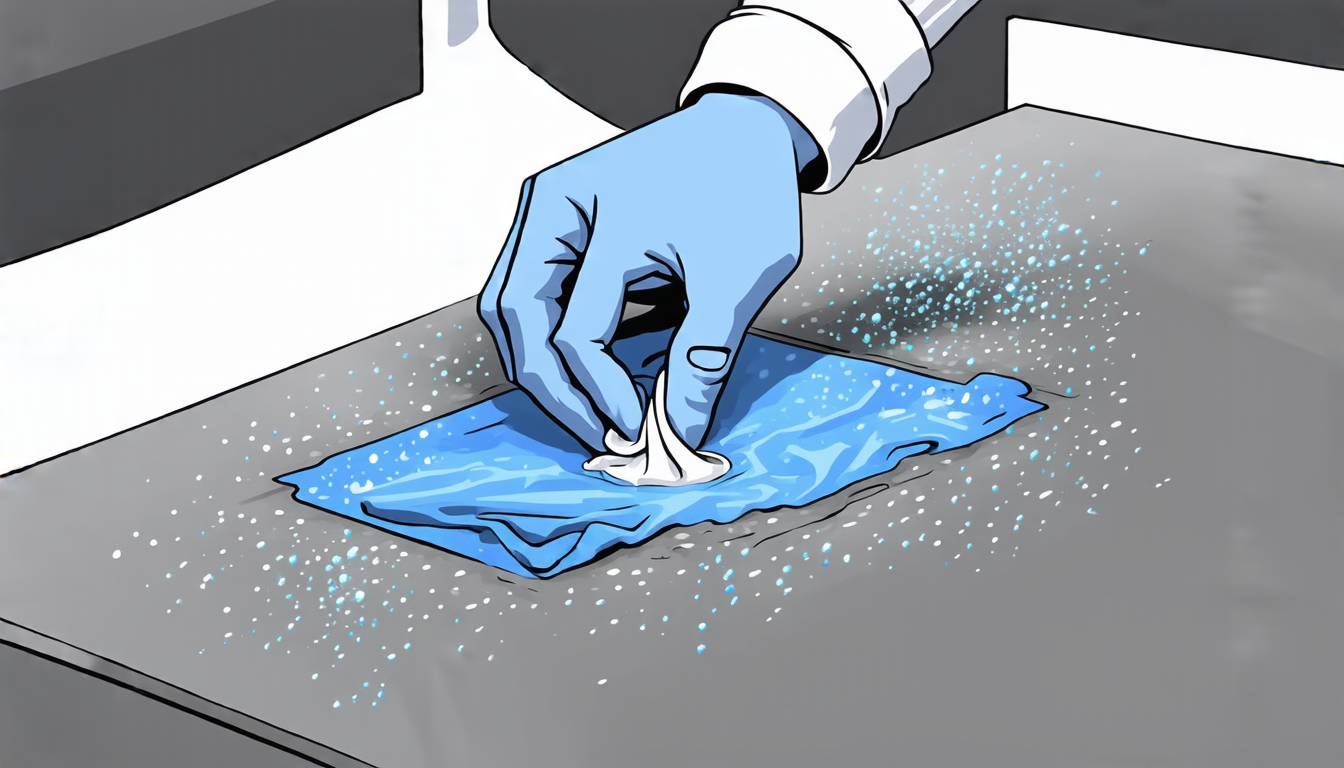
One such method is acetone wiping – simply wiping the surface with a cloth soaked in acetone to remove any attached radon decay products. But how effective is it? A new study published in Journal of Instrumentation has shed some light on this question.
The researchers tested the effectiveness of acetone wiping on copper and silicon surfaces, two common materials used in experimental equipment. They exposed the surfaces to radon gas and then wiped them with acetone-impregnated cloths, measuring how much radiation they emitted before and after cleaning.
To their surprise, the results showed that about half of the radon decay products could be removed from these surfaces using this simple method. But what’s even more impressive is that the removal rate was similar for both copper and silicon – it didn’t matter which material was used, acetone wiping seemed to work just as well.
This finding has important implications for scientists working on sensitive experiments, such as searching for dark matter or neutrinos. By using acetone wiping to remove radon decay products from their equipment, they can significantly reduce the amount of background noise and improve the accuracy of their measurements.
The researchers also found that the removal rate didn’t change much over time – even after repeated cleanings, the surfaces still seemed to be effective at removing radon decay products. This suggests that acetone wiping could be a reliable method for maintaining equipment cleanliness in sensitive experiments.
Of course, there are always limitations to any cleaning method, and this one is no exception. The researchers acknowledge that their results may not apply to all types of materials or surfaces, and further testing will be needed to confirm the effectiveness of acetone wiping in different contexts.
But for now, it’s an exciting development in the quest to improve experimental accuracy and reduce background noise. By using a simple, low-tech method like acetone wiping, scientists can take a significant step towards achieving their research goals – and that’s something to get excited about.
Cite this article: “Acetone Wiping: A Simple yet Effective Method for Removing Radon Decay Products from Surfaces”, The Science Archive, 2025.
Radon, Acetone Wiping, Cleaning Methods, Radiation, Experimental Equipment, Sensitivity, Background Noise, Scientific Research, Dark Matter, Neutrinos
Reference: D. Chernyak, A. Piepke, “Removal of radon progeny from delicate surfaces” (2025).





