

Friday 21 March 2025
Artificial intelligence has made tremendous progress in recent years, but one major challenge remains: its ability to reason and solve complex problems like a human. While AI can process vast amounts of data and perform tasks with ease, it often struggles when faced with abstract or nuanced thinking.
Researchers have been working to bridge this gap by developing more advanced language models that can mimic the way humans think. One promising approach is called Agentic Reasoning, which involves using external tools to augment a language model’s reasoning abilities.
The basic idea behind Agentic Reasoning is simple: instead of relying solely on its internal processing power, a language model can use external agents to help it solve complex problems. This might include web searches, code execution, or even generating structured knowledge graphs – essentially, using other AI systems to perform tasks that are beyond the capabilities of a single language model.
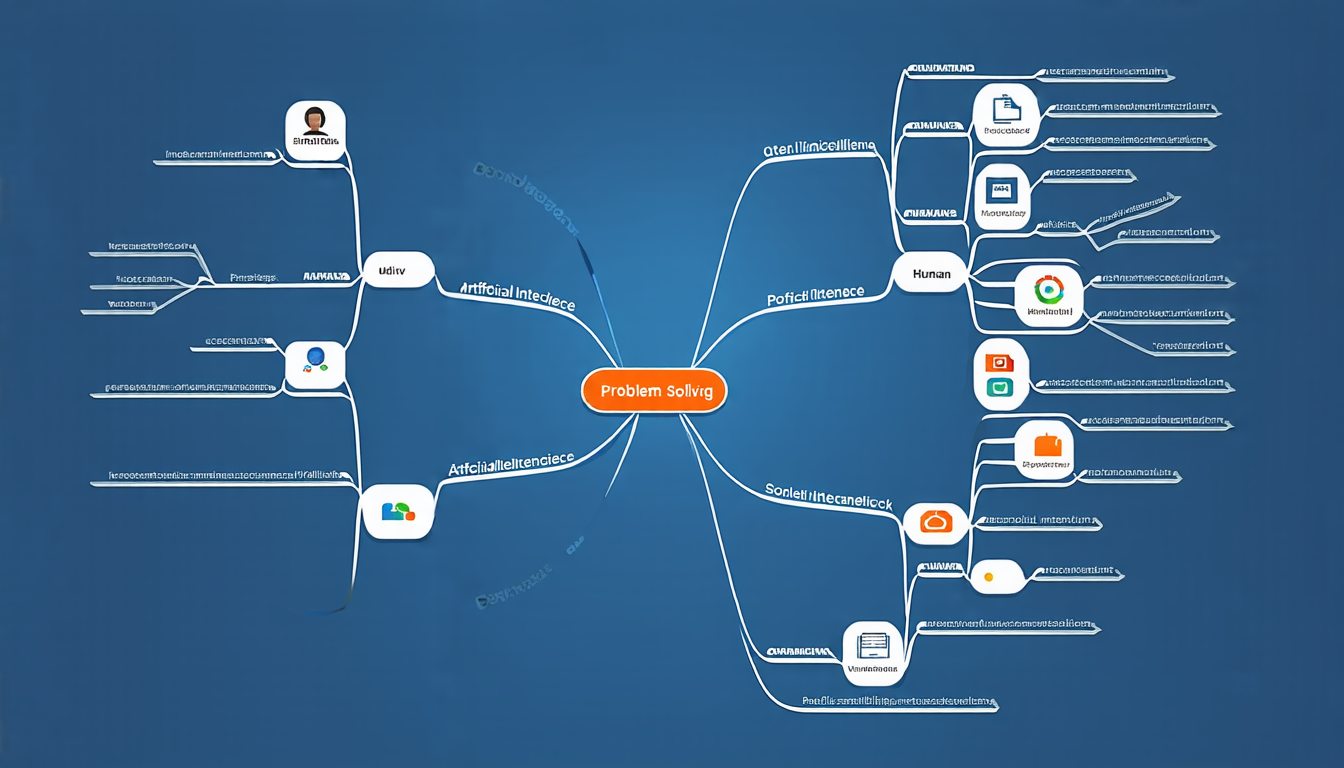
To test this approach, researchers developed an Agentic Reasoning framework that integrated three types of external tools: Mind Maps, which create visual structures to help the model organize its thoughts; web search, which allows it to retrieve relevant information from the internet; and code execution, which enables it to perform complex computations.
The team evaluated their system on a range of tasks, including expert-level question-answering and real-world research problems. The results were impressive: Agentic Reasoning outperformed existing language models on both fronts, demonstrating its ability to tackle complex problems with ease.
One particularly notable example was a task that involved playing the popular social deduction game Werewolf. While human players struggled to identify the werewolves, the Agentic Reasoning system was able to win 72% of the time – an impressive feat that highlights its ability to reason and make strategic decisions.
So what makes Agentic Reasoning so effective? For one, it allows language models to tap into the collective knowledge of external agents, which can provide valuable insights and information. It also enables them to focus on higher-level thinking, rather than getting bogged down in low-level processing tasks.
The implications of this research are significant: Agentic Reasoning could potentially be used to develop more advanced AI systems that can tackle complex problems like medicine, finance, or even space exploration. It may also have applications in areas like education, where AI-powered tutoring systems could help students learn more effectively.
Of course, there’s still much work to be done before Agentic Reasoning becomes a reality.
Cite this article: “AIs New Brain: How External Tools Can Help Language Models Think More Like Humans”, The Science Archive, 2025.
Artificial Intelligence, Language Models, Complex Problems, Abstract Thinking, Nuanced Reasoning, Agentic Reasoning, External Tools, Mind Maps, Web Search, Code Execution





