

Friday 21 March 2025
Deep within a massive galaxy cluster, astronomers have discovered a peculiar phenomenon that sheds new light on the mysterious workings of the universe. The galaxy cluster in question is called Abell 1775, and it’s home to a type of celestial object known as a head-tail radio galaxy.
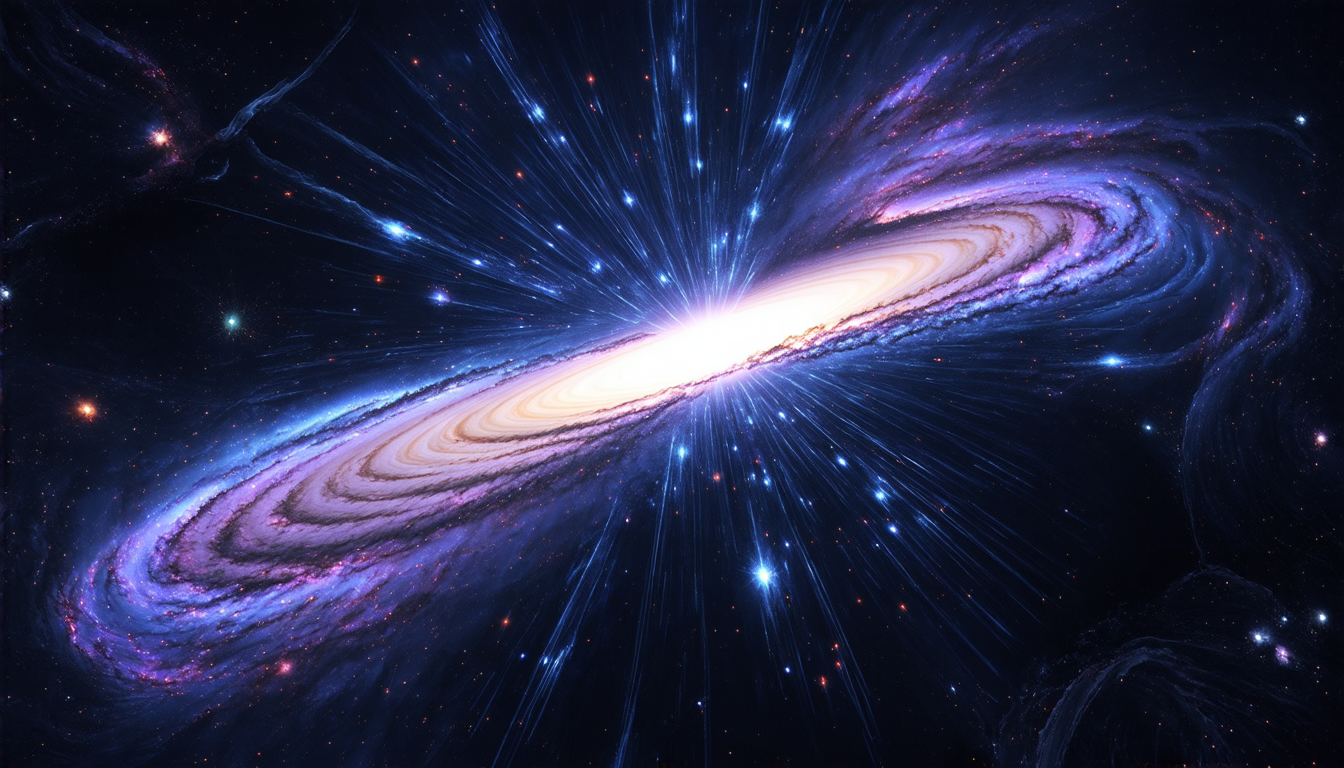
Head-tail radio galaxies are rare and fascinating objects that consist of a bright, elliptical galaxy at their center, surrounded by two long, sweeping jets of energy. These jets can stretch for millions of light-years, emitting intense radiation across the entire electromagnetic spectrum. The unusual thing about Abell 1775 is that its head-tail radio galaxy has an incredibly long tail, stretching over three times farther than any previously observed.
To understand what’s happening here, let’s dive into some basic astronomy. Radio galaxies are formed when a supermassive black hole at the center of a galaxy begins to accrete material from its surroundings. As this material falls towards the black hole, it becomes incredibly hot and dense, emitting intense radiation across all wavelengths. The resulting energy jets can be tens of millions of light-years long, and they’re thought to be responsible for shaping the surrounding environment.
In the case of Abell 1775, astronomers have observed that the head-tail radio galaxy is interacting with the surrounding galaxy cluster in a complex dance. The tail of the radio galaxy appears to be sweeping back through the cluster, causing it to collide with other galaxies and distort their shapes. This process is thought to be responsible for the formation of the long, sinuous structure seen in images of the cluster.
But what’s really remarkable about Abell 1775 is the discovery of two previously unknown filaments of energy within the cluster. These filaments, known as revived fossil plasma, are thought to have been injected into the cluster by the galaxy itself millions of years ago. However, they’ve only recently become visible due to changes in the surrounding environment.
The presence of these filaments provides a unique opportunity for astronomers to study the properties of hot, ionized gas within the cluster. By analyzing the radiation emitted by these filaments, scientists can gain insights into the temperature, density, and composition of the surrounding plasma.
So what does this all mean? The discovery of Abell 1775’s head-tail radio galaxy and revived fossil plasma provides a fascinating window into the complex interactions between galaxies and their surroundings.
Cite this article: “Unveiling the Secrets of Abell 1775: A Galaxy Clusters Cosmic Dance”, The Science Archive, 2025.
Galaxy Cluster, Abell 1775, Head-Tail Radio Galaxy, Supermassive Black Hole, Radio Emission, Jet Formation, Galaxy Interaction, Fossil Plasma, Revived Filaments, Plasma Properties, Astronomical Observations





