

Saturday 22 March 2025
As autonomous vehicles continue to hit the roads, ensuring their safety and reliability is crucial for widespread adoption. One of the key challenges in achieving this is estimating the state of the vehicle – its speed, position, and orientation – in real-time. This information is essential for making decisions about steering, braking, and acceleration.
Researchers have been working on developing more accurate methods for state estimation using various sensors and algorithms. However, a new study has proposed a novel approach that combines machine learning with traditional model-based techniques to improve the accuracy of vehicle state estimation.
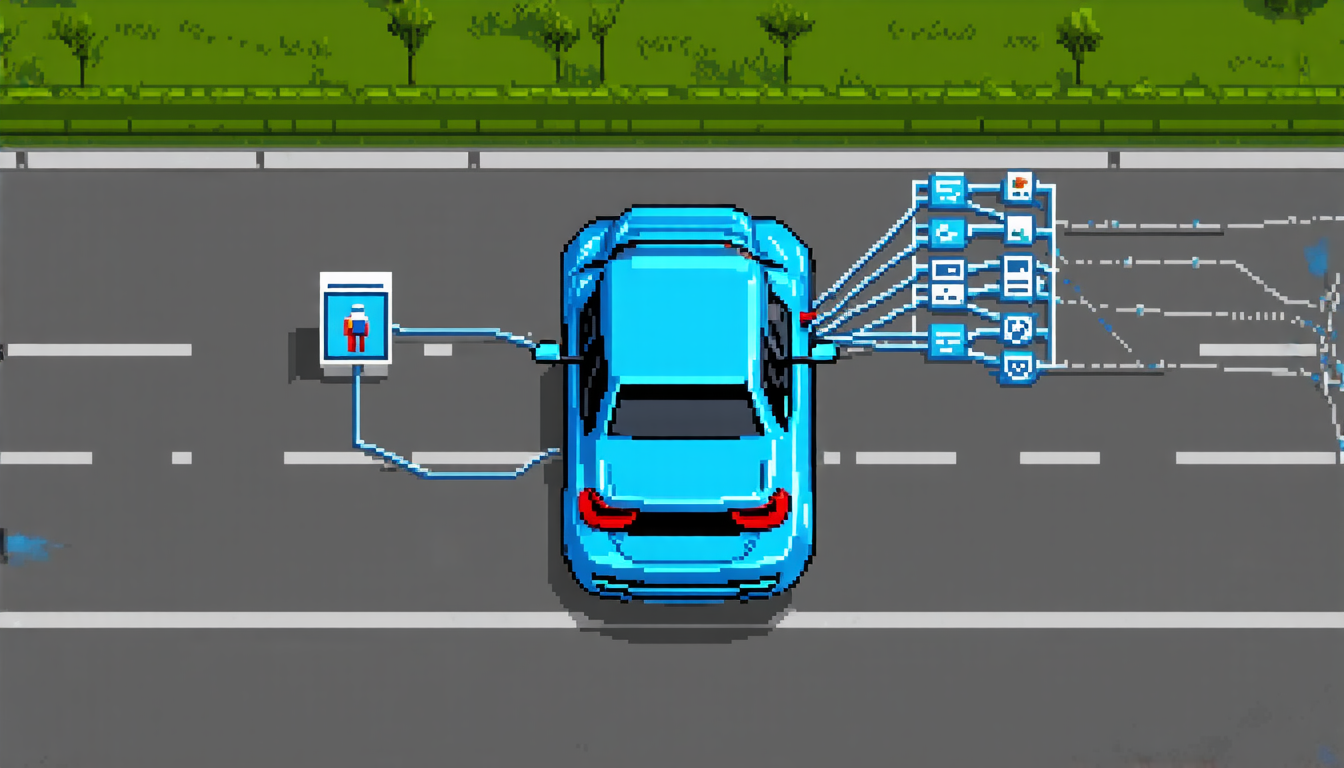
The researchers used a combination of data-driven Kalman filters and neural networks to develop an observer that can accurately estimate the state of the vehicle even in high-acceleration scenarios. The data-driven Kalman filter is a type of algorithm that uses real-world data to improve its estimates, while the neural network provides additional information about the vehicle’s behavior.
The team tested their observer on a range of driving scenarios, including highway cruising and aggressive cornering. In each case, they found that their observer outperformed traditional model-based methods in terms of accuracy and reliability.
One of the key benefits of this approach is its ability to adapt to changing road conditions and vehicle dynamics. Unlike traditional methods, which can become less accurate when faced with unexpected events, the data-driven Kalman filter can learn from new data and adjust its estimates accordingly.
The researchers believe that their observer has significant implications for the development of autonomous vehicles. By providing more accurate state estimation, it could enable vehicles to make better decisions about steering and braking, leading to improved safety and reliability.
Furthermore, the approach is not limited to vehicle state estimation. The same techniques could be applied to other areas where real-time data is critical, such as robotics or medical devices.
The development of this observer highlights the importance of collaboration between researchers from different fields. By combining expertise in machine learning, control theory, and vehicle dynamics, the team was able to develop a more accurate and reliable method for state estimation.
As autonomous vehicles continue to evolve, it’s likely that we’ll see even more innovative approaches to improving their safety and reliability. But for now, this observer provides an exciting glimpse into the future of autonomous driving.
Cite this article: “Accurate State Estimation for Autonomous Vehicles Using Machine Learning and Kalman Filters”, The Science Archive, 2025.
Autonomous Vehicles, State Estimation, Machine Learning, Kalman Filters, Neural Networks, Vehicle Dynamics, Robotics, Medical Devices, Real-Time Data, Control Theory





