

Saturday 22 March 2025
Scientists have long been fascinated by the Mpemba effect, a phenomenon where hot water freezes faster than cold water. It’s a curious observation that has sparked debate and research for decades. Now, a new study sheds light on this enigmatic process, revealing surprising insights into the world of phase transitions.
The researchers began by studying active matter systems, which are collections of particles or objects that move and interact with each other. These systems can exhibit complex behaviors, such as clustering and ordering, which are crucial for understanding many natural phenomena. By analyzing these systems, scientists can gain a deeper understanding of how materials behave under different conditions.
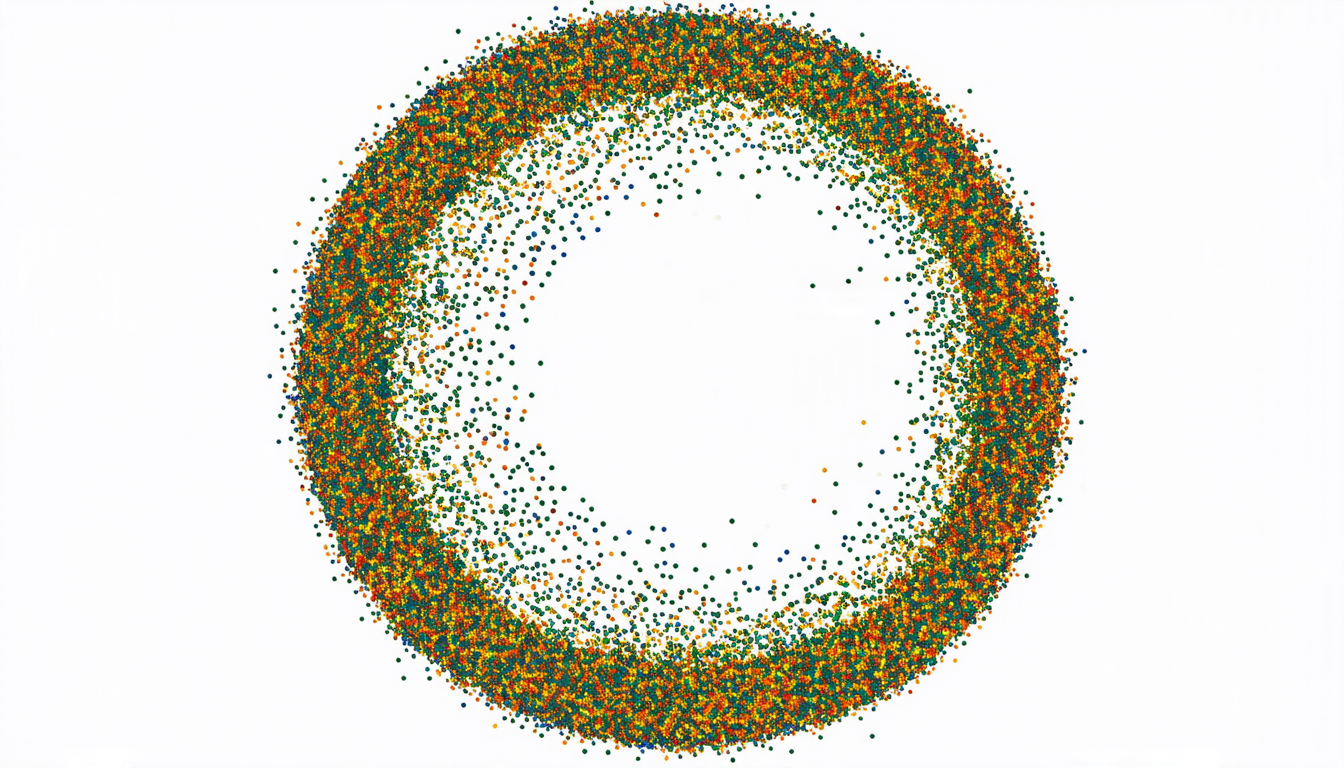
The researchers used computer simulations to study the behavior of active matter systems undergoing phase transitions. A phase transition is a sudden change in the properties of a material, such as its temperature or density, that occurs when it reaches a critical point. In this case, the team focused on the Vicsek model, which describes the collective motion of self-propelled particles.
Their simulations revealed an intriguing result: when initial states have higher noise strengths, the system reaches the new steady state faster. This means that if you start with a more disordered system, it will evolve towards order faster than one that is already well-ordered. This phenomenon contradicts our intuitive understanding of phase transitions and has important implications for many fields.
The researchers also found that the initial correlation length plays a crucial role in determining the rate at which the system evolves. The correlation length refers to the distance over which particles or objects are correlated with each other. When this length is shorter, the system tends to reach its final state faster. This result highlights the importance of considering the initial conditions when studying phase transitions.
These findings have significant implications for our understanding of many natural phenomena, from the behavior of water to the movement of crowds. They also suggest that there may be more to the Mpemba effect than previously thought, and that this phenomenon could be an example of a larger class of phase transitions that are influenced by initial conditions.
The study’s results have sparked new questions and avenues for research. For instance, scientists are eager to explore how these findings might apply to other systems, such as granular materials or biological organisms. They also hope to better understand the underlying mechanisms driving this behavior, which could lead to breakthroughs in fields like materials science and biophysics.
In the end, this study serves as a reminder of the power of scientific inquiry and the importance of questioning our assumptions about the world around us.
Cite this article: “Unraveling the Mpemba Effect: New Insights into Phase Transitions”, The Science Archive, 2025.
Mpemba Effect, Phase Transitions, Active Matter Systems, Vicsek Model, Noise Strengths, Initial Conditions, Correlation Length, Collective Motion, Self-Propelled Particles, Scientific Inquiry.





