

Sunday 23 March 2025
Scientists have made a significant breakthrough in understanding how objects oscillate, or move back and forth, when they’re subjected to different types of friction. Friction is the force that opposes motion between two surfaces that are in contact with each other.
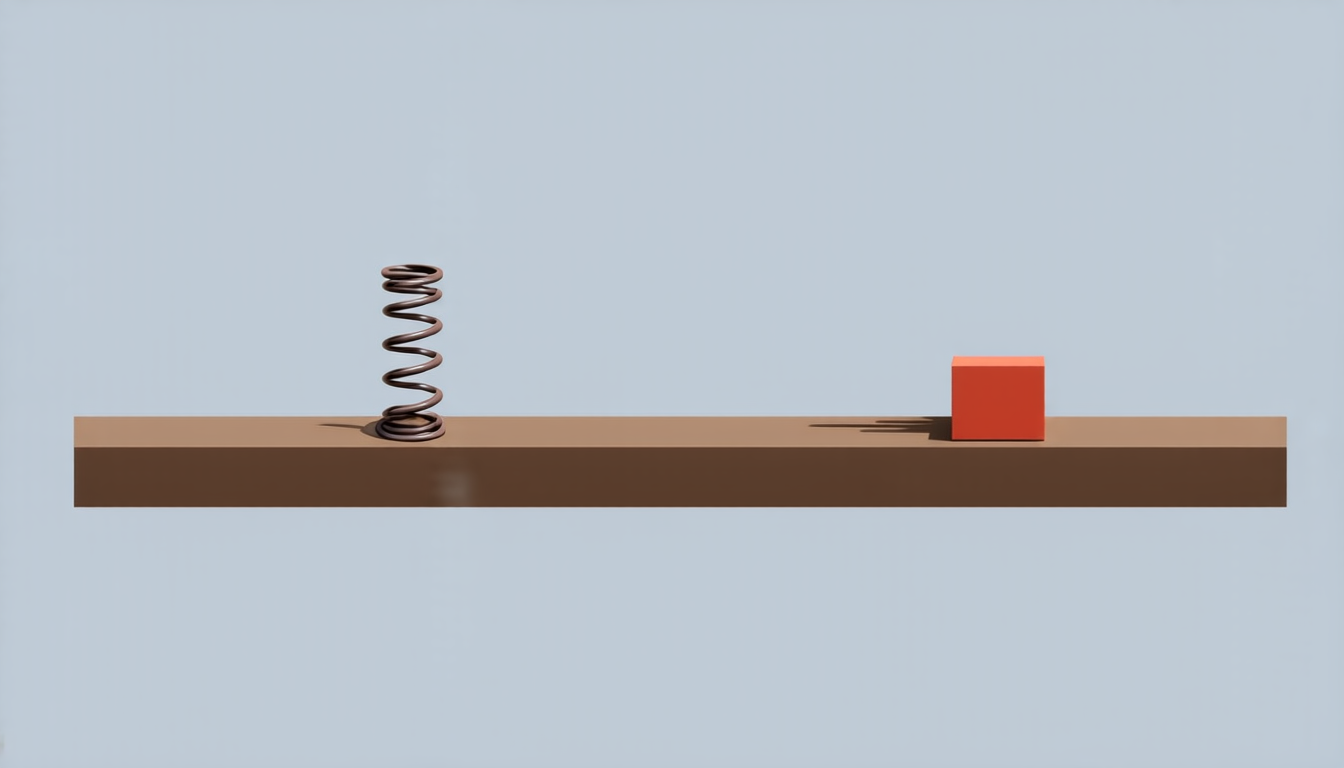
The researchers studied a simple system called a harmonic oscillator, which consists of a mass attached to a spring. When you pluck the spring, the mass starts oscillating, or moving back and forth. The team wanted to see how different types of friction would affect these oscillations.
They found that when there’s constant friction, like the kind you’d feel if you were sliding a block across a surface, the oscillator will eventually come to a stop. But what’s interesting is that the rate at which it slows down depends on the strength of the friction.
The scientists also looked at linear friction, where the force of friction increases in proportion to the velocity of the oscillator. This type of friction can be seen in systems like gears or bearings. They discovered that under these conditions, the oscillator will also eventually come to a stop, but the rate of slowing down is different from when there’s constant friction.
But things get really interesting when they introduced quadratic friction, where the force of friction increases in proportion to the square of the velocity of the oscillator. This type of friction can be seen in systems like air resistance or the drag on an object moving through water. The team found that under these conditions, the oscillator doesn’t necessarily come to a stop – instead, it will settle into a steady oscillation.
These findings have important implications for understanding real-world systems where friction plays a crucial role. For example, they could help engineers design more efficient gearboxes or improve the performance of aircraft by optimizing their shape and surface texture to reduce air resistance.
One of the most exciting aspects of this research is that it shows how different types of friction can interact with each other in complex ways. This has significant implications for understanding how systems behave in real-world situations, where multiple forces are often at play.
The researchers used a combination of mathematical modeling and computer simulations to study the behavior of their system. They found that their analytical solutions matched perfectly with numerical simulations, giving them confidence in their findings.
This research is a great example of how scientists can use simple systems like harmonic oscillators to gain insights into complex phenomena.
Cite this article: “Unraveling the Interplay between Friction and Oscillation”, The Science Archive, 2025.
Friction, Oscillation, Harmonic Oscillator, Spring, Mass, Constant Friction, Linear Friction, Quadratic Friction, Air Resistance, Drag





