

Monday 24 March 2025
In the quest for more efficient and effective ways of teaching robots, researchers have been exploring the potential of large language models (LLMs) in robotic task planning. These LLMs are capable of processing vast amounts of data and generating human-like responses to complex questions.
To better understand how these models can be used in robotics, a team of scientists has developed a novel framework that integrates multimodal perception with reasoning capabilities. This integration enables robots to not only recognize objects and scenes but also reason about the actions required to perform tasks.
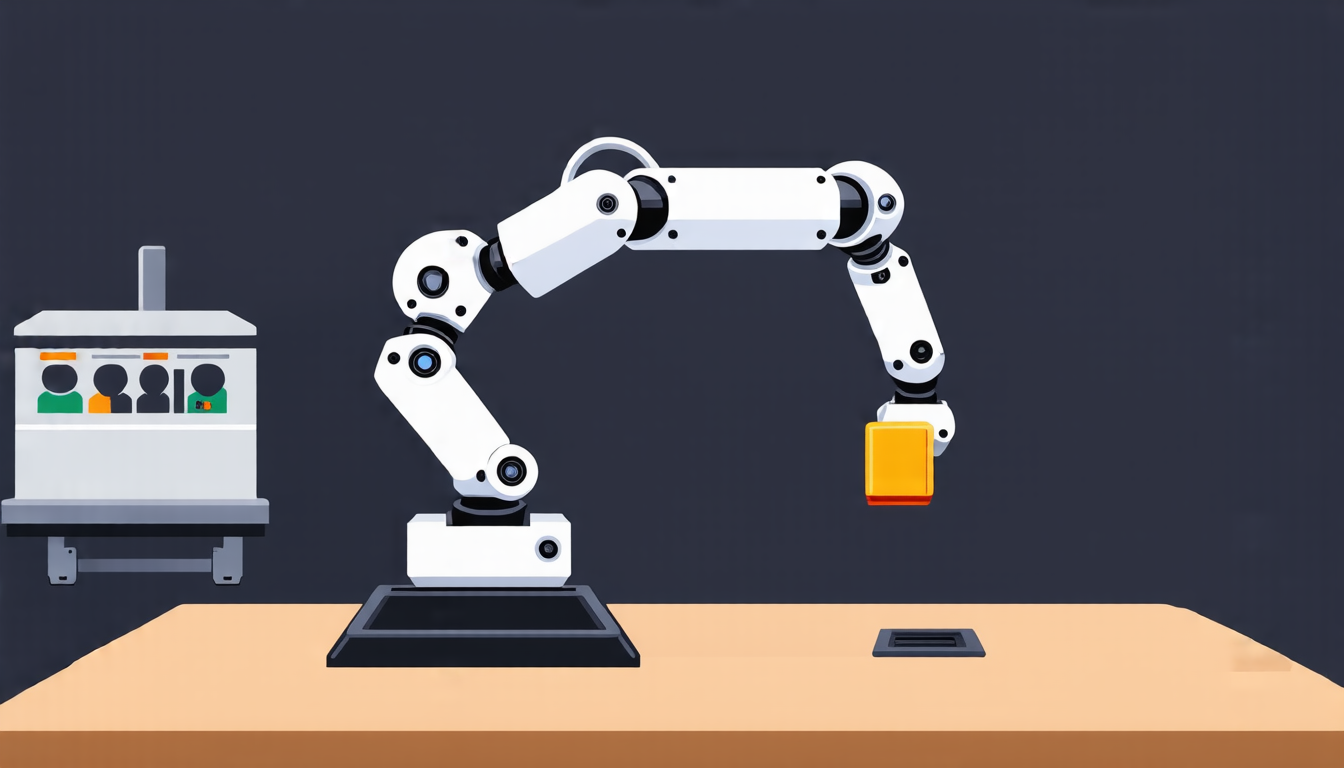
The framework is designed to work in conjunction with a robotic arm, using camera and lidar sensors to gather data on its environment. The LLM is then used to analyze this data and generate a task plan, which includes specific instructions for the robot to follow.
One of the key advantages of this approach is its ability to handle complex tasks that require multiple steps and interactions with the environment. For example, a robot might need to move an object from one location to another, or perform a series of actions in a specific order.
To test the effectiveness of their framework, the researchers designed a series of experiments in which a robotic arm was tasked with performing various tasks, such as picking up objects and placing them on a table. The results showed that the LLM-based approach outperformed traditional methods in terms of efficiency and accuracy.
The team’s work has significant implications for the development of robots capable of performing complex tasks in real-world environments. By leveraging the power of large language models, researchers may be able to create robots that are more adaptable, flexible, and effective in a wide range of applications, from manufacturing and logistics to healthcare and education.
Moreover, this technology can also be applied to other areas such as autonomous driving, where self-driving cars can understand and respond to complex traffic scenarios. The potential is vast, and it will be exciting to see how these advancements shape the future of robotics and artificial intelligence.
The researchers’ approach has also sparked new avenues for research in multimodal learning, where machines learn to process and integrate different types of data such as text, images, and audio. This could lead to even more sophisticated robots capable of understanding and responding to a wide range of cues from their environment.
As the field continues to evolve, it will be fascinating to see how these advancements are applied in real-world scenarios and how they shape our understanding of artificial intelligence and its potential applications.
Cite this article: “Unlocking Complex Robotics with Large Language Models”, The Science Archive, 2025.
Robotics, Artificial Intelligence, Large Language Models, Task Planning, Multimodal Perception, Reasoning Capabilities, Robotic Arm, Camera Sensors, Lidar Sensors, Autonomous Systems





