

Wednesday 26 March 2025
The quest for a deeper understanding of gravitational waves has led scientists to develop innovative methods for analyzing these cosmic phenomena. A recent study published in Physical Review D demonstrates a novel approach to hierarchical Bayesian inference, allowing researchers to extract more accurate information from large datasets.
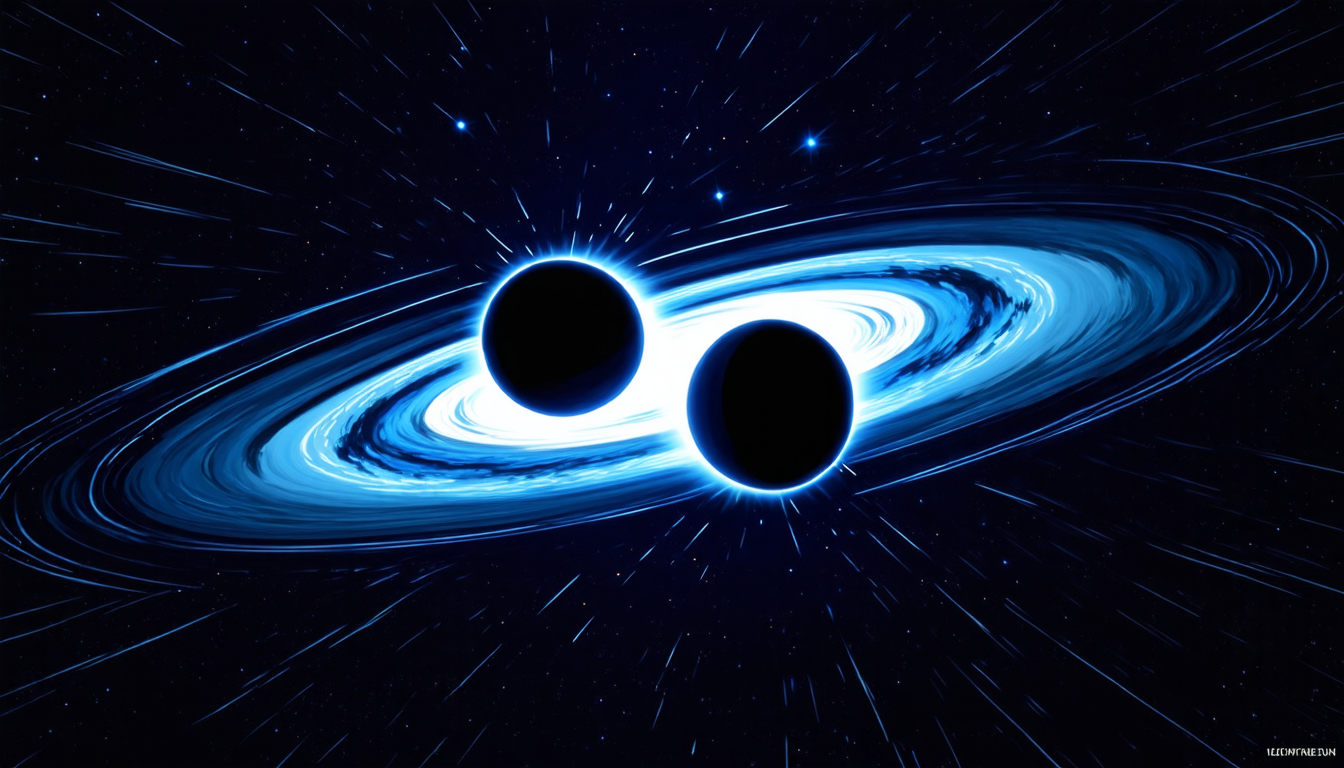
Gravitational waves are ripples in spacetime produced by violent cosmic events, such as the collision of two black holes or neutron stars. Detecting and characterizing these waves is crucial for understanding the universe’s most violent and energetic processes. However, the signals are extremely weak and often buried beneath noise and instrumental errors.
To extract meaningful information from gravitational wave data, scientists employ Bayesian inference techniques. These methods involve using statistical models to describe the likelihood of different events and then combining those probabilities with prior knowledge to estimate the population properties. The challenge lies in balancing the complexity of these models against the limited amount of available data.
The new study introduces a novel approach to hierarchical Bayesian inference, which involves sampling the full parameter space of individual events and their correlations. This method allows researchers to capture the intricate relationships between different parameters, such as the masses and spins of binary black holes.
The authors applied this technique to a set of simulated gravitational wave signals, mimicking the data expected from current and future detectors like LIGO and Virgo. By analyzing these simulations, they demonstrated that their approach can recover population properties with higher accuracy than traditional methods.
One key advantage of this new method is its ability to handle complex models with many free parameters. In traditional Bayesian inference, researchers often simplify their models by marginalizing over certain parameters or assuming specific distributions. However, these simplifications can lead to inaccurate results and a loss of information.
In contrast, the novel approach presented in this study allows for a more nuanced understanding of gravitational wave sources. By directly sampling the full parameter space, researchers can capture subtle correlations between different parameters that might be lost through marginalization.
The implications of this research are significant for the field of gravitational wave astronomy. As detectors continue to improve and collect more data, scientists will need sophisticated methods to extract meaningful information from these signals. The novel approach presented in this study provides a powerful tool for achieving this goal, paving the way for more accurate and detailed studies of cosmic phenomena.
In the future, researchers can expect to apply this technique to real gravitational wave datasets, providing new insights into the properties of binary black holes and other cosmic sources.
Cite this article: “Unveiling Hierarchical Bayesian Inference in Gravitational Wave Astronomy”, The Science Archive, 2025.
Gravitational Waves, Bayesian Inference, Hierarchical Modeling, Parameter Estimation, Gravitational Wave Astronomy, Ligo, Virgo, Binary Black Holes, Neutron Stars, Astrophysics





