

Wednesday 26 March 2025
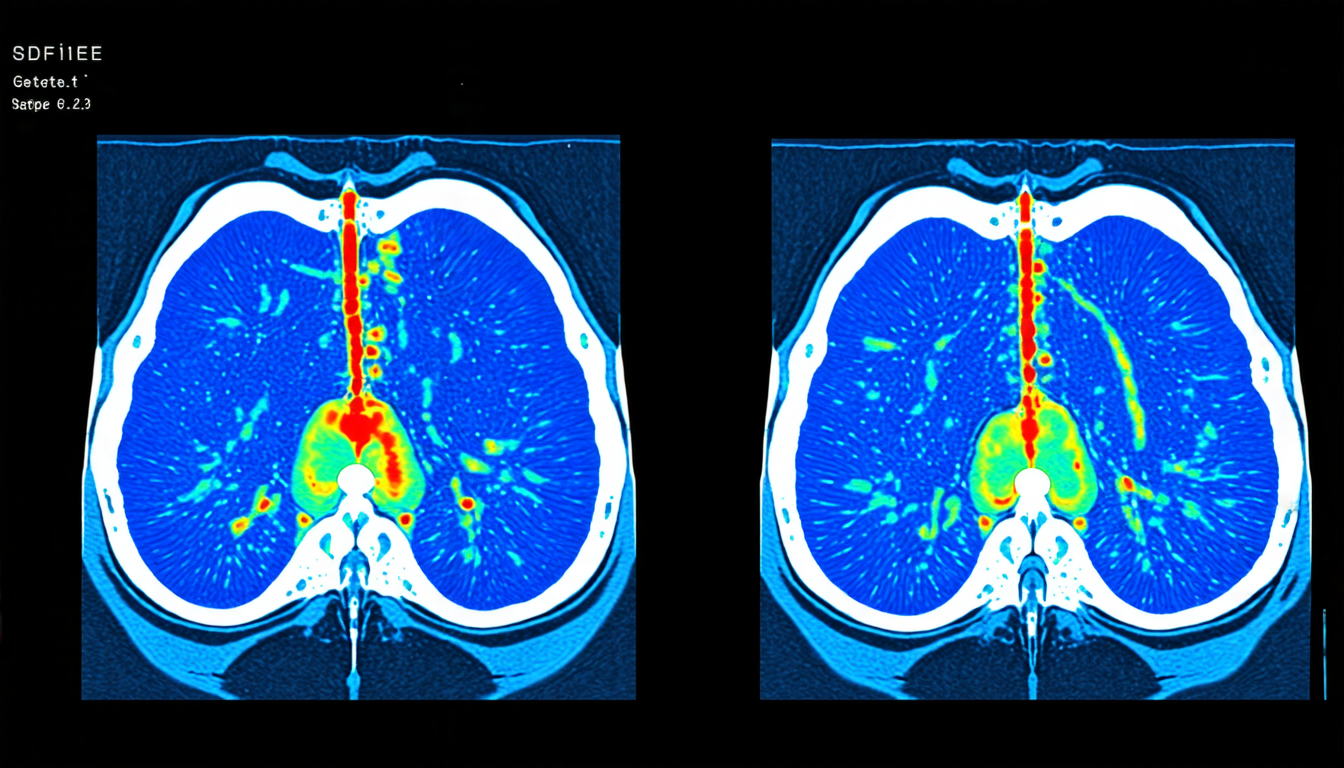
The quest for accurate medical imaging has long been a challenge, especially when it comes to computed tomography (CT) scans. Limited-angle CT scans, in particular, have been plagued by artifacts and noise, making it difficult to produce high-quality images from incomplete data sets. However, researchers have now developed a novel approach that uses deep learning algorithms to reconstruct images from these limited-angle scans with unprecedented accuracy.
The traditional method of CT scanning involves rotating an X-ray source around the patient’s body while capturing multiple projections. This process allows for a complete reconstruction of the image, but it requires a full 180-degree rotation, which isn’t always feasible or practical in certain medical settings. Limited-angle CT scans, on the other hand, only capture a fraction of this data, resulting in incomplete and often distorted images.
To address this issue, researchers have turned to deep learning algorithms, specifically convolutional neural networks (CNNs). By training these networks on large datasets of CT scans, they can learn to recognize patterns and relationships between the limited-angle projections and the complete image. This allows them to generate high-quality reconstructions from incomplete data sets.
The new approach uses a combination of techniques, including sinogram filtering, total variation regularization, and patch similarity regularization. Sinogram filtering helps to reduce noise and artifacts in the projection data, while total variation regularization encourages the reconstruction to be smooth and continuous. Patch similarity regularization, on the other hand, ensures that the reconstructed image resembles the original image by comparing patches of the image with corresponding patches from the training dataset.
The results are impressive: the new approach can produce high-quality reconstructions from limited-angle scans with accuracy comparable to that of full-angle CT scans. In fact, it outperforms traditional methods in many cases, particularly when dealing with complex structures and noisy data.
The implications of this research are significant for medical imaging and beyond. With the ability to reconstruct images from limited-angle scans, doctors can now quickly and accurately diagnose a wide range of conditions without having to perform full-angle CT scans. This could be especially important in emergency situations where every minute counts.
Furthermore, this technology has potential applications beyond medical imaging. By applying similar techniques to other areas such as seismic imaging, materials science, or even astronomy, researchers could potentially unlock new insights and discoveries.
In the future, it will be interesting to see how this technology is refined and applied in real-world settings. As with any new innovation, there are likely to be challenges and limitations that need to be addressed.
Cite this article: “Revolutionizing Medical Imaging: Deep Learning Algorithms Reconstruct High-Quality Images from Limited-Angle CT Scans”, The Science Archive, 2025.
Computed Tomography, Deep Learning, Medical Imaging, Convolutional Neural Networks, Limited-Angle Scans, Image Reconstruction, Sinogram Filtering, Total Variation Regularization, Patch Similarity Regularization, Artificial Intelligence





