

Wednesday 26 March 2025
Photonic waveguide arrays have been a staple of integrated photonics for decades, but their limitations have long hindered their potential for complex applications like optical quantum computing and photonic neural networks. The lack of reconfigurability has made them inflexible, restricting their use to simple tasks like light propagation studies.
Recently, however, programmable waveguide arrays (PWAs) have emerged as a promising solution to overcome these limitations. By allowing the manipulation of light pathways in real-time, PWAs can enable complex operations that were previously impossible with traditional waveguides.
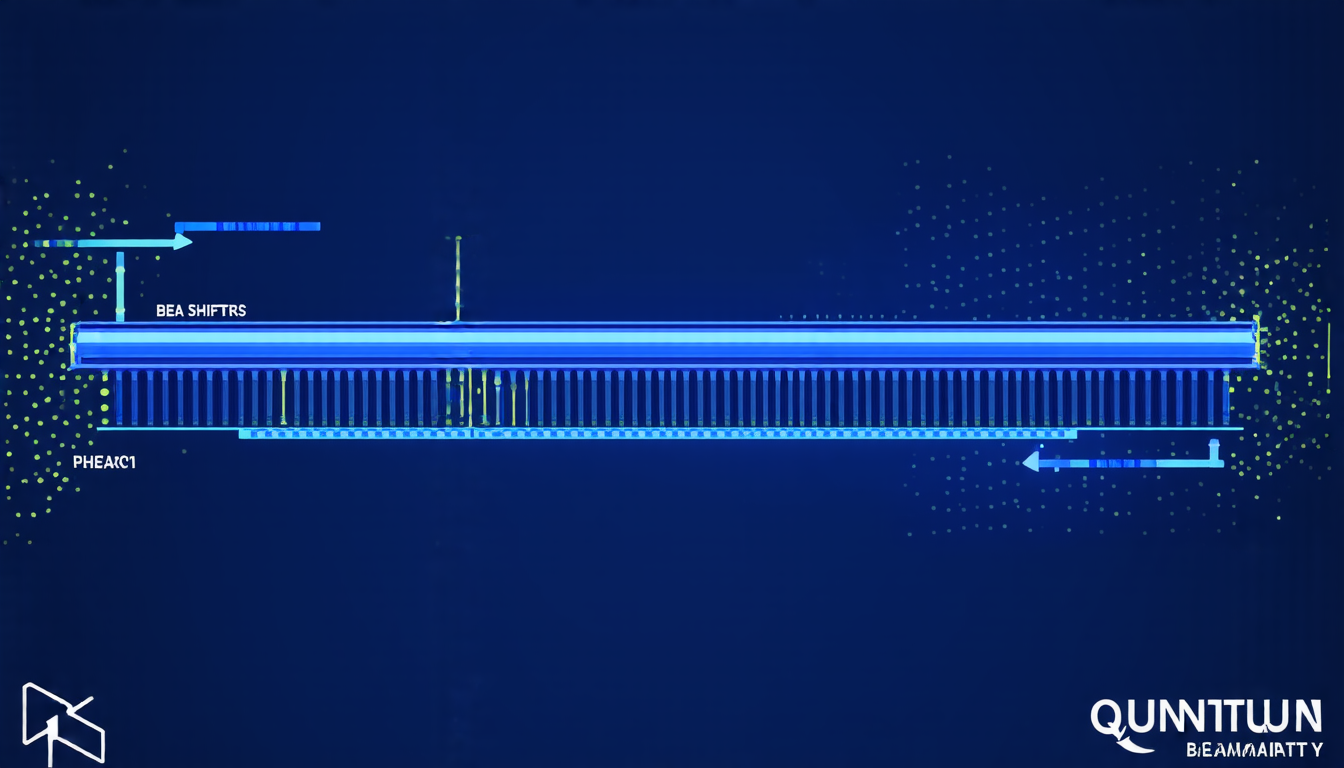
The development of PWAs has been driven by advancements in programmable photonic circuits, which enable the implementation of diverse functions within a single device. These devices primarily use mesh structures based on Mach-Zehnder interferometers (MZI), relying on balanced 2×2 beam splitters and phase shifters, adapted from free-space optics.
The key to PWAs lies in their ability to dynamically reconfigure the light pathways, enabling the implementation of complex operations like quantum computing and photonic neural networks. This is achieved through the use of programmable components like phase shifters and beam splitters, which can be adjusted in real-time to alter the light path.
One potential application of PWAs is in boson sampling, a process that simulates the behavior of particles in complex systems. By using PWAs to manipulate the light pathways, researchers can simulate the behavior of particles in complex systems like quantum many-body systems or condensed matter physics.
Another potential application is in photonic neural networks, which mimic the structure and function of biological neurons. PWAs could be used to create programmable photonic circuits that can learn and adapt to new patterns and inputs, enabling applications like image recognition and data analysis.
While PWAs are still a relatively new technology, their potential for complex operations has already been demonstrated in several experiments. For example, researchers have used PWAs to simulate the behavior of particles in quantum many-body systems and to create programmable photonic circuits that can learn and adapt to new patterns.
The development of PWAs is an exciting step towards creating more complex and versatile photonic devices. By enabling real-time manipulation of light pathways, PWAs could open up a wide range of possibilities for applications like optical quantum computing, photonic neural networks, and boson sampling.
Cite this article: “Programmable Waveguide Arrays: Unlocking Complex Photonic Operations”, The Science Archive, 2025.
Photonic Waveguide Arrays, Programmable Waveguide Arrays, Quantum Computing, Photonic Neural Networks, Boson Sampling, Mach-Zehnder Interferometers, Phase Shifters, Beam Splitters, Free-Space Optics, Mesh Structures





