

Wednesday 26 March 2025
Scientists have long been fascinated by the ability of robots to navigate and understand their surroundings. One major challenge in achieving this is the need for precise calibration between different sensors on the robot, such as cameras and lidars. A new paper proposes a novel solution to this problem, using geometric features extracted from raw lidar scans to calibrate the system.
The proposed method, called LiMo-Calib, takes advantage of the fact that many real-world environments contain planar surfaces, such as walls or floors. By analyzing these surfaces and identifying corresponding points between different scans, the system can estimate the relative position and orientation of the sensors. This information is then used to calibrate the system, allowing it to more accurately perceive its surroundings.
One of the key challenges in this approach is dealing with noise and irregularities in the lidar data. To overcome this, LiMo-Calib uses a combination of normal homogenization and planarity weighting to select high-quality features for calibration. Normal homogenization reduces the impact of points that are over-represented due to similar orientations, while planarity weighting prioritizes planes with good fits.
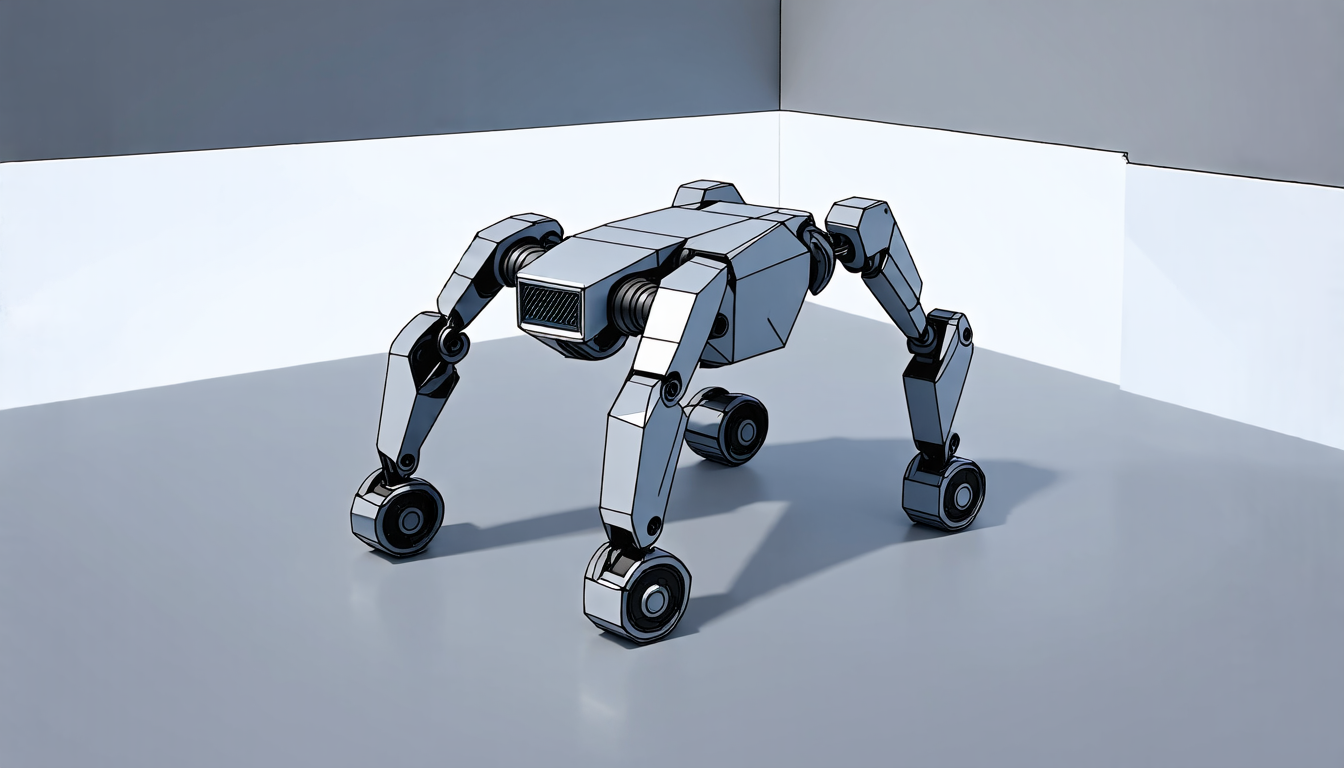
The authors tested LiMo-Calib on a motorized lidar system mounted on a quadruped robot, using three different test sites with varying levels of complexity. The results show that LiMo-Calib significantly outperforms traditional calibration methods in terms of accuracy and efficiency. In one test site, the method achieved an average plane fitting error of just 1.09 millimeters, compared to 4.84 millimeters without calibration.
The implications of this research are significant for the development of autonomous robots that can navigate complex environments. By allowing these systems to accurately perceive their surroundings, LiMo-Calib could enable them to make more informed decisions and avoid obstacles with greater ease. The method also has potential applications in fields such as surveying and mapping, where precise calibration is critical.
Overall, LiMo-Calib represents an important step forward in the development of autonomous robots and sensor systems. By leveraging geometric features extracted from raw lidar scans, it offers a powerful tool for calibrating complex sensors and enabling more accurate perception of the environment. As researchers continue to push the boundaries of what is possible with these technologies, LiMo-Calib is likely to play an important role in shaping the future of robotics and beyond.
Cite this article: “Accurate Sensor Calibration Enables Precise Perception in Autonomous Robots”, The Science Archive, 2025.
Lidar, Robot Calibration, Geometric Features, Sensor Fusion, Autonomous Robotics, Computer Vision, Machine Learning, Planar Surfaces, Normal Homogenization, Planarity Weighting





