

Wednesday 26 March 2025
Scientists have been working on a way to compare two different distributions of data, which is a fundamental task in many fields such as medicine and finance. This problem has been around for decades, but it’s only recently that researchers have made significant progress.
The key challenge lies in the fact that these distributions can be extremely high-dimensional, meaning they contain thousands or even millions of variables. In such cases, traditional methods become impractical because they require estimating both distributions separately, which is computationally expensive and often yields unreliable results.
To overcome this hurdle, researchers have developed a method called Kullback-Leibler Importance Estimation Procedure (KLIEP). It’s a clever way to estimate the difference between two distributions by minimizing a specific loss function. The idea is to find a set of parameters that best describe how the two distributions differ from each other.
However, there’s a catch. The KLIEP method can be prone to non-existence issues, which means that the estimated parameters may not always exist or may not be unique. This problem arises when the tuning parameter, which is used to regularize the loss function, is too small.
To address this issue, researchers have proposed an elastic net penalty, which adds a new term to the loss function. This modification ensures that the minimizer always exists and provides better estimation results.
The idea behind the elastic net penalty is simple: it combines both ℓ1 (Lasso) and ℓ2 (Ridge) penalties in a single loss function. The ℓ1 penalty helps to eliminate unimportant variables, while the ℓ2 penalty reduces overfitting. By combining these two penalties, the elastic net penalty provides a more robust and efficient way to estimate the difference between two distributions.
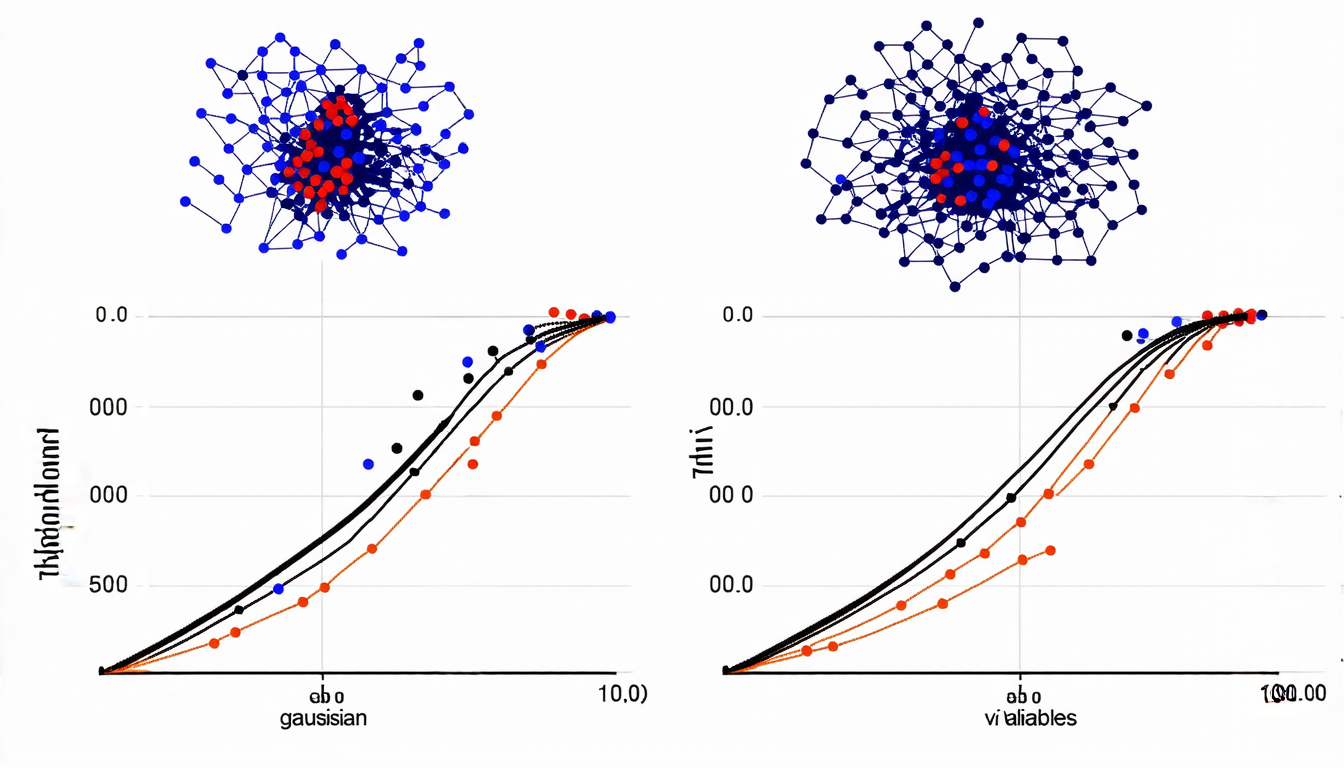
The researchers tested their method on simulated data and found that it outperformed traditional methods in terms of accuracy and computational efficiency. They also demonstrated its effectiveness in real-world applications, such as identifying changes in gene regulatory networks.
The development of this new method has significant implications for many fields where data analysis is crucial. It provides a powerful tool for researchers to compare complex distributions and identify patterns that would be difficult or impossible to detect using traditional methods.
In the future, scientists plan to build upon this research by exploring other modifications to the KLIEP loss function and developing more efficient algorithms for high-dimensional data. As our ability to collect and analyze large datasets continues to grow, the need for robust and efficient methods like this one will only become more pressing.
Cite this article: “Comparing Complex Distributions with KLIEP: A Robust Method for High-Dimensional Data”, The Science Archive, 2025.
Data Analysis, Distribution Comparison, Kullback-Leibler Importance Estimation Procedure, Kliep, Elastic Net Penalty, Loss Function, High-Dimensional Data, Machine Learning, Statistics, Regularization, Optimization.





