
Thursday 27 March 2025
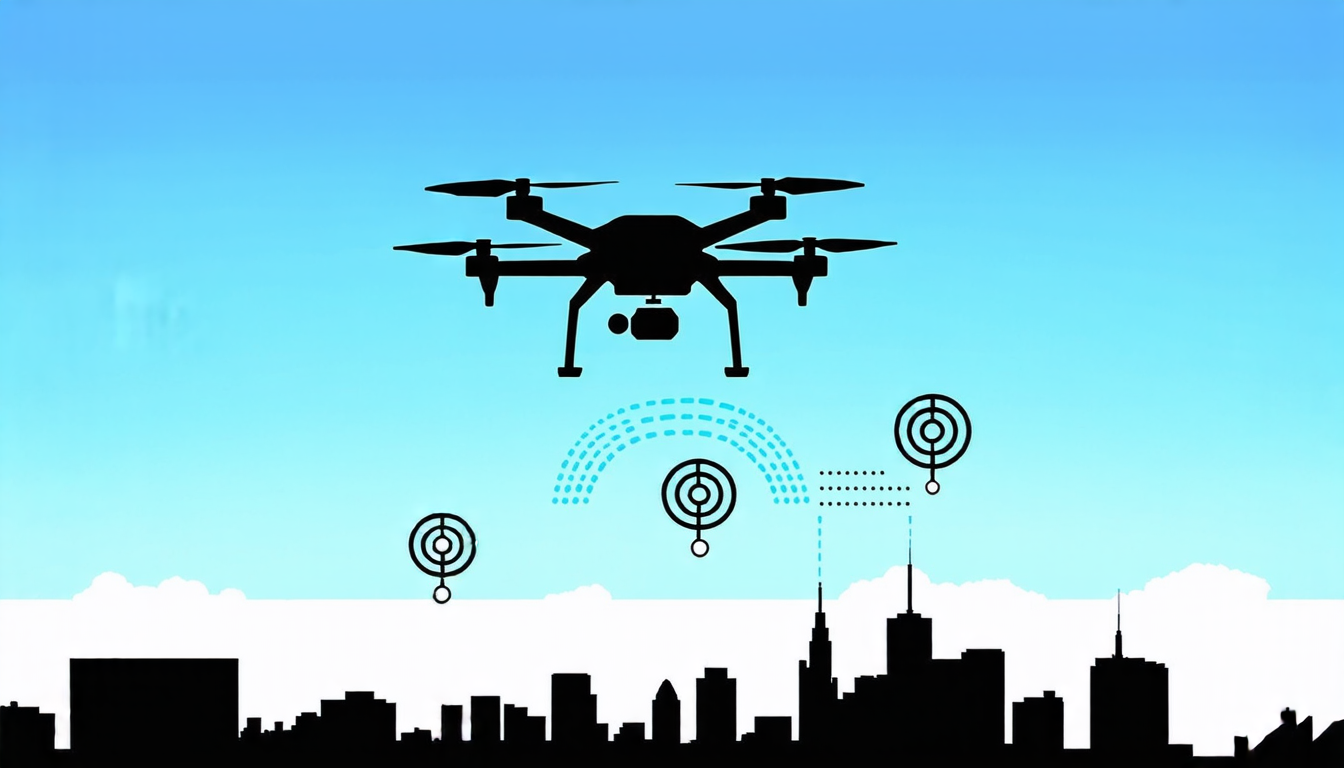
In a significant advancement in the field of wireless communication, researchers have developed an innovative method for efficiently covering large areas using unmanned aerial vehicles (UAVs). The new approach, which involves packing elliptical footprints generated by directional antennas onto a convex quadrilateral region, offers a novel solution to the complex challenge of maximizing coverage density while minimizing path loss.
The problem of optimizing UAV placement has been a long-standing issue in wireless communication research. Traditional approaches often rely on simplistic assumptions and heuristics, leading to suboptimal solutions that fail to account for the complexities of real-world environments. In contrast, this new method leverages advanced mathematical techniques to derive an optimal placement strategy that takes into consideration factors such as environmental conditions, user mobility, and antenna characteristics.
The key innovation lies in the application of circle-packing techniques to a unit square, which is then transformed via homography to fit the quadrilateral region. This approach allows researchers to efficiently arrange multiple UAVs in an optimal configuration, ensuring maximum coverage density while minimizing path loss.
Numerical simulations demonstrate the effectiveness of this method in various environmental conditions, including suburban, urban, and dense urban environments. The results show that the proposed approach can significantly improve coverage density and reduce path loss compared to traditional methods.
The implications of this research are far-reaching, with potential applications in a wide range of fields, from emergency response and disaster relief to wireless network design and optimization. By providing a more efficient and effective solution for UAV placement, researchers hope to enable the development of robust and scalable wireless communication systems that can adapt to changing environmental conditions.
In addition to its practical significance, this research also highlights the importance of mathematical modeling in solving complex problems. By leveraging advanced mathematical techniques and computational methods, researchers are able to derive optimal solutions that would be difficult or impossible to achieve through intuition or trial-and-error approaches.
As wireless communication technology continues to evolve, the need for innovative and effective solutions to complex challenges will only continue to grow. This research serves as a powerful reminder of the importance of continued investment in fundamental research, and the potential rewards that can come from pushing the boundaries of what is thought possible.
Cite this article: “Optimal UAV Placement for Efficient Wireless Coverage”, The Science Archive, 2025.
Unmanned Aerial Vehicles, Wireless Communication, Coverage Density, Path Loss, Optimization, Circle-Packing, Homography, Unit Square, Quadrilateral Region, Mathematical Modeling