

Thursday 27 March 2025
A new study has shed light on the mysterious relationship between galaxy clusters and star formation, revealing a surprising lack of enhancement in infalling galaxies.
Galaxy clusters are massive collections of galaxies held together by gravity, often found at the centers of large-scale cosmic structures. As these galaxies move through the cluster’s gravitational potential, they experience intense forces that can strip away gas and stars, quenching their star-forming activity. This process is known as ram pressure stripping.
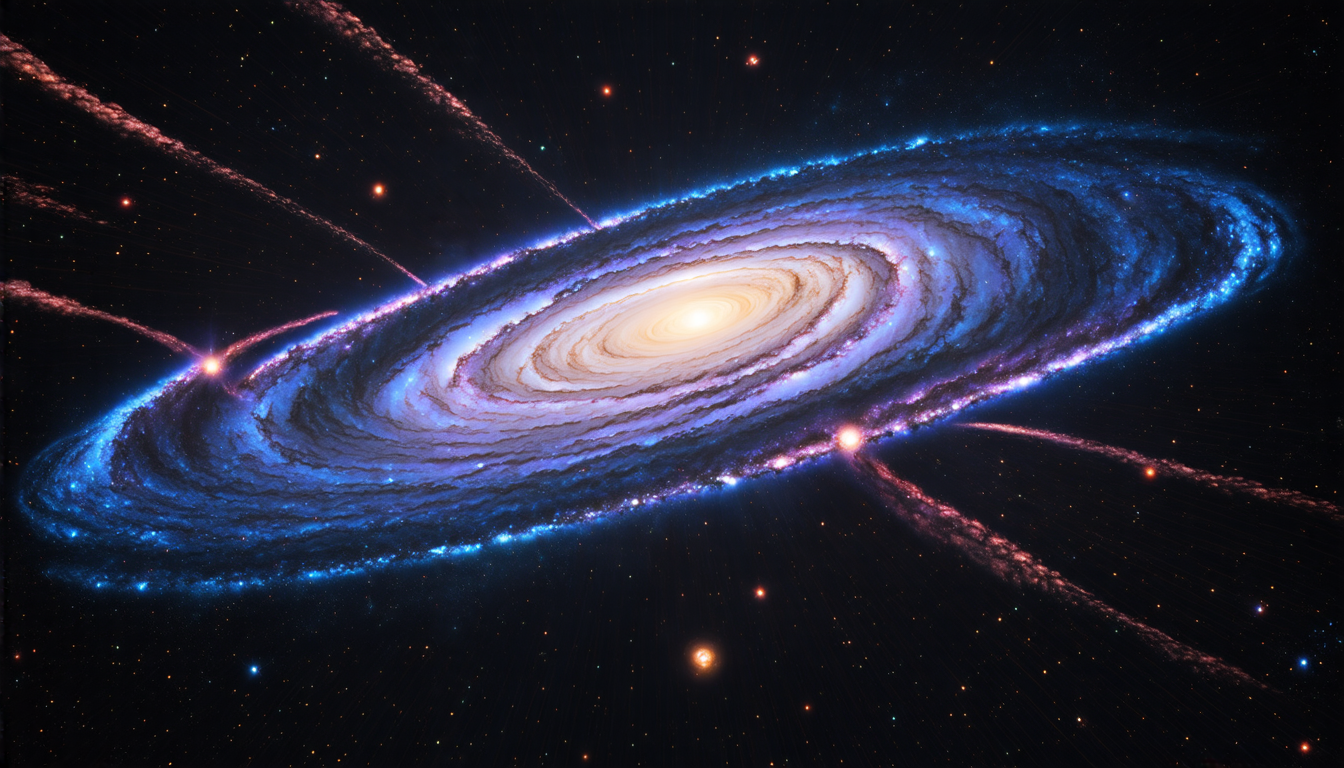
In a recent paper, researchers have investigated whether this stripping process leads to enhanced star formation in infalling galaxies before they’re fully incorporated into the cluster. To answer this question, they analyzed data from the Ultraviolet- Near Infrared Northern Survey (UNIONS), which observed over 5,200 local satellite galaxies with stripped tails of gas.
The team found that despite expectations, these galaxies did not exhibit increased star formation rates compared to field galaxies without such interactions. This suggests that ram pressure stripping does not trigger a burst of star formation in infalling galaxies before they’re fully incorporated into the cluster.
This finding has significant implications for our understanding of galaxy evolution and the role of environment in shaping their properties. It implies that other factors, such as the internal dynamics of the galaxy or the presence of supermassive black holes, play a more important role in regulating star formation than previously thought.
The study also highlights the complexity of galaxy interactions within clusters. In addition to ram pressure stripping, galaxies can experience other forms of environmental interaction, such as tidal forces and harassment from neighboring galaxies. These interactions can lead to changes in galaxy morphology, gas content, and ultimately, their overall evolution.
The researchers’ findings have important implications for our understanding of the formation and evolution of galaxy clusters themselves. By better understanding how galaxies interact within these massive structures, scientists can gain insights into the history and assembly of our own cosmic neighborhood.
The study’s results also underscore the importance of multi-wavelength observations in uncovering the intricate relationships between galaxies and their environments. By combining data from multiple surveys and telescopes, researchers can build a more comprehensive picture of galaxy evolution and the role of environment in shaping their properties.
As scientists continue to explore the mysteries of galaxy clusters, this new study serves as a reminder that the universe is full of surprises, and our understanding of its workings is constantly evolving.
Cite this article: “Galaxy Clusters Mysterious Relationship with Star Formation Revealed”, The Science Archive, 2025.
Galaxy Clusters, Star Formation, Ram Pressure Stripping, Galaxy Evolution, Environment, Supermassive Black Holes, Internal Dynamics, Tidal Forces, Harassment, Multi-Wavelength Observations





